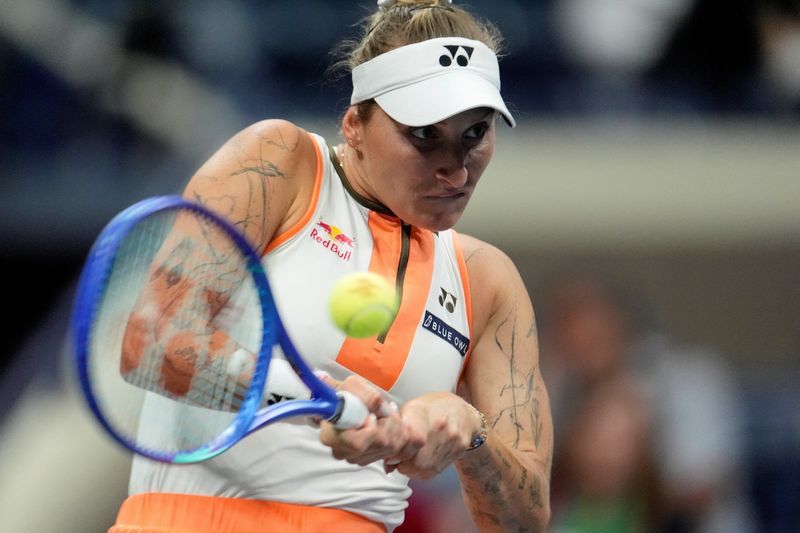
The tennis world faces mounting pressure to overhaul its anti-doping governance after the International Tennis Integrity Agency handed a four-year suspension to former Wimbledon champion Marketa Vondrousova on Monday for refusing to submit to an out-of-competition test at her home in December. The sanction has galvanised the Professional Tennis Players Association to demand that athletes receive meaningful representation in the rule-making processes that govern their sport's testing regime, reigniting longstanding tensions between regulatory authorities and the playing community.
Vondrousova's case carries particular weight because the 26-year-old Czech player has never tested positive for banned substances, making the severity of her punishment controversial among advocates for player welfare. The incident unfolded when a doping control officer arrived at her residence at 8:15 p.m. requesting an immediate sample, a procedure Vondrousova has described as a traumatic intrusion that left her fearing for her safety. Her reluctance to open her door to an unidentified person late at night reflects genuine security concerns within the female athlete community, rooted in part by historical incidents such as the 2016 knife attack on fellow Czech professional Petra Kvitova in her own home.
The PTPA's response to the ban struck a careful rhetorical balance, refraining from pronouncing judgment on Vondrousova's culpability while questioning whether the punishment fits the offence. The players' organisation argued that a four-year suspension for someone without a positive test result demands serious reflection from tennis authorities, and emphasised that athletes deserve genuine input into the rules they must follow. This represents a broader strategic shift within professional tennis, where rank-and-file players increasingly view anti-doping enforcement as disconnected from their lived experiences and legitimate privacy concerns.
The timing of Vondrousova's ban arrives amid simmering frustration over perceived inconsistencies in how tennis authorities have handled high-profile cases involving top-ranked players. Notable examples include Italian sensation Jannik Sinner and Polish star Iga Swiatek, both of whom received relatively lenient sanctions after failing drug tests, outcomes that contrasted sharply with the four-year hammer that fell on Vondrousova. These disparities have fuelled suggestions that enforcement lacks uniformity and that players of different rankings, nationalities, or commercial value may experience differential treatment within the disciplinary system.
The PTPA's concerns are not entirely new; the players' association filed a formal lawsuit against tennis governing bodies last year challenging the lawfulness of random out-of-competition testing on privacy rights grounds. That litigation underscores a fundamental philosophical disagreement about where the boundary should lie between ensuring clean sport and respecting athletes' personal autonomy and security. For many players, particularly women competing at elite levels, the balance has tilted too far toward intrusive surveillance with minimal athlete consultation during the policy formulation stage.
Tennis authorities defend their testing protocols by pointing to alignment with the World Anti-Doping Agency code, which applies standardised rules across all Olympic and major sports globally. This framework arguably lends legitimacy and consistency to tennis's approach, insulating it from accusations of arbitrary rule-making confined to the sport. The ITIA's position is that cases are adjudicated according to facts and evidence irrespective of a player's ranking, reputation, or national origin, a principle the agency says independent tribunals have consistently upheld in defence of unpredictable testing as essential to maintaining competitive integrity.
ITIA Chief Executive Officer Karen Moorhouse has acknowledged that testing procedures create genuine discomfort for athletes already navigating substantial professional pressures and media scrutiny. However, she maintains that such measures remain indispensable to protect fair competition and preserve the sport's credibility. Moorhouse has also pushed back against safety allegations, noting that all testing personnel are properly trained professionals who carry identification and take gender-matching precautions when working with female athletes. Players who feel uncertain about an official's identity can verify credentials through alternative means, she indicated, though this assurance may offer limited comfort to athletes traumatised by unexpected late-evening visits to their homes.
The safety dimension of Vondrousova's case extends beyond her individual experience to encompass systemic vulnerabilities affecting women players globally. Out-of-competition testing conducted at unconventional hours, particularly at residential addresses, creates inherent safety risks that male athletes may experience differently given prevailing gender-based crime patterns. The fact that a high-ranking professional felt unable to answer her door to a purported official reveals how anti-doping procedures, however well-intentioned, can conflict with legitimate personal security measures that female athletes feel compelled to maintain.
Vondrousova currently sits sidelined from competition due to a shoulder injury, having not played professionally since January, which means she may not immediately feel the concrete effects of the ban. Nevertheless, her right to appeal the suspension to the Court of Arbitration for Sport remains available, offering a final avenue through which the punishment might be reduced or eliminated if the independent tribunal finds merit in her arguments. Any successful appeal would likely reverberate through tennis's regulatory apparatus and strengthen the PTPA's position that current disciplinary practices require fundamental recalibration.
The broader implications of this dispute extend throughout professional tennis and potentially to other sports grappling with similar tensions. The challenge facing governing bodies is demonstrating that anti-doping enforcement can remain rigorous and effective while incorporating athlete voices into rule design and acknowledging legitimate safety and privacy concerns. Without substantive reforms that address player anxieties, the sport risks deepening alienation among its competitors and inviting continued legal challenges to testing procedures deemed invasive or inadequately protective of women's security.