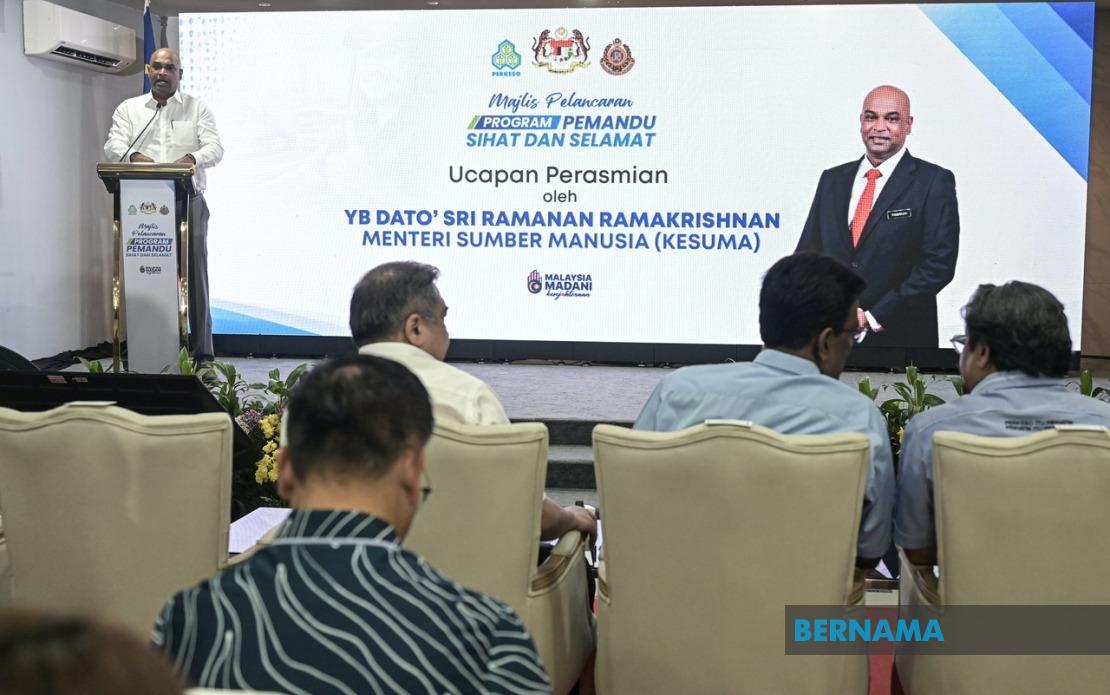
Professional drivers seeking to renew their vocational licences must now complete a comprehensive health assessment through the Healthy and Safe Driver Programme (PSS), announced Human Resources Minister Datuk Seri R. Ramanan during the initiative's launch in Kuala Lumpur. The screening requirement represents a significant shift in Malaysia's approach to road safety, positioning health evaluations as a critical gateway to continuing work as a commercial driver.
The PSS screening encompasses a broad range of medical assessments designed to identify conditions that could impair driving ability. Beyond standard physical examinations and vision checks, the programme includes hearing tests and specialised evaluation for sleep disorders, particularly obstructive sleep apnea, which studies have linked to increased accident risk. Assessments of major bodily systems—cardiovascular, respiratory, and neurological—form part of the evaluation, alongside blood tests measuring glycated haemoglobin levels for drivers where such testing is indicated. This multi-layered approach reflects growing recognition internationally that professional drivers face distinctive health risks and bear heightened responsibility for public safety.
The affordability structure demonstrates government commitment to making the initiative accessible rather than punitive. Drivers contribute RM30 towards the screening cost, while the MADANI Government, through the Social Security Organisation (Socso), covers the remaining RM55 subsidy. This means vocational drivers access comprehensive health evaluation at a fraction of actual cost, removing financial barriers that might otherwise discourage participation or incentivise unsafe drivers to avoid detection. The subsidy model signals that road safety is positioned as a collective societal investment rather than an individual burden.
Currently, the PSS operates through 500 panel clinics distributed across Malaysia, ensuring geographic accessibility for most vocational drivers. However, the ministry has signalled ambitions to substantially expand this network. Plans to increase participation venues to 3,000 panel clinics nationwide would represent a six-fold expansion, potentially bringing health screening facilities within much closer reach of drivers in rural and semi-urban areas. Such expansion would require coordination with private healthcare providers and may involve incentive structures to encourage clinic participation in what amounts to a subsidised screening programme.
The initiative emerged against a backdrop of concerning road safety statistics that underscore why intervention appears necessary. Road accidents claimed 115 workers' lives in 2025, representing an uptick from 94 fatalities recorded in 2024. This upward trajectory prompted urgent action from both the Ministry of Human Resources and Ministry of Transport. Among worker categories relying on roads for employment—including truck drivers, bus operators, delivery van drivers, and motorcyclists—the fatality burden falls disproportionately on lorry drivers, who accounted for 62 deaths, or 21 per cent of total work-related road fatalities. These figures suggest that heavy vehicle operators face particular vulnerability, whether due to longer hours, vehicle size, cargo weight, or other occupational factors.
Ramanan characterised the screening requirement not as bureaucratic inconvenience but as preventive healthcare infrastructure. Early detection of health problems enables timely treatment and intervention before conditions deteriorate to accident-causing severity. Undiagnosed or poorly managed hypertension, diabetes, sleep apnea, or cardiac conditions can impair reaction time, judgement, and alertness—factors critical to safe driving. By institutionalising health checks as a licence renewal prerequisite, the programme shifts responsibility for safety upstream, to the point where health issues can be identified and managed proactively rather than addressed retrospectively after accidents occur.
The policy reflects evolving international best practice in occupational road safety. Many developed nations have implemented similar health screening requirements for professional drivers, recognising that commercial vehicle operation represents a high-risk activity requiring fitness standards beyond those applied to casual drivers. Malaysia's adoption of this approach positions the country alongside regional and global peers in prioritising evidence-based safety measures. The PSS framework also aligns with International Labour Organisation guidelines emphasising employer and government responsibility for occupational health and safety.
For Malaysia's transport sector—a critical economic pillar dependent on reliable, safe professional driving—the initiative carries significant implications. Ensuring that vocational drivers receive regular health monitoring can reduce accident rates, which generate substantial costs through vehicle damage, cargo loss, medical treatment, and productivity disruption. Insurance premiums may eventually reflect improved safety outcomes. More fundamentally, the programme acknowledges that professional drivers represent valued workers deserving health protection, not merely operational inputs to be exploited until incapacity forces replacement.
Implementation success will depend on several factors including clinic readiness, driver awareness and cooperation, and coordination between transport operators and healthcare providers. Transport companies may need to accommodate driver schedules for screening appointments, and enforcement mechanisms must balance safety imperative against livelihoods concerns for drivers who might be found unfit. The government's subsidy approach mitigates financial disincentives, but questions remain about how unfit drivers will be managed—whether through treatment support, temporary licence suspension, or permanent disqualification.
The PSS initiative represents deliberate policy investment in driver health as foundational to road safety. By connecting licence renewal to comprehensive health evaluation and making such evaluation affordable, Malaysia signals that commercial driving standards must encompass medical fitness alongside driving skills and legal compliance. Whether the programme achieves intended fatality reduction will depend on implementation rigour and sustained commitment to expanding access while maintaining assessment quality across hundreds of clinics nationwide.

