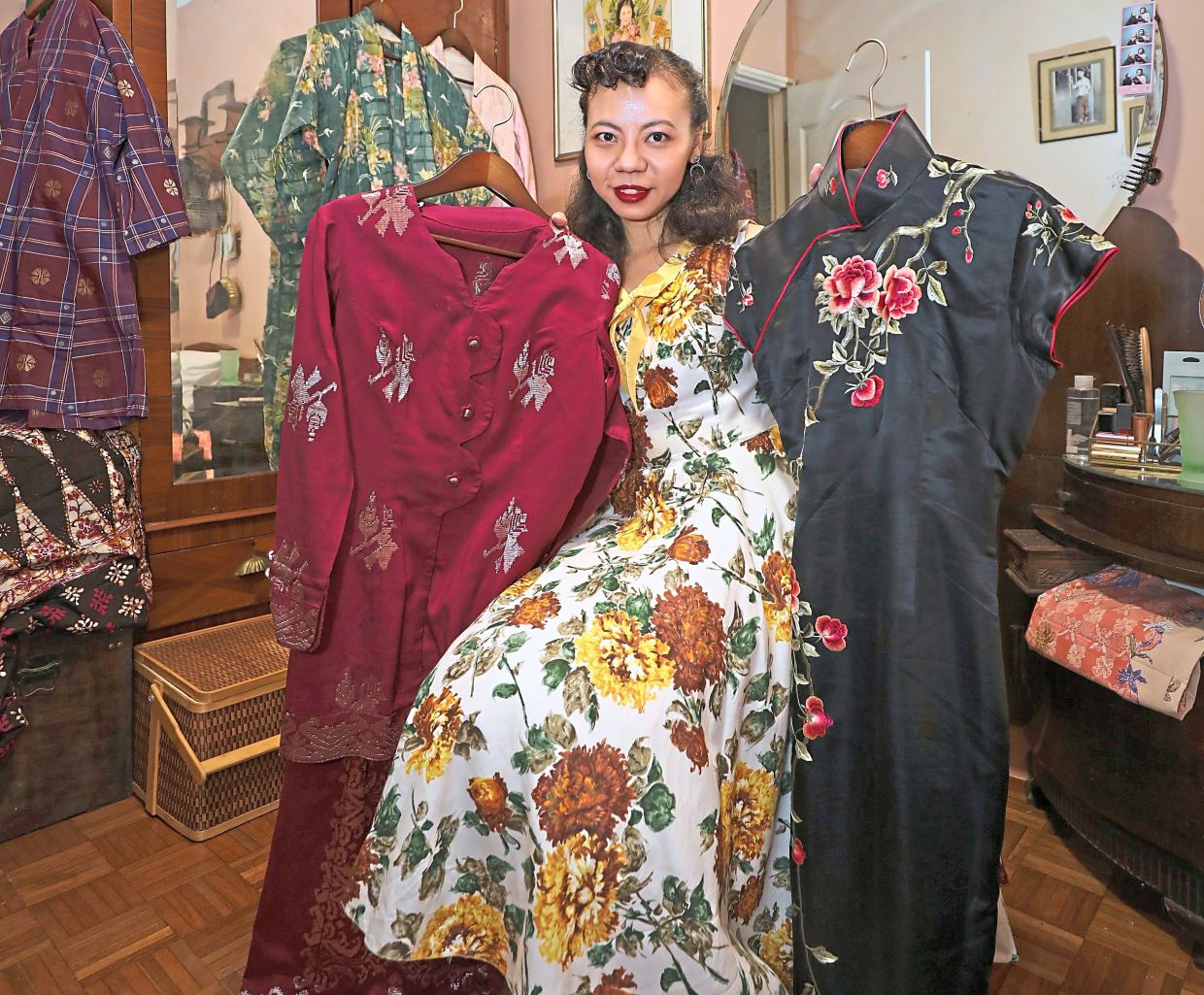
Inspiration often arrives through family memory. For 33-year-old graphic designer Suzanne Lim, it came from a black-and-white photograph of her grandparents dancing in a 1950s dance hall, both dressed immaculately in their finest attire. That single image planted a seed that would eventually blossom into a deep passion for vintage Malaysian clothing. Her grandfather's love of rock and roll and her grandmother's background as a taxi dancer exposed her to a world where fashion and culture intertwined, and those early influences shaped not just her wardrobe but her entire worldview about the past.
Lim's journey into vintage collecting began with movement and performance. Starting formal Latin and ballroom dance lessons as a child, she later participated in a secondary school cultural club where she encountered elaborate traditional costumes complete with all their accessories. These early performances awakened her curiosity about the garments themselves—the craftsmanship, the historical context, and the stories they carried. Years later, when she purchased her first vintage Malaysian piece, that initial curiosity transformed into an unshakeable passion. Today, her collection spans kebaya, cheongsam, batik, and songket, each piece carefully documented and displayed on social media against heritage backdrops that frame these garments within their original cultural landscape.
What distinguishes Lim's approach is her understanding that clothing functions as historical evidence. Rather than viewing vintage pieces merely as fashionable accessories, she recognises them as windows into how previous generations lived, worked, and expressed themselves. The economic conditions of an era, the social hierarchies that shaped daily life, and the cultural values a society held—all of these become readable through the lens of what people wore. By wearing and documenting these pieces, Lim effectively curates an alternative history museum accessible through the digital platforms where younger Malaysians spend most of their time, sidestepping the traditional museum experience that many no longer visit.
Mohamad Alif Daniel Mohammad Nor, a 25-year-old recent graduate, pursues a different but complementary path toward historical understanding. His relationship with the past originated in conversations with his grandmother, tales that gradually expanded into broader interests encompassing music, historical film, and military uniforms. Beginning his collection during his mid-teens with Japanese occupation currency notes, he eventually joined Persatuan Reka Ulang Sejarah (PRUS), an organization dedicated to historical re-enactment. Through hands-on engagement with period clothing and accessories, he discovered that textbooks alone could never convey the visceral understanding that comes from actually inhabiting history. Wearing a uniform, handling original fabrics, or moving in clothes designed for different times teaches lessons about identity and mentality that no written account can fully capture.
The distinction between Lim's approach and Mohamad Alif Daniel's re-enactment highlights different methodologies serving the same broader goal: making Malaysian heritage tangible and relevant. While Lim often blends vintage pieces with contemporary styling, Mohamad Alif Daniel prioritises historical accuracy through immersive reconstruction. Yet both recognise that their efforts fill a critical gap in how younger Malaysians connect with their past. In an era where many skip museums and distrust unreliable online sources, personal testimony through visual documentation and direct engagement becomes a powerful educational tool. The authenticity lies not just in period-correctness but in genuine enthusiasm and transparent engagement with the material culture of previous eras.
Lim remains pragmatic about the balance between strict historical accuracy and creative reinterpretation. She acknowledges that not every outfit she constructs adheres rigidly to period standards, especially when she reimagines vintage pieces through a modern lens. However, whenever she has access to authentic textiles and garments, she maintains fidelity to their original forms and contexts. This calibrated approach reflects a mature understanding that heritage preservation need not mean freezing the past in amber. Instead, the key lies in maintaining enough structural and cultural integrity that the pieces remain recognisably rooted in their original context while allowing for contemporary creative expression.
The resurgence of vintage clothing collecting among Malaysian youth taps into psychological currents running through modern life. Lim observes that the digital saturation of contemporary existence creates a hunger for tangible, tactile experiences—clothing offers precisely that form of escapism. Unlike consuming digital content endlessly, holding a piece of batik or slipping on a vintage kebaya engages multiple senses simultaneously. It represents a deliberate rejection of the intangible and ephemeral in favour of objects with weight, texture, and history. This generational yearning connects to broader global trends toward sustainability and vintage consumption, yet in the Malaysian context, it carries the additional significance of cultural reclamation and identity affirmation.
The creative freedom that younger people find in reimagining vintage styles drives much of this renewed interest. Lim emphasises that contemporary collectors and wearers enjoy the liberty to take inspiration from the past and add their own modern flourishes, creating hybrid styles that speak to their generation while remaining rooted in their heritage. This approach differs markedly from purely nostalgic recreation or academic preservation; instead, it represents a living, evolving dialogue between past and present. The resulting aesthetic innovations make heritage feel less like museum pieces and more like living traditions that can adapt without losing their essential character. Yet Lim also recognises important boundaries: the fundamental elements of traditional clothing must be preserved sufficiently that they do not become so altered as to obscure their origins or risk cultural misrepresentation.
Mohamad Alif Daniel's experiences highlight another dimension of this movement—the psychological and social impact of reclaiming traditional dress as something desirable rather than shameful. Through his social media presence showcasing historical and traditional attire, he has noticed that others begin following his example, particularly younger Malaysians who previously felt self-conscious wearing traditional clothing in public spaces. His visibility creates permission and validation for others to wear what their ancestors wore without apology or embarrassment. This social influence extends beyond fashion into the territory of cultural confidence, suggesting that individual acts of heritage appreciation can collectively reshape community attitudes toward identity and belonging.
The emergence of this vintage and historical clothing movement among Malaysia's youth represents something quietly significant: a generation choosing to deepen rather than abandon connection with their past. In a globalized world where Western fashion dominates and traditional dress risks being relegated to ceremonial occasions, these young Malaysians actively work to integrate their heritage into everyday aesthetics and contemporary identity. They employ the tools of their generation—social media, digital documentation, online communities—to make the past accessible and relevant. Their efforts suggest that cultural preservation need not be a rearguard action against modernity but can instead become an integral part of how younger generations construct meaning, express themselves, and navigate questions of identity in an increasingly complex world.
What emerges from conversations with collectors like Lim and Mohamad Alif Daniel is a vision of heritage that remains dynamic and inclusive rather than fixed and exclusive. Their work demonstrates that vintage clothing collecting transcends mere fashionable nostalgia, instead functioning as a form of active historical engagement and cultural citizenship. By wearing these pieces, documenting them, and sharing their stories, they participate in a collective act of remembrance that keeps Malaysian history alive not in academic archives but in the lived experience of daily life. For Malaysia's younger generation navigating questions of identity amid rapid modernization, this movement toward vintage and traditional clothing offers both a practical means of cultural expression and a philosophical stance: that the past belongs to the present and future just as much as to those who lived it.

