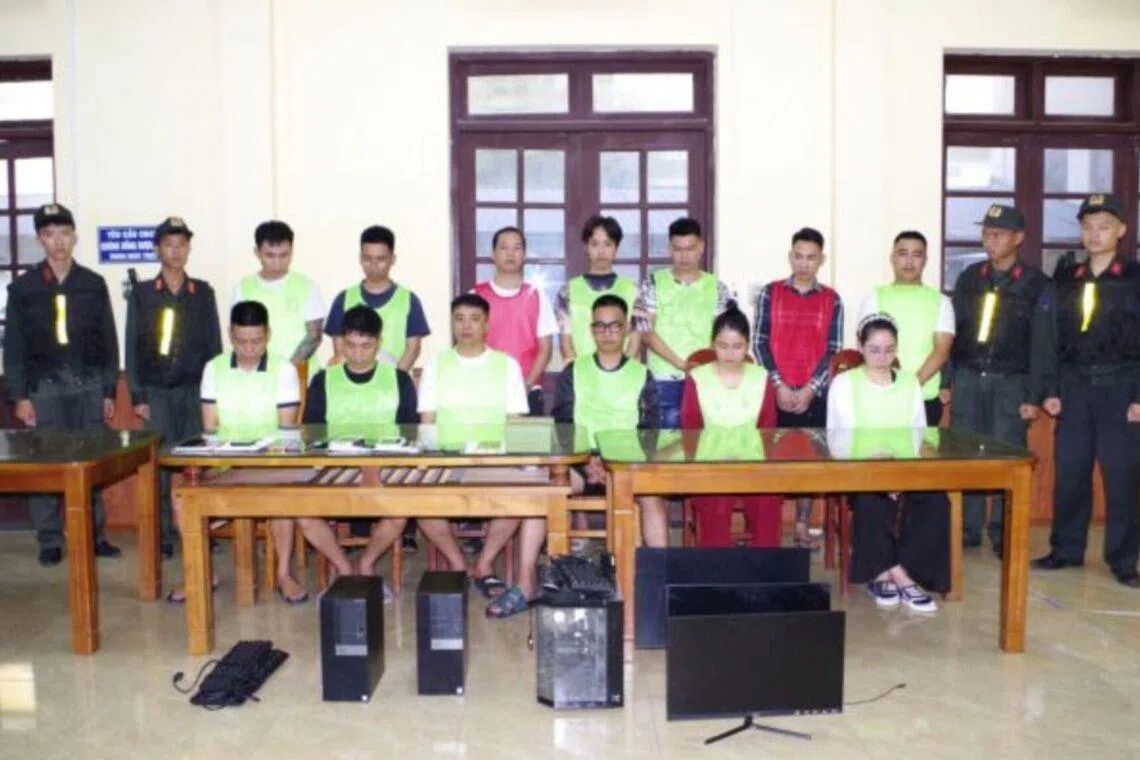
Police in Vietnam's northern Ninh Binh province have successfully broken up a sophisticated transnational online fraud syndicate that targeted hundreds of victims across the region, with losses exceeding RM39.2 million. The operation culminated in the arrest of 12 suspects, including two alleged masterminds identified as Nguyen Van Cuong, 28, and Nguyen Van Phuong, 34. Authorities seized substantial quantities of cash, vehicles, mobile devices, computers, forged identity documents, jewellery and extensive operational records during coordinated raids on the criminal enterprise.
The criminal network exemplifies an emerging threat across Southeast Asia: organised online fraud conducted from safe havens with minimal geographic restriction. Vietnamese police investigations revealed that the suspects had recruited a workforce of Vietnamese nationals and systematically transported them across the border to Cambodia, where the operation established robust infrastructure with clearly delineated roles and responsibilities. This geographic separation between recruitment and operational bases created deliberate distance from law enforcement oversight, a tactic increasingly common among transnational cybercrime syndicates targeting the region.
The sophistication of the group's methodology underscores how contemporary fraud has evolved beyond simple scams into carefully orchestrated deception campaigns. Members assumed identities of high-authority figures—police officers, prosecutors, judges, financial institution employees and tax officials—leveraging the psychological impact of official authority to manipulate victims. The criminals understood that impersonating government representatives creates immediate compliance psychology, making targets more vulnerable to follow-up requests for financial transactions or sensitive personal information.
The technological infrastructure deployed by the network demonstrates technical proficiency in web development and digital manipulation. Perpetrators constructed counterfeit websites and mobile applications designed to replicate legitimate government agencies and established business entities, meticulously crafting visual and functional elements to ensure convincing mimicry. These fake digital platforms served as the primary trust-building mechanism, allowing criminals to harvest financial information and persuade victims into voluntary fund transfers. The existence of multiple fabricated applications indicates this was not ad hoc criminality but rather a structured enterprise with dedicated technical resources.
The scam methodologies employed reveal the criminals' deep understanding of victim psychology and behavioural patterns. False job recruitment schemes lured economically motivated targets seeking supplementary income, particularly vulnerable during periods of economic uncertainty. Investment fraud—leveraging the allure of high returns in finance, securities and cryptocurrency—exploited victims' aspirations for wealth accumulation. Romance scams created emotional dependencies that bypassed rational financial decision-making. Social media account hijacking transformed victims' personal networks into unwitting accomplices, corrupting trust relationships to solicit loans from secondary victims. Each approach targeted distinct psychological vulnerabilities, suggesting the group had refined these methodologies through repeated application.
One particularly elaborate variation involved impersonating military officers who placed bulk orders with business establishments. The fraudsters then manipulated shop owners into purchasing additional inventory at their own expense, with promises of reimbursement through direct bank transfers. This scheme cleverly exploited existing business relationships and commercial trust to facilitate unauthorised fund movements. The technique demonstrates how organised fraud networks weaponise legitimate economic relationships and exploit the time-pressure dynamics inherent in commercial transactions.
The scale of victimisation uncovered by police investigations is substantial: approximately 500 victims defrauded since October 2024 alone, accumulating losses exceeding 250 billion Vietnamese dong. This temporal concentration suggests either rapid acceleration of the operation or heightened detection success. The figure likely represents only identified victims, as cybercrime typically suffers significant under-reporting due to shame, confusion about legal recourse and distrust of authorities among affected populations. The actual victimisation scope probably extends considerably beyond police-documented cases.
Legal proceedings have commenced against six of the arrested suspects on charges of fraudulent appropriation of property, with detention in temporary custody pending trial. The remaining six suspects are subject to procedural investigative measures as law enforcement continues examining the conspiracy's full scope. Vietnamese authorities have deliberately maintained the investigation in active status, signalling intent to identify additional network members who may currently evade detection. This ongoing investigative posture reflects recognition that organised fraud networks typically involve broader membership than initially apprehended suspects.
Asset seizure and financial freezing operations have been initiated to recover misappropriated funds and support judicial proceedings. Vietnamese authorities are engaging in the technically complex work of tracing cryptocurrency transactions, identifying beneficiary accounts across multiple financial institutions and jurisdictions, and establishing legal claims to sequestered resources. Recovery of stolen funds presents particular challenges in cases involving cryptocurrency or transfers routed through jurisdictions with limited cooperation frameworks. The intersection of transnational financial crime and Southeast Asian legal systems creates substantial practical obstacles to asset recovery, even when perpetrators face successful prosecution.
For Malaysian and broader Southeast Asian audiences, this case illustrates the persistent vulnerability of the region to organised digital fraud emanating from jurisdictions with inadequate cybercrime enforcement. The operational model—recruiting locally, executing remotely, and leveraging geographical distance—remains highly viable given current law enforcement coordination limitations. Singapore's figures cited in the reporting (S$12.3 million) underscore how Southeast Asian financial systems remain attractive targets for criminal networks that have successfully industrialised fraud operations.
The emergence of coordinated transnational fraud enterprises operating from Cambodia and similar jurisdictions represents a significant trend requiring strengthened regional cooperation mechanisms. Individual country law enforcement actions, while valuable, prove insufficient against networks deliberately structured to exploit jurisdictional boundaries. Effective countermeasures demand improved information-sharing protocols, harmonised legal frameworks recognising cybercrime, capacity-building initiatives in smaller jurisdictions hosting criminal operations, and coordinated financial tracking systems that trace illicit fund flows across borders. Until Southeast Asian nations establish genuine intelligence and legal cooperation infrastructure, similar operations will continue proliferating.

