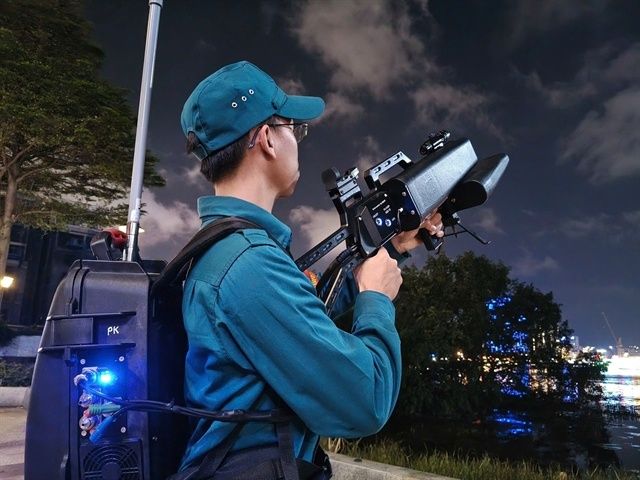
Vietnamese authorities have escalated their campaign against illegal drone operations around the country's airports, issuing a formal public warning as the frequency of dangerous incursions continues to climb at an alarming rate. The Immigration Department, operating under the Ministry of Public Security, has characterised unauthorised drone flights as a mounting threat to aviation safety that demands immediate public attention and compliance with strict regulations.
The scale of the problem has become difficult to ignore. Official records reveal that Vietnam experienced 34 documented cases of drones or unidentified aircraft penetrating restricted airspace zones surrounding airports during 2025, with the problem accelerating dramatically into 2026. By the halfway point of the current year alone, authorities had already logged 17 additional incursions, suggesting that the trajectory is worsening rather than improving. Each unauthorised intrusion into these sensitive zones compels air traffic controllers to implement emergency protocols to avert potential collisions, a response that cascades into disruption across the entire aviation system.
The immediate impact on airport operations is severe and measurable. When a drone enters an airport's controlled airspace, controllers must make split-second decisions that halt aircraft departures, suspend incoming landings, or redirect planes to alternate airports. These emergency measures, while essential for safety, create bottlenecks that ripple through flight schedules and passenger itineraries. The operational friction generated by even a single incursion can disrupt multiple flights and affect thousands of travellers in a single day.
The financial consequences have proven substantial and well-documented. Vietnam Airlines, the country's flagship carrier, reported that drone-related incidents occurring over just one week in late February 2026 resulted in losses approaching VNĐ5.6 billion, equivalent to approximately US$215,000. Beyond the direct financial hit to the airline's operations, the disruptions inconvenienced roughly 9,200 passengers who experienced delays or had their travel plans modified. Danang International Airport, one of Vietnam's major aviation hubs, separately calculated direct losses exceeding VNĐ10 billion, or US$384,000, from drone-related incidents. However, these figures capture only the most visible costs; the indirect economic damage to freight operators, tourism services, and travellers whose plans were derailed extends considerably beyond these official estimates.
Beyond economics, authorities have emphasised the existential safety dimension that renders this issue genuinely critical. A drone collision with an aircraft during the most vulnerable phases of flight—takeoff or landing—could trigger a catastrophic accident with potential loss of life among passengers and crew. This is not a theoretical concern but rather a concrete possibility that aviation authorities take with utmost seriousness. The risk, though perhaps statistically low at any given moment, carries consequences so grave that preventing even a single collision justifies robust regulatory enforcement.
Vietnamese law establishes a comprehensive framework governing drone operations that extends beyond mere registration. Drone owners must register their aircraft with authorities and separately obtain an explicit flight permit—an important distinction, as registration alone provides no legal authorisation to fly. Each permit carries specific operational parameters that define the geographic area where the drone may operate, the maximum altitude it may reach, the hours during which it may fly, and the scope of permitted activities. Operators who transgress these boundaries expose themselves to administrative penalties, civil liability, or criminal prosecution depending on the gravity of their violation.
The regulatory consequences for violations escalate significantly based on the nature and severity of the breach. A government decree promulgated in 2025 established a tiered penalty system that includes monetary fines, mandatory confiscation of the drone equipment, and suspension of the operator's flight privileges. For more serious violations where a drone physically obstructs air traffic or creates genuine danger to aviation safety, authorities may pursue criminal charges rather than merely administrative sanctions. These criminal cases carry severe penalties ranging from substantial fines and non-custodial reform sentences to imprisonment terms extending up to fifteen years in the most egregious circumstances.
Notably, Vietnamese law does not require that an actual collision occur for criminal charges to be filed. The act of flying a drone into an aircraft's approach corridor, takeoff path, or landing zone—creating substantial risk of collision regardless of whether contact actually happened—constitutes sufficient grounds for criminal prosecution. Those convicted of such behaviour face potential fines ranging from VNĐ10 million to VNĐ50 million (US$384 to US$1,920), non-custodial reform of up to two years, or imprisonment from three months to two years. Additionally, individuals convicted of drone-related aviation offences can be barred from employment in certain professions or positions for between one and five years following conviction, a consequence that may prove as punishing as the direct penalties.
The authorities have made clear that responsibility for maintaining aviation safety extends across society rather than residing solely with airport operators or government agencies. The Immigration Department has appealed directly to drone operators to respect the time windows, geographic boundaries, and operational conditions specified in their individual permits. Simultaneously, the department has urged ordinary citizens to become part of the safety infrastructure by reporting any suspicious or unauthorised drone activity near airports to police, military authorities, or airport security personnel. This public engagement strategy recognises that prevention often proves more effective than enforcement after an incident has occurred.
The warning carries implicit significance for the broader Southeast Asian region, where drone technology adoption continues accelerating across civilian and commercial sectors. As more individuals and businesses acquire drone equipment, regulatory frameworks and public awareness campaigns become increasingly important across the region. Malaysia, Thailand, Singapore, and other neighbouring nations face similar challenges managing the intersection between technological innovation and aviation safety. Vietnam's experience—and its increasingly stringent regulatory response—offers both cautionary lessons and potential models for other regional aviation authorities grappling with identical problems. For Malaysian readers and operators, Vietnam's hardline approach underscores the seriousness with which regional aviation authorities are beginning to view drone incursions and suggests that similar enforcement escalation may follow in other jurisdictions.

