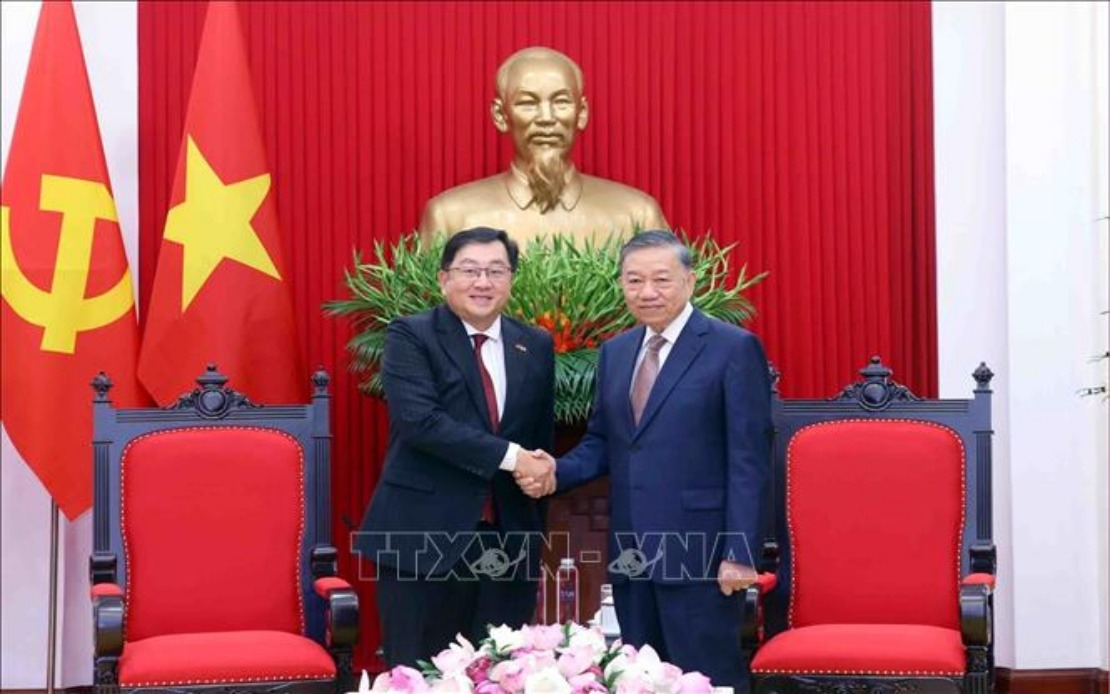
Vietnamese President To Lam has characterised relations with Malaysia as notably dynamic and underpinned by substantial political goodwill and expanding economic partnerships, during a formal meeting with outgoing Malaysian Ambassador to Vietnam Datuk Tan Yang Thai in Hanoi this week. The Vietnamese leader's remarks reflect Kuala Lumpur's elevated strategic standing in Hanoi's foreign policy calculus, as both nations navigate an increasingly complex regional environment and seek to capitalise on complementary economic strengths.
During the Wednesday reception, President Lam conveyed his regards to His Majesty Sultan Ibrahim, King of Malaysia, and Prime Minister Datuk Seri Anwar Ibrahim, while formally inviting them to undertake state visits to Vietnam. Such overtures underscore Hanoi's commitment to deepening high-level engagement and demonstrating the importance it attaches to bilateral ties at the highest levels of government.
The Vietnamese president commended Ambassador Tan for his stewardship of Malaysia's diplomatic mission and acknowledged his contributions to nurturing bilateral relations. Lam extended best wishes for Tan's subsequent diplomatic assignment, expressing confidence that the outgoing envoy would continue representing Malaysian interests effectively on the international stage. This gracious farewell reflects the cordial tenor that characterises official exchanges between Hanoi and Kuala Lumpur.
Among the most substantive elements of Lam's remarks was his emphasis on Malaysia's centrality to Vietnam's regional strategic calculations. By reaffirming Hanoi's commitment to deepening the Comprehensive Strategic Partnership framework, the Vietnamese leader signalled that the bilateral relationship extends far beyond transactional commerce, encompassing shared security interests and long-term geopolitical alignment within Southeast Asia.
Trade performance has emerged as a compelling indicator of the relationship's vigour. Two-way commerce reached US$10.8 billion during the first half of 2026, representing a robust 40 percent increase year-on-year. This growth trajectory underscores the resilience of bilateral economic ties despite regional headwinds and reflects deepening supply-chain integration between Vietnamese and Malaysian enterprises. For Malaysian businesses, Vietnam's manufacturing sector and market of 98 million people represent significant opportunities, particularly in automotive components, electronics, and processed foods.
Malaysia's investment position within Vietnam's broader economic landscape further testifies to the relationship's substance. As the third-largest ASEAN investor and the tenth-largest globally among 154 countries and territories channelling capital into Vietnam, Malaysia commands considerable economic influence in Hanoi's development strategies. Malaysian manufacturers have established significant production facilities in Vietnamese industrial zones, particularly around Ho Chi Minh City and Hanoi, contributing to employment and technology transfer.
President Lam explicitly identified several convergent strategic priorities that will likely shape bilateral cooperation in coming years. Digital economic development and green transition initiatives represent particularly fertile ground for collaboration, given Malaysia's established expertise in financial technology and renewable energy alongside Vietnam's rapid digital adoption and vast untapped potential in sustainable development. Energy and electricity connectivity projects, especially those linking the two nations through ASEAN frameworks, offer opportunities for joint infrastructure development that could enhance regional energy security.
Maritime cooperation constitutes another dimension of shared interest, reflecting both nations' significant coastlines and overlapping economic zones in the South China Sea. Coordinated approaches to maritime security, fisheries management, and naval capacity-building align with both countries' strategic priorities and their commitment to maintaining stability in contested waters. Such collaboration, conducted within multilateral frameworks like the ASEAN Regional Forum, enables both nations to advance shared interests while respecting the principle of non-interference.
President Lam's specific recommendations for strengthening the partnership centred on enhancing political trust through increased official exchanges and meticulous implementation of high-level agreements already concluded. He called for expanded cooperation in defence and security matters, acknowledging that bilateral military-to-military relations serve as both a confidence-building mechanism and a practical tool for addressing shared security challenges. He further advocated for facilitating balanced trade and investment flows and intensifying collaboration across digital innovation, green economic sectors, science and technology development, and research initiatives.
Ambassador Tan's departing remarks complemented the Vietnamese president's vision, expressing admiration for Vietnam's substantial development achievements in recent years and reaffirming Malaysia's confidence in Vietnam's continued growth trajectory. Tan emphasised Malaysia's commitment to advancing bilateral cooperation, particularly within emerging economic domains including the digital economy, renewable energy sectors, and green industrial development—areas where both nations possess complementary capabilities and shared vulnerability to climate impacts.
The ambassador also extended a formal invitation from His Majesty Sultan Ibrahim for President Lam to visit Malaysia, mirroring Hanoi's earlier invitation to Malaysian leadership. Such reciprocal invitations reflect the mutual respect characterising contemporary Vietnam-Malaysia relations and signal both governments' determination to expand people-to-people connections alongside official exchanges.
For regional observers and policymakers throughout Southeast Asia, the trajectory of Vietnam-Malaysia relations offers a valuable illustration of how neighbouring nations with distinct historical experiences and political systems can forge pragmatic partnerships grounded in economic complementarity and strategic alignment. As both countries navigate the region's geopolitical complexities and economic challenges, the deepening of bilateral ties serves broader ASEAN objectives of collective resilience and prosperity, contributing to the regional cohesion that underpins stability across the entire Southeast Asian region.

