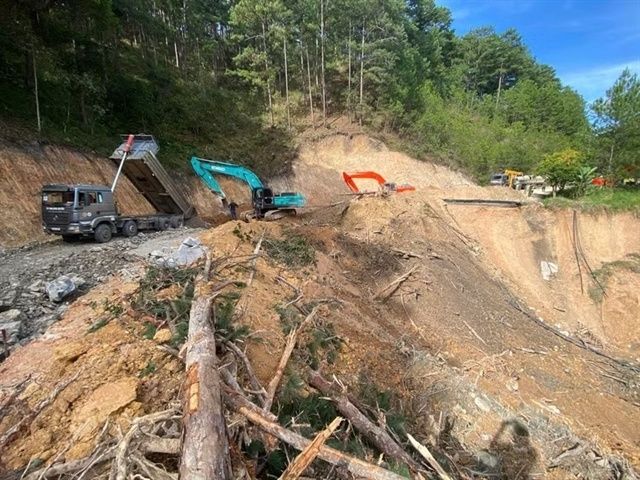
Vietnam's Ministry of Construction has formally declared a natural disaster emergency affecting a critical section of Ho Chi Minh Road passing through Tuyen Quang Province, signalling the severity of infrastructure damage wrought by relentless monsoon conditions last month. The declaration focuses on the area around kilometre marker 115+000, where the major transport artery intersects with National Highway 2C under the jurisdiction of Road Management Zone I. The move underscores growing concerns about climate resilience in Vietnam's transport network, a crucial consideration for regional logistics and trade connectivity across Southeast Asia.
The cascade of heavy rainfall events that pummelled the region throughout June created widespread deformation and structural compromise of the roadway, posing significant risks to the travelling public. Successive downpours overwhelmed drainage systems and undermined the road surface, forcing authorities to prioritise immediate intervention. The decision to invoke emergency protocols reflects the extent of deterioration—damage severe enough that standard maintenance procedures would prove inadequate. This pattern of extreme weather events highlights the vulnerability of Vietnam's infrastructure to increasingly intense monsoon seasons, a challenge not unique to Hanoi but emblematic of broader Southeast Asian development concerns.
Data from the Tuyen Quang Provincial Hydrometeorological Station and the National Centre for Hydrometeorological Forecasting documented the relentless nature of the precipitation. The month-long assault of heavy rainfall between June 1 and June 30 created conditions that overwhelmed existing infrastructure capacity and accelerated physical deterioration of the roadbed. Such persistent weather patterns, which climate scientists increasingly associate with shifting monsoon dynamics, present unprecedented challenges for transport authorities across the region. Vietnam's experience serves as a cautionary tale for neighbouring countries investing in major highway corridors and underscores the necessity of climate-adaptive engineering standards.
The Ministry of Construction has tasked the Department for Roads of Vietnam and Road Management Zone I with leading a comprehensive damage assessment and developing repair solutions. This institutional response demonstrates Vietnam's structured approach to crisis management, though it also reveals the challenge of coordinating multiple agencies in emergency situations. The Department for Roads of Vietnam bears primary responsibility for reviewing the full extent of infrastructure compromise, a process that will likely require detailed engineering surveys and structural evaluations. These findings will inform the Emergency Construction Order, a legal instrument that expedites procurement and contracting procedures to accelerate reconstruction work.
Beyond the primary emergency zone, authorities have identified a secondary flooding concern along a stretch between kilometre markers 124+600 and 128, where Ho Chi Minh Road overlaps with National Highway 2. This flooded section demands immediate attention not only for safety reasons but also for maintaining traffic flow through a critical corridor. The Director General of the Department for Roads of Vietnam and the Director of Road Management Zone I have assumed direct accountability for coordinating relief efforts, managing congestion, and restoring normal operations. Their personal accountability reflects the political importance of maintaining transport stability and public confidence in infrastructure management.
The emergency construction framework allows Vietnamese authorities to bypass standard procurement timelines and administrative procedures, enabling rapid deployment of repair crews and materials. However, the success of this approach depends on effective coordination between the Transport and Road Safety Division of the Ministry of Construction and field-level agencies. Once remedial work concludes, the Department for Roads of Vietnam must report completion status back to the ministry, which will then assess whether conditions warrant lifting the emergency declaration. This staged process ensures both operational transparency and sustained focus on comprehensive rather than superficial repairs.
For Malaysian and broader Southeast Asian stakeholders, Vietnam's situation carries important implications. Ho Chi Minh Road functions as a vital commercial thoroughfare linking northern Vietnam with southern regions, and any extended disruption reverberates through regional supply chains. Malaysian companies with operations in Vietnam or relying on Vietnamese logistics networks may experience delays or increased transportation costs during the repair period. The incident also underscores the importance of infrastructure investment in climate adaptation—a theme increasingly central to discussions within ASEAN about regional development priorities and international cooperation on disaster management.
The underlying vulnerability exposed by this emergency reflects a wider pattern across Southeast Asia, where rapid industrialisation and development have sometimes preceded adequate climate-proofing of major infrastructure. Vietnam's response, while structured, also highlights the reactive rather than preventative nature of current approaches. Building redundancy into transport networks, upgrading drainage systems, and incorporating climate projections into engineering standards represent longer-term solutions that require sustained investment and political commitment. Other regional governments watching Vietnam's situation may recognise parallels in their own infrastructure challenges and consider whether current maintenance budgets and design standards adequately account for shifting weather patterns.
The declaration of emergency status also carries symbolic weight beyond its immediate practical implications. It signals to investors and commercial users that Vietnam takes infrastructure disruptions seriously and possesses mechanisms to address crises swiftly. However, repeated invocation of emergency protocols might eventually erode public and investor confidence if underlying vulnerabilities remain unaddressed. The frequency and intensity of rainfall events triggering such declarations may increase if climate models predicting stronger monsoons prove accurate. This possibility argues for more fundamental reassessment of infrastructure design standards and disaster prevention strategies rather than reliance on emergency response protocols as primary management tools.
As reconstruction work proceeds on Ho Chi Minh Road, regional observers should monitor whether Vietnamese authorities use this opportunity to implement climate-resilient upgrades alongside conventional repairs. The choices made during emergency reconstruction—whether to restore to previous specifications or to enhance drainage, use more durable materials, or incorporate environmental buffers—will significantly influence the road's ability to withstand future extreme weather. Vietnam's response to this crisis may establish benchmarks that influence how other Southeast Asian nations approach infrastructure maintenance and climate adaptation in their own transport networks.

