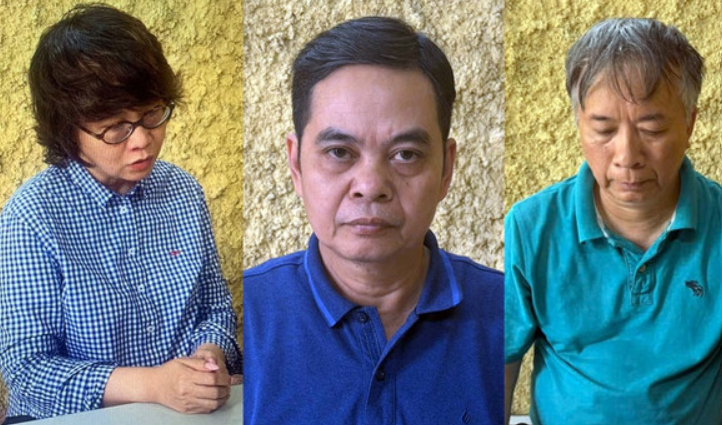
Vietnamese police have intensified their control over political discourse by detaining three senior officials from the Vietnam Writers' Association Publishing House over their role in releasing a controversial biography of Ho Chi Minh, the nation's revered Communist Party founder. The arrests, confirmed on Wednesday, represent part of a broader campaign by Hanoi authorities to suppress what they view as revisionist accounts of the country's revolutionary history and the party's canonical narratives.
The book in question, titled "Stories with Thanh -- A New Account of Light", was authored by former telecommunications executive Nguyen Thanh Nam and published in May. The biography focuses on Ho Chi Minh's formative years spent abroad, documenting his search for ideological frameworks and organisational models that would eventually enable Vietnam's national liberation struggle. Despite its historical subject matter, the publication triggered an unprecedented government response that extended far beyond the publishing house itself.
Authorities have characterised the work as containing material that distorts revolutionary history and party ideology. According to police statements, the three detained individuals—identified as the publishing house's director, editor-in-chief, and head of the editorial board—face charges of producing, possessing, and disseminating content intended to oppose the Socialist Republic of Vietnam. These are serious charges in Vietnam's legal system, reflecting how the state treats challenges to its official historical interpretations as threats to political stability.
Nguyen Thanh Nam himself was arrested in early July on identical charges, preceding the publisher crackdown by several weeks. Beyond the author, authorities also arrested an influencer who used social media platforms to promote the book, indicating that the government views digital distribution and contemporary marketing methods as particularly concerning vectors for disseminating unauthorised narratives. This multi-pronged enforcement suggests a coordinated strategy to eliminate the book's circulation and influence at every level.
The publishing house subsequently withdrew the book from circulation under government pressure, effectively removing it from the Vietnamese market. However, this capitulation failed to prevent further consequences. On the same day authorities announced the arrests, Vietnam's culture ministry revealed it had sanctioned 23 news outlets that had published articles reviewing or praising the biography. The ministry claimed these media organisations had acknowledged their "errors" and promised improved verification procedures, euphemistic language masking what amounts to coerced compliance with state censorship directives.
The financial and personnel consequences for the implicated media outlets have been substantial. The 23 news organisations collectively paid nearly US$2,500 in fines—modest sums individually but collectively demonstrating the economic pressure applied to non-compliant publishers. More significantly, more than a dozen journalists and editors involved in covering the book faced reassignment, suspension, or outright dismissal from their positions, sending a clear deterrent message to Vietnam's media sector about the costs of independent editorial judgment.
In a carefully choreographed display of contrition broadcast nationally, Nguyen Thanh Nam made a televised apology acknowledging that his book contained "factual errors and false assertions" contradicting party guidelines and damaging President Ho Chi Minh's image. The forced nature of such confessions is characteristic of Vietnam's system of political control, where public recantations serve simultaneously as punishment and as propaganda affirming state orthodoxy over alternative interpretations.
This episode reflects Vietnam's broader approach to managing historical narratives and controlling intellectual space. While the country has achieved substantial economic development and maintains relative stability, its Communist Party leadership remains extraordinarily sensitive to challenges against its monopoly on interpreting national history and current political direction. The Ho Chi Minh biography case demonstrates that even reverent treatments of the nation's founding figure can face suppression if they deviate from officially sanctioned accounts.
For regional observers and press freedom advocates, the crackdown illustrates enduring constraints on Vietnam's media environment despite economic liberalisation. Human Rights Watch documents that Vietnam currently imprisons more than 160 critics and dissidents, placing it among the world's worst performers on freedom of expression metrics. The Ho Chi Minh book case shows that these restrictions extend beyond overtly political activism to encompass scholarly and journalistic work examining historical subjects.
The case carries implications beyond Vietnam's borders. As Southeast Asian nations grapple with balancing development with political stability, Vietnam's example demonstrates one endpoint of state control over information and interpretation. For Malaysian readers accustomed to a more permissive media environment, the Vietnamese approach highlights the fragility of press freedom in single-party systems and the vulnerability of publishers and journalists operating under authoritarian frameworks.
International media organisations and publishing houses watching these developments face uncomfortable choices about their relationship with Vietnam's market. The rapid escalation from publication to arrests suggests that foreign involvement in publishing might similarly attract government attention, potentially deterring international collaboration on Vietnamese topics. This self-censoring dynamic, even among entities not directly subject to Vietnamese law, effectively extends state control beyond formal borders.

