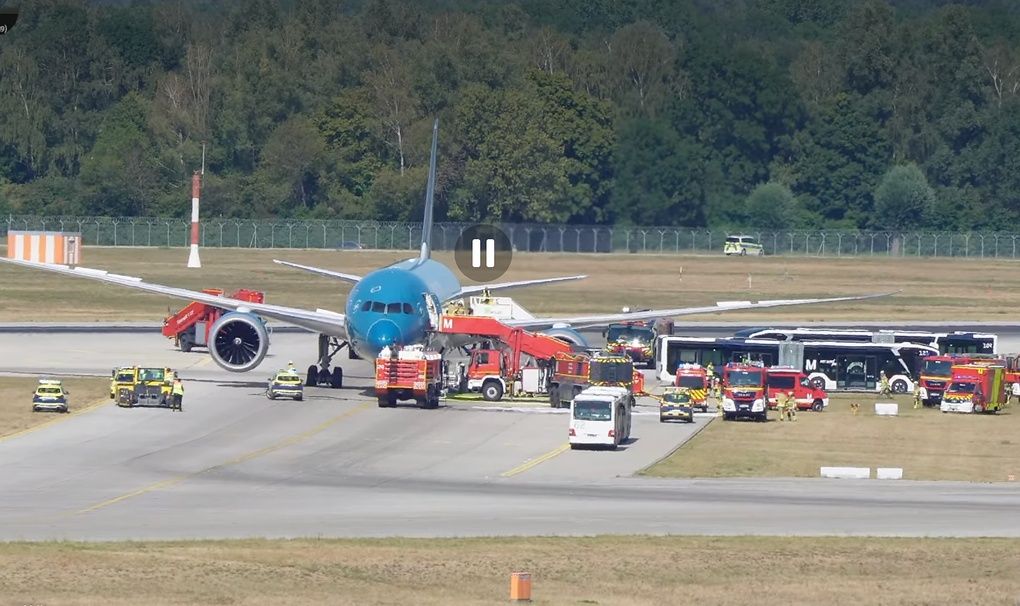
A Vietnam Airlines Boeing 787-9 operating a direct service from Munich to Hanoi encountered serious difficulties moments after lifting off on August 15, forcing the crew to abandon the flight and execute an emergency return to the German airport just two hours after initial departure. The incident, which unfolded with dramatic footage capturing the aircraft's problematic rotation along the runway, has raised fresh questions about aircraft maintenance protocols and pre-flight safety checks on long-haul Southeast Asian carriers operating European routes.
The flight's troubles began during the takeoff roll, when the aircraft experienced what aviation specialists describe as a late rotation—a situation where the nose of the plane fails to lift at the expected moment during acceleration. Eyewitness videos recorded near Munich Airport reveal the Boeing 787 moving rapidly along the runway before climbing away, with visible dust clouds suggesting the aircraft's tail may have struck the tarmac during this critical phase. Such tail strikes, though rare on modern jets, represent a significant structural stress that demands immediate assessment and potential airworthiness inspection before any further operations.
The Aviation Herald, a specialized aviation incident reporting service, documented additional damage sustained during the departure sequence, noting that the aircraft experienced not only a late rotation and possible tail strike but also a runway overrun condition, where the jet consumed excessive runway length before becoming airborne. This sequence of events compounded concerns about the aircraft's structural integrity, with tyre damage subsequently confirmed during the incident. The combination of these factors prompted the crew's decision to remain airborne in a holding pattern rather than immediately attempting to land, allowing time for ground personnel at Munich to prepare for the emergency return and for fuel to be burned down to safer landing weights.
Following standard emergency procedures, the aircraft climbed to approximately 9,000 feet and entered a circling pattern above Munich Airport, giving the crew and ground controllers crucial time to assess the situation and alert emergency response teams. This measured approach reflects modern aviation's emphasis on deliberate crisis management rather than panic responses. Emergency services were placed on standby throughout the two-hour holding pattern, ensuring that fire, medical, and rescue personnel stood ready at the airport's gates and runways when the aircraft eventually declared its return to Munich.
When the Boeing 787 finally touched down at Munich Airport, the landing itself produced visible smoke, consistent with the tyre damage that had occurred during the initial takeoff attempt. The aircraft was safely guided to a parking position, and all passengers and crew members were evacuated without reported injuries. Vietnam Airlines confirmed that every person aboard had been safely removed from the aircraft and escorted into the terminal building, where airline representatives began coordinating alternative arrangements for the disrupted service.
The incident carries particular significance for Vietnamese travelers and the broader Southeast Asian aviation landscape, where Vietnam Airlines serves as the national carrier and a symbol of the region's growing connectivity to Europe. The airline operates dual European routes from both Hanoi and Ho Chi Minh City to Munich and Frankfurt, deploying its most modern long-haul aircraft including Boeing 787 Dreamliners and Airbus A350s. These routes represent important bridges for business travelers, tourists, and expatriates connecting Vietnam with Central Europe, making any disruption a matter of concern not merely for commercial reasons but for the carrier's international reputation.
Vietnam Airlines has committed to cooperating fully with German aviation authorities and relevant technical bodies to determine the precise cause of the technical malfunction that precipitated the emergency departure. The airline stated that its crew had adhered to established safety protocols throughout the incident, a assertion that will likely be scrutinized during formal accident investigation procedures. Such investigations typically examine multiple factors including aircraft maintenance records, crew training, weather conditions, and pre-flight inspection documentation.
The carrier is actively arranging alternative transportation and accommodation for affected passengers, acknowledging the disruption while emphasizing its safety-first priorities. The airline has promised further updates once technical inspections of the aircraft are completed and new operational schedules are finalized. This phased communication approach allows the airline to gather complete technical data before making public statements about causation, avoiding speculation that could either undermine confidence or mislead passengers about the severity of the underlying problem.
For Malaysian and regional aviation observers, this incident underscores the critical importance of rigorous pre-flight inspection protocols and the need for Southeast Asian carriers to maintain the highest maintenance standards when operating modern wide-body jets on international routes. The Boeing 787 Dreamliner remains one of aviation's most sophisticated aircraft, yet its advanced systems and materials demand equally advanced maintenance expertise. As Vietnam Airlines and other regional carriers expand their European operations, maintaining this technical capability becomes increasingly vital for passenger safety and carrier credibility.
The incident also highlights the robust nature of modern aircraft design and emergency procedures. Despite the technical failure and subsequent physical stress on the airframe, the crew's adherence to safety protocols ensured that no lives were endangered. The aircraft's structure remained sufficiently intact to permit controlled flight operations and a safe return landing, testament to engineering standards that prioritize passenger safety even when systems fail.

