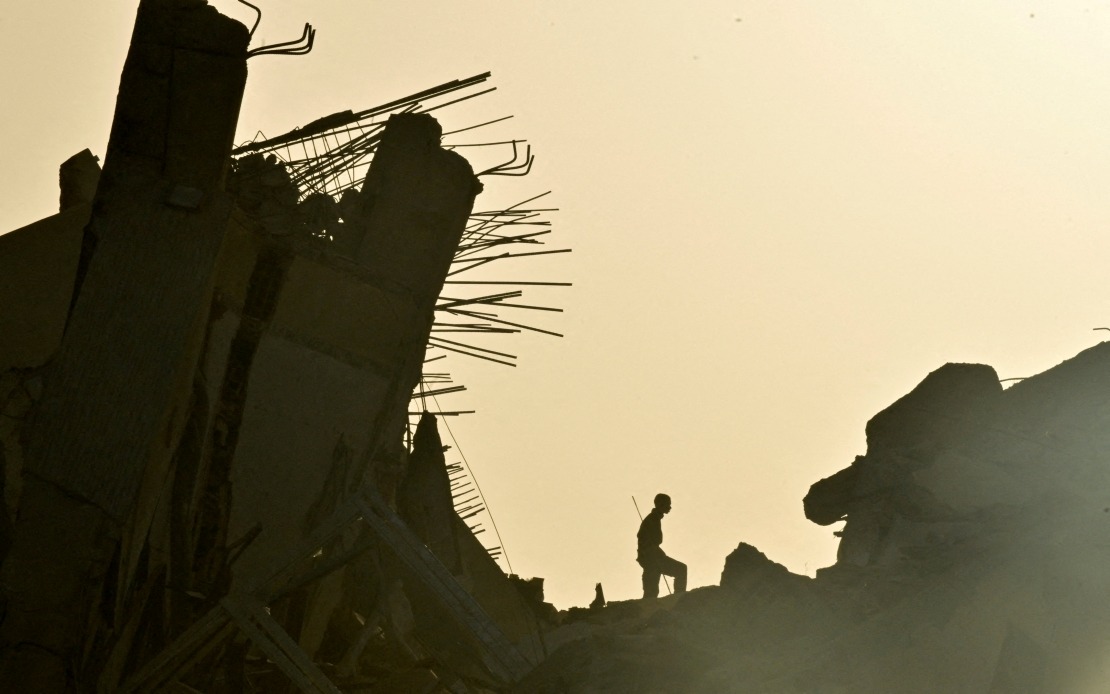
Venezuela is reeling from a catastrophic natural disaster after twin earthquakes struck the South American nation on Wednesday, with authorities confirming on Sunday that at least 1,450 people have been killed and more than 3,200 others injured in the devastating seismic events. The back-to-back tremors, measured at magnitudes 7.2 and 7.5, have unleashed one of the country's most severe humanitarian crises in recent memory, leaving hundreds of thousands of residents displaced and vast swathes of critical infrastructure reduced to rubble.
National Assembly President Jorge Rodríguez has warned that thousands of individuals remain unaccounted for and are believed to be buried beneath collapsed structures across the hardest-hit regions. The official assessment indicates that 430 aftershocks have struck since the initial earthquakes, continuing to destabilise already weakened buildings and complicating ongoing rescue operations. The coastal state of La Guaira and the capital Caracas have been identified as the epicentres of destruction, where entire city blocks featuring high-rise residential and commercial complexes have been completely flattened.
The scale of the infrastructure collapse is staggering. Preliminary damage surveys reveal that more than 2,500 structures—comprising residential buildings, commercial establishments, and public facilities—have either been completely destroyed or suffered severe structural damage. Among the most alarming losses are approximately 780 homes that now stand as uninhabitable ruins and 38 hospitals that have been partially or wholly destroyed, severely hampering the capacity to treat the injured and coordinate relief efforts across affected areas.
The international response has been mobilised at an unprecedented scale, with rescue and relief personnel converging on Venezuela from 24 nations beyond the country's own borders. Venezuela has deployed approximately 30,000 emergency workers to participate in search and rescue operations, complemented by 2,700 specialist rescue experts who have arrived from allied nations. These teams work around the clock navigating dangerous debris fields, utilising advanced detection equipment to locate survivors trapped in underground voids and collapsed basement areas.
However, rescue specialists have sounded increasingly urgent warnings about the biological reality constraining survival prospects. International disaster response protocols indicate that the probability of locating survivors falls dramatically after 72 hours have elapsed from the initial collapse event, as trapped individuals rapidly deplete oxygen supplies and sustain life-threatening injuries without medical intervention. With the initial earthquakes having occurred on Wednesday and the official death count announced on Sunday, rescue teams were confronted with a rapidly narrowing temporal window to identify and extract survivors from the rubble.
For Malaysia and other Southeast Asian nations monitoring the situation, Venezuela's disaster underscores the vulnerability of densely populated urban centres in seismically active regions and the critical importance of rigorous building code enforcement, early warning systems, and comprehensive disaster preparedness frameworks. The scale of international cooperation demonstrated in the Venezuelan response offers a model for regional partnerships, though it also highlights how natural disasters can overwhelm national resources even in relatively developed countries.
The psychological and social dimensions of the crisis extend far beyond casualty figures. Thousands of families remain unable to locate missing relatives, while survivor communities face severe shortages of clean water, medical supplies, and shelter. The destruction of 38 hospitals is particularly catastrophic given the urgent need for trauma care, surgical services, and management of infectious disease outbreaks that typically follow major earthquakes when sanitation systems collapse.
The economic ramifications will persist for years. With residential and commercial infrastructure devastated across major urban and industrial centres, Venezuela faces reconstruction costs that will strain governmental budgets already stressed by existing economic challenges. The loss of hospital capacity will degrade healthcare delivery across the nation, while displacement of residents creates secondary crises affecting employment, education, and social stability.
Geological analysis indicates that the sequential magnitude-7.2 and 7.5 earthquakes were likely part of a single tectonic event, with the stronger tremor representing a massive mainshock following an initial foreshock. The subsequent 430 aftershocks reflect ongoing stress redistribution along the fault zone, creating continued hazard for rescue workers navigating unstable ruins and for residents sheltering in compromised structures. Geophysicists warn that major seismic zones in Venezuela may experience aftershocks of significant magnitude for weeks or months ahead.
Venezuela's response capacity has been complicated by pre-existing institutional challenges and resource constraints affecting the nation's emergency management agencies. The mobilisation of 30,000 domestic emergency workers represents a substantial commitment of national resources, yet international assistance has proven indispensable for augmenting search capabilities and providing medical support beyond Venezuelan hospitals' surviving capacity. The coordination between Venezuelan authorities and foreign rescue teams demonstrates how international disaster response mechanisms function under extreme pressure.
For regional observers, the Venezuelan earthquake sequence reinforces that natural disaster preparedness cannot be deferred or minimised as a budgetary priority. Malaysia, Indonesia, and the Philippines—all situated in tectonically and meteorologically active zones—face similar risks and would benefit from examining Venezuelan response operations to identify lessons applicable to their own emergency management protocols. The experience underscores how rapidly normal governance and infrastructure can become overwhelmed when natural forces of sufficient magnitude strike population centres.
The humanitarian crisis continues to evolve as rescue operations proceed. Survivor trauma, disease prevention, psychological support services, and the monumental task of identifying remains will occupy Venezuelan institutions for extended periods. International medical teams have established field hospitals and trauma centres to supplement surviving hospital capacity, while water purification systems and sanitation facilities are being constructed in displacement camps sheltering tens of thousands of homeless survivors.

