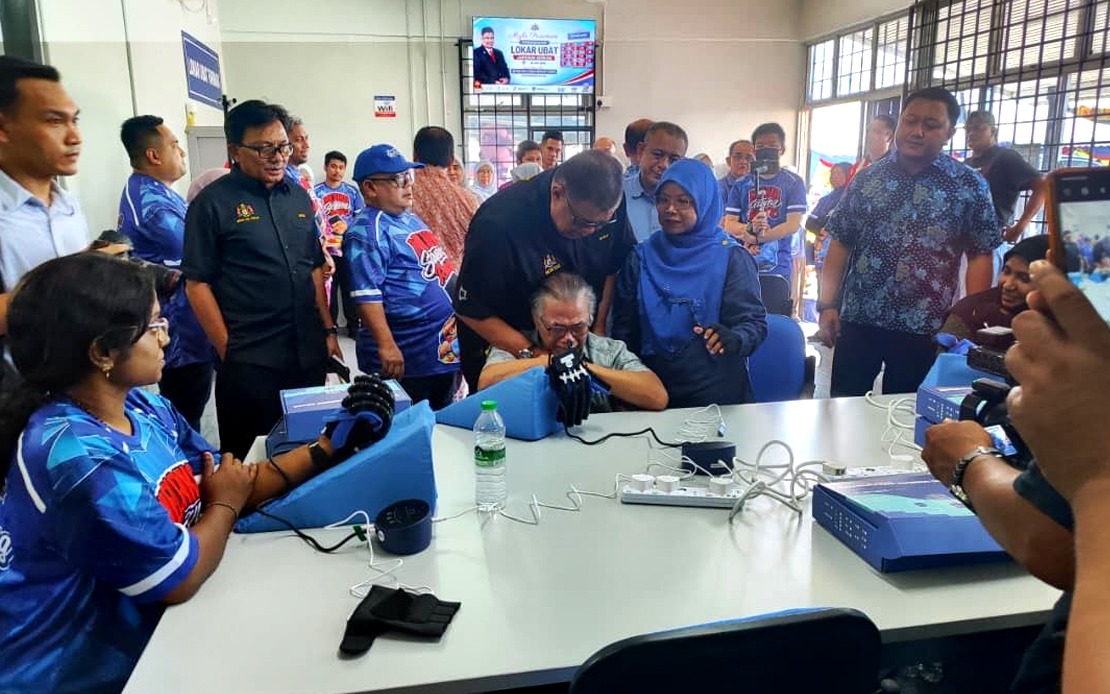
Universiti Teknikal Malaysia Melaka (UTeM) has opened an innovative rehabilitation facility in Serkam, Jasin, that harnesses university-developed technologies to deliver treatment and physiotherapy services to stroke survivors, injured individuals, and those struggling with mobility challenges. Officially launched by Melaka Chief Minister Datuk Seri Ab Rauf Yusoh as part of the Public University Community Empowerment Programme, the MADANI Community Rehabilitation Centre and Gymnasium represents a meaningful attempt to translate academic research into tangible healthcare improvements for ordinary Malaysians seeking recovery support.
The facility emerged through funding from the Finance Ministry's UniMADANI 2024 Grant, signalling government commitment to supporting university-led community initiatives. The decision to locate the centre in the Serkam area reflects deliberate effort to reach underserved populations outside major urban centres, where access to advanced physiotherapy and rehabilitation services typically remains limited. This positioning addresses a genuine gap in Malaysia's healthcare landscape, where rehabilitation expertise concentrates heavily in Kuala Lumpur and major state capitals, leaving regional communities dependent on conventional facilities with limited technological support.
Three primary technological innovations form the centre's core offerings. The Roboglove system provides structured hand rehabilitation training through robotic assistance, enabling patients to perform repetitive exercises with precision and consistency that manually-guided therapy cannot match. The Assistive Lower Limb Chair (ALLC) automates lower limb exercises, allowing patients with severe mobility restrictions to engage in therapeutic movement without requiring constant caregiver intervention. An exoskeleton system complements these tools by enhancing movement training effectiveness through mechanical support and real-time biofeedback. These technologies collectively expand what therapists can accomplish within constrained session times and reduce the physical burden on healthcare workers managing multiple patients.
The innovations were developed by UTeM researchers, with the project led by Associate Professor Dr Mariam Md Ghazaly. This research-to-application pipeline demonstrates how Malaysian technical universities can transform academic outputs into commercially and medically viable products. Rather than publishing findings that gather dust in journals, UTeM took the additional step of constructing physical infrastructure and deploying systems where patients can actually access them. This commitment to translational research aligns with broader Southeast Asian efforts to position the region as a developer rather than merely a consumer of healthcare technology.
The centre operates through an extensive collaborative framework involving multiple stakeholders beyond the university itself. Partnerships with the Serkam State Constituency Development and Coordination Committee (Japerun), the Kampung Pulai Village Development and Security Committee, the Social Welfare Department, and the Social Security Organisation (PERKESO) create a governance structure that bridges academic, administrative, and social welfare domains. Such institutional coordination proves essential for sustainable community healthcare initiatives, as universities alone lack authority over social welfare systems and local development planning. The multi-agency approach suggests that UTeM learned from instances where well-intentioned academic facilities failed through insufficient integration with existing government structures.
UTeM Vice-Chancellor Prof Datuk Dr Massila Kamalrudin framed the centre as a prototype for broader replication. Her remarks emphasise that the model depends on genuine collaboration between universities, government agencies, and local communities—a partnership pattern that remains underdeveloped across Malaysian higher education. Most university community engagement consists of one-off outreach events or student volunteering; sustainable service delivery requires institutional buy-in and resource commitments that extend beyond academic calendars. The vice-chancellor's explicit hope that this model could expand to additional locations acknowledges that a single facility in Jasin cannot adequately serve Melaka's 1.9 million residents, let alone the broader Southeast Asian context where rehabilitation needs vastly exceed current provision.
The rehabilitation sector across Southeast Asia faces acute capacity constraints. Stroke incidence rises steadily as populations age and lifestyle-related diseases proliferate, yet most countries lack sufficient physiotherapists and rehabilitation specialists to meet demand. Malaysia's physiotherapy workforce, while growing, remains concentrated in private urban practices accessible primarily to affluent patients. Public sector rehabilitation services often operate with outdated equipment and chronically overextended staff. Technology-assisted rehabilitation offers a potential lever for addressing these systemic bottlenecks—if the economic model can be proven sustainable and if devices can be manufactured or maintained cost-effectively within the region.
The MADANI Centre's technology focus addresses an important but often overlooked aspect of rehabilitation quality: consistency and precision in therapeutic intervention. Human therapists provide invaluable assessment, motivation, and adaptive strategy, but they cannot perfectly replicate exercise protocols across dozens of daily sessions. Robotic systems excel at this standardisation while simultaneously collecting quantitative performance data that informs clinical decision-making. For stroke patients especially, where neural plasticity windows remain narrow and intensive repetitive training drives recovery, such technological precision can meaningfully improve functional outcomes. Whether the centre's innovations achieve published evidence of superior results compared to conventional therapy will significantly influence their wider adoption.
Financial sustainability represents the unspoken challenge facing the facility. Rehabilitation services typically generate modest revenue through government health budgets or patient out-of-pocket spending, neither of which typically justifies investment in expensive robotic equipment. The initial grant funding secured the establishment, but ongoing operational costs—device maintenance, software updates, staff training—require predictable funding streams. If the centre must eventually become self-financing through user fees, it risks reverting to serving primarily paying patients, undermining the community empowerment mandate. Alternatively, if it remains subsidised indefinitely, expansion to other locations faces immediate budgetary constraints in an era of government fiscal discipline.
The initiative carries symbolic weight within Malaysia's development narrative. As the country pursues advanced economy aspirations, demonstrating that Malaysian universities generate technologies applicable to genuine social challenges strengthens arguments for sustained higher education investment. Neighbouring countries closely observe such initiatives; Thailand, Vietnam, and Indonesia are similarly attempting to leverage academic research toward healthcare innovation. If UTeM's model succeeds in delivering measurable health improvements while proving financially viable at scale, it could establish a template adopted across Southeast Asia. Conversely, if it becomes a well-intentioned facility with modest patient throughput and limited replication prospects, it joins numerous development projects that generate impressive inaugurations but modest real-world impact.
Looking forward, the centre's success hinges on several practical factors: whether rehabilitation specialists choose to practise there despite limited earning potential, whether patients embrace technology-assisted therapy or prefer human contact, whether the devices prove reliable in a tropical climate with potential maintenance challenges, and whether academic collaborators commit sustained research effort to refine and improve the systems. These implementation details receive far less attention than grand opening ceremonies but ultimately determine whether innovation translates into improved health outcomes or remains an impressive but underutilised facility. For Malaysian healthcare planners and Southeast Asian policymakers watching this experiment, those practical lessons will ultimately matter far more than the symbolic milestone of bringing rehabilitation technology to Melaka.

