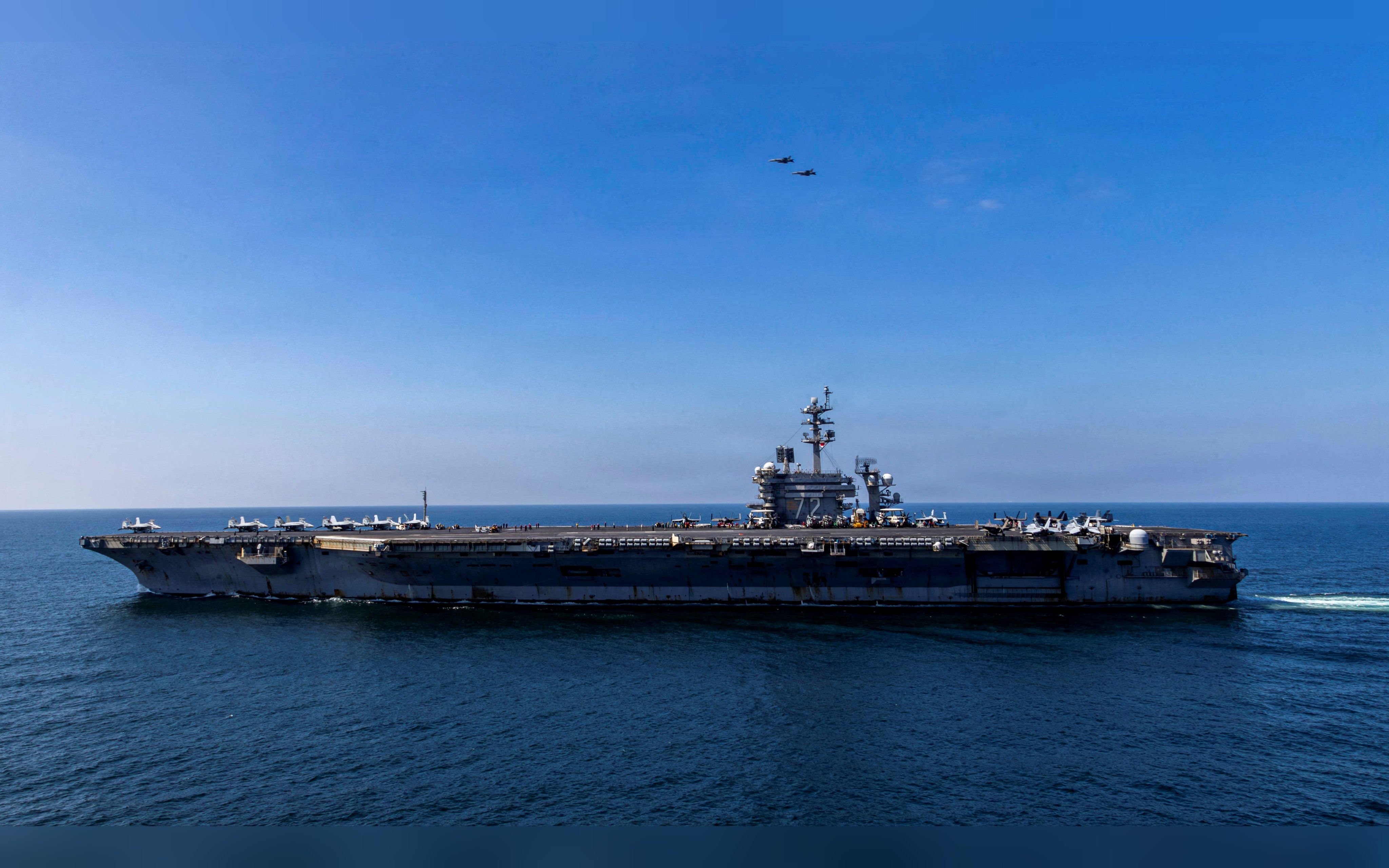
The United States has officially announced plans to rotate out the USS Abraham Lincoln aircraft carrier from West Asia, addressing mounting concerns about the extended deployment and its impact on service members and their families. President Donald Trump confirmed the transition during a Friday briefing, stating that the vessel would be relieved by another carrier of similar capability as part of what the administration characterises as a routine operational rotation. The announcement comes amid growing scrutiny of the deployment's duration and the conditions experienced by the roughly 5,000 sailors and Marines assigned to the carrier strike group.
The USS Abraham Lincoln has remained continuously deployed for more than 250 days, an unusually lengthy assignment that has strained both personnel and ship systems. More notably, the vessel has spent the past 200 days without a scheduled port call, restricting crew rest opportunities and limiting the ability to conduct routine maintenance and resupply operations. The carrier's extended presence in the region reflects the intensification of Middle Eastern tensions and represents a significant commitment of American naval power to the Western Indian Ocean and Persian Gulf area. The deployment began in November of the previous year under standard plans, but the vessel was redirected to West Asia in January as part of broader strategic positioning related to regional security concerns.
The decision to maintain the Lincoln on station for this extended period drew formal objections from Senator Richard Blumenthal, who submitted a detailed letter to Defence Secretary Pete Hegseth and acting Navy Secretary Hung Cao outlining multiple welfare and safety issues affecting the crew. According to Blumenthal's correspondence, sailors aboard the carrier have contended with inadequate supplies of essential items, contaminated water systems, non-functional plumbing infrastructure, and deteriorating mental health conditions resulting from the prolonged isolation. Additionally, the senator highlighted deck safety concerns and significant delays in mail delivery, which has prevented care packages from reaching deployed personnel for months. These grievances suggest systemic strain on a vessel operating beyond optimal deployment parameters.
The replacement vessel designated for the Lincoln's relief is the USS George Washington, a sister carrier of similar tonnage and operational capacity that will assume responsibility for regional operations as part of the previously scheduled carrier rotation cycle. This substitution maintains the continuous carrier presence that the Department of Defense regards as essential for maintaining American strategic influence throughout the Middle East and beyond. The transition allows the Lincoln to return home for crew rest, maintenance, and personnel reintegration following an extraordinarily demanding operational period. The USS George Washington's deployment will continue the American naval commitment to the region while providing the relief crew aboard the Lincoln with much-needed respite.
Acting Navy Secretary Hung Cao publicly validated the rotation announcement on Friday, emphasising that the USS Abraham Lincoln would return to the United States as part of planned succession procedures. Cao acknowledged the vessel's operational achievements while addressing the underlying welfare challenges that prompted political attention. He characterised the deployment as demonstrating crew excellence and mission focus, noting that the Lincoln's aircraft had conducted more than 10,000 combat sorties and delivered over 1.5 million pounds of ordnance during its tenure in the theatre. These figures underscore the intensity of operations and the demanding schedule to which personnel have been subjected throughout the extended deployment.
Cao's statement revealed the navy's framework for understanding the deployment extension, attributing the prolonged presence to mission requirements rather than administrative oversight or policy failure. He acknowledged that combat operations inherently disrupt normal routines and create unavoidable hardships for service members, framing wartime deployment as necessarily complicated by uncertainty and unpredictable operational demands. The acting secretary explicitly prioritised sailor and marine welfare in his public remarks, stating that safety and security considerations drive decision-making at the highest levels of naval command. However, his explanation also suggested that operational necessity sometimes supersedes comfort considerations, a position that may not fully satisfy families concerned about the extended separation.
Mental health emerged as a notable concern during the deployment, with Cao acknowledging that a small number of sailors and Marines required treatment for psychological conditions stemming from the prolonged operational tempo and isolation. He reported that no deaths were associated with these mental health interventions, suggesting the navy's medical personnel successfully identified and treated affected personnel before critical situations developed. Nonetheless, the acknowledgment of mental health treatment cases reinforces the gravity of extended deployments and their psychological toll on service members, particularly when deployments exceed standard rotation cycles by such substantial margins. The existence of these cases indicates that even with professional support systems in place, the strain of 250-day deployments manifests in measurable psychological impacts.
President Trump's response to concerns about the deployment's length proved characteristically dismissive, telling reporters that the Lincoln's time in theatre was "not nearly long enough" despite the documented wellness issues affecting the crew. This position reflects the administration's prioritisation of operational commitments and strategic positioning in the region, even when such commitments generate legitimate welfare concerns from elected officials and service member families. Trump's confidence in the crew's capacity to sustain operations aligns with military culture's emphasis on resilience and mission accomplishment, though it potentially underestimates the cumulative effects of extended separation from family, restricted leave opportunities, and maintenance challenges aboard the vessel.
The USS Abraham Lincoln's deployment represents a microcosm of broader American strategic challenges in West Asia, where maintaining naval presence and demonstrating commitment to regional partners requires sustained carrier operations. However, the wellness issues documented aboard the Lincoln highlight the personnel costs associated with extended deployments and raise questions about whether current rotation cycles adequately balance strategic requirements with crew welfare. The move toward transitioning the Lincoln out of the theatre through the USS George Washington rotation suggests the navy recognises the necessity of relieving extended deployments, even if senior administration officials dispute whether such relief was overdue.
For Malaysian observers and regional analysts, the Lincoln's extended deployment and the attendant welfare concerns illustrate the resource intensity required for the United States to maintain its strategic presence throughout the Indo-Pacific and beyond. The commitment of a major carrier strike group for 250 days demonstrates American determination to remain engaged in the region despite competing global commitments. The rotation to the USS George Washington ensures continuity of American naval operations while permitting the Lincoln crew to return home and the vessel to undergo necessary maintenance and modernisation. This rotation cycle will likely continue the pattern of sustained American carrier presence that has characterised post-Cold War naval strategy in the Middle East and Indian Ocean regions.
The incident also raises broader questions about sustainable deployment cycles for modern naval forces operating in contested environments. As regional tensions persist and the operational demands placed on carrier strike groups remain elevated, navies must balance strategic requirements against personnel welfare and equipment sustainability. The Lincoln's experience suggests that 250-day deployments without port calls represent an unsustainable tempo for modern personnel and vessels, potentially justifying arguments for increased carrier deployments or alternative operational concepts that distribute demand more evenly across the fleet. The transition to the USS George Washington will test whether the navy has learned lessons from the Lincoln's extended deployment or whether similar challenges will recur with future rotations in this strategically vital region.

