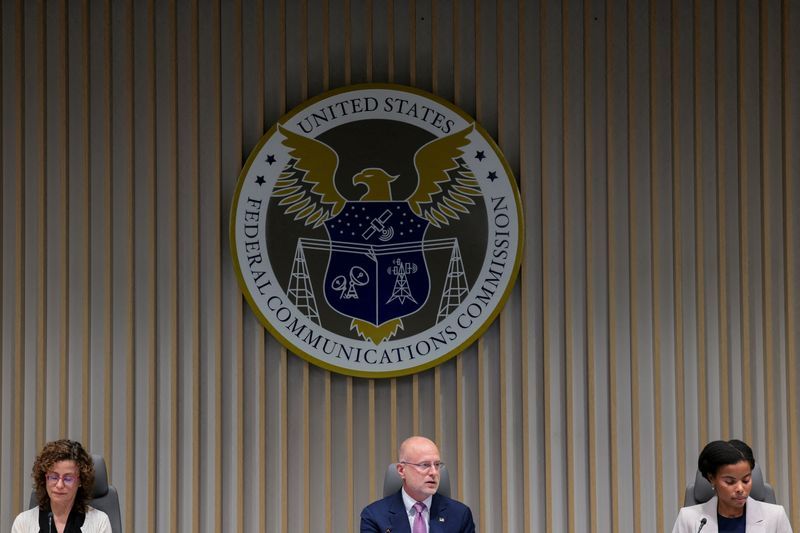
The United States has escalated its technological standoff with China by moving to comprehensively block American consumers and businesses from purchasing devices that incorporate critical hardware manufactured by blacklisted Chinese firms. The Federal Communications Commission's decision on Wednesday represents a significant tightening of existing restrictions and signals the Trump administration's determination to sever supply chains linking American infrastructure to Chinese technology suppliers deemed to pose national security threats.
At the heart of this regulatory shift is a recognition that previous enforcement mechanisms contained a substantial vulnerability. Although the FCC had since 2022 prevented companies like Huawei and ZTE from obtaining new market authorizations for finished devices, a critical gap remained: manufacturers could still incorporate component parts produced by these banned firms into products destined for American approval. This loophole allowed Chinese technology to reach US markets through the back door, entering via smaller, less visible pieces rather than complete systems. The new rules directly address this oversight by prohibiting any device sold in the United States from containing logic-bearing hardware components manufactured by Huawei or other blacklisted entities, effectively closing what FCC Chair Brendan Carr characterized as an unacceptable breach in national security defences.
The timing of this decision reflects broader geopolitical anxieties about technological vulnerability in an era of great power competition. National security experts have repeatedly warned that compromised semiconductors or communications hardware embedded within otherwise legitimate devices create pathways for espionage, surveillance, or infrastructure sabotage. According to Chris McGuire, a former White House National Security Council official under the Biden administration, corrupted components—particularly those designed to process or transmit information—can be weaponized to compromise entire systems, potentially affecting everything from critical infrastructure to consumer communications networks. This concern extends beyond theoretical scenarios, as countries worldwide have grown increasingly alarmed about the security implications of relying on supply chains they cannot fully control or inspect.
The FCC's action fits within a much broader Trump administration campaign to systematically reduce American technological dependence on China. Over recent months, the regulatory agency has pursued an increasingly aggressive agenda targeting Chinese hardware across multiple domains. Last month alone, the commission banned imports of additional equipment from numerous Chinese manufacturers, with restrictions taking effect in mid-July. The administration has also proposed prohibitions on military-grade drones of Chinese origin, moved to prevent American companies from purchasing certain foreign drone and router models, and is considering measures that would fundamentally reshape how Chinese telecommunications companies operate within American territory.
Particularly significant are proposals under development that would restrict how Chinese telecom firms utilize American infrastructure. These discussions focus on eliminating or substantially limiting the ability of Chinese telecommunications companies to maintain data centers or establish Points of Presence—the physical and digital locations that sit at major internet exchange points where international data flows are directed and distributed. Should the FCC proceed with such rules, Chinese telecom firms would effectively be forced to cease operating these facilities, dramatically curtailing their capacity to provide services within the United States or to route international traffic through American infrastructure. Such a move would represent an unprecedented level of technological decoupling between the two economic superpowers.
The regulatory environment now extends to interconnection agreements as well. The FCC has proposed prohibiting American telecommunications carriers from establishing interconnection relationships with Chinese telecom companies deemed to present national security risks. These interconnections are fundamental to how the global telecommunications system functions, allowing carriers to exchange traffic and provide services across borders. Restricting them would sever direct relationships between American and Chinese networks, forcing any necessary communications to route through intermediaries and potentially creating significant operational complications for businesses with operations in both countries.
Huawei, the Chinese telecommunications equipment manufacturer most visibly affected by these restrictions, has not publicly commented on the latest FCC action. The company has long maintained that its equipment poses no security threat and has blamed American restrictions on competitive motivations rather than legitimate security concerns. Nevertheless, the company's ability to participate in the American market has been systematically constrained through multiple regulatory channels over several years, and the latest component-level restrictions represent perhaps the most comprehensive barrier yet to its commercial activities.
For Southeast Asian policymakers and technology managers, these American regulatory developments carry significant implications. The region has substantial economic ties with both the United States and China, and many regional businesses rely on supply chains that integrate components and finished goods from both sources. The widening American restrictions on Chinese technology could eventually ripple through regional markets, potentially forcing companies throughout Southeast Asia to choose between American and Chinese technology ecosystems or to maintain parallel supply chains at increased cost. Additionally, the principle that governments can systematically restrict access to technology from specific countries based on security concerns establishes a precedent that other nations may increasingly adopt.
The practical effect of these restrictions falls heavily on companies that have integrated Chinese components into their manufacturing processes. Many global technology firms source semiconductors, communications hardware, and other critical components from suppliers across multiple countries to optimize costs and access specialized capabilities. The FCC's ban effectively forces a redesign decision: companies must either eliminate Chinese component suppliers from their products intended for American markets or accept exclusion from one of the world's largest consumer and business technology markets. For multinational firms with significant manufacturing operations in Malaysia, Vietnam, Thailand, and other Southeast Asian nations, this creates immediate pressure to audit and potentially restructure global supply chains.
The escalating pattern of Chinese technology restrictions also reflects deeper anxieties within the American government about the vulnerability of critical infrastructure to disruption or compromise. As societies have become increasingly dependent on digital networks for everything from power distribution to financial transactions to emergency communications, the prospect of hidden vulnerabilities within that infrastructure has become a paramount security concern. The FCC's actions suggest that American officials view the risk of Chinese-manufactured components within American networks as sufficiently grave to justify sweeping market access restrictions, even though such measures carry their own economic costs and geopolitical consequences.
Moving forward, the regulatory trajectory appears unmistakably toward further restrictions rather than accommodation. The FCC has several additional proposals under consideration, and the administration shows no signs of moderating its approach. For technology companies, supply chain managers, and traders throughout the region, understanding these American regulatory developments has become essential to long-term business planning. The technological decoupling between the United States and China appears to be accelerating, and regional players must carefully assess how these restrictions will affect their operations, sourcing strategies, and market access.

