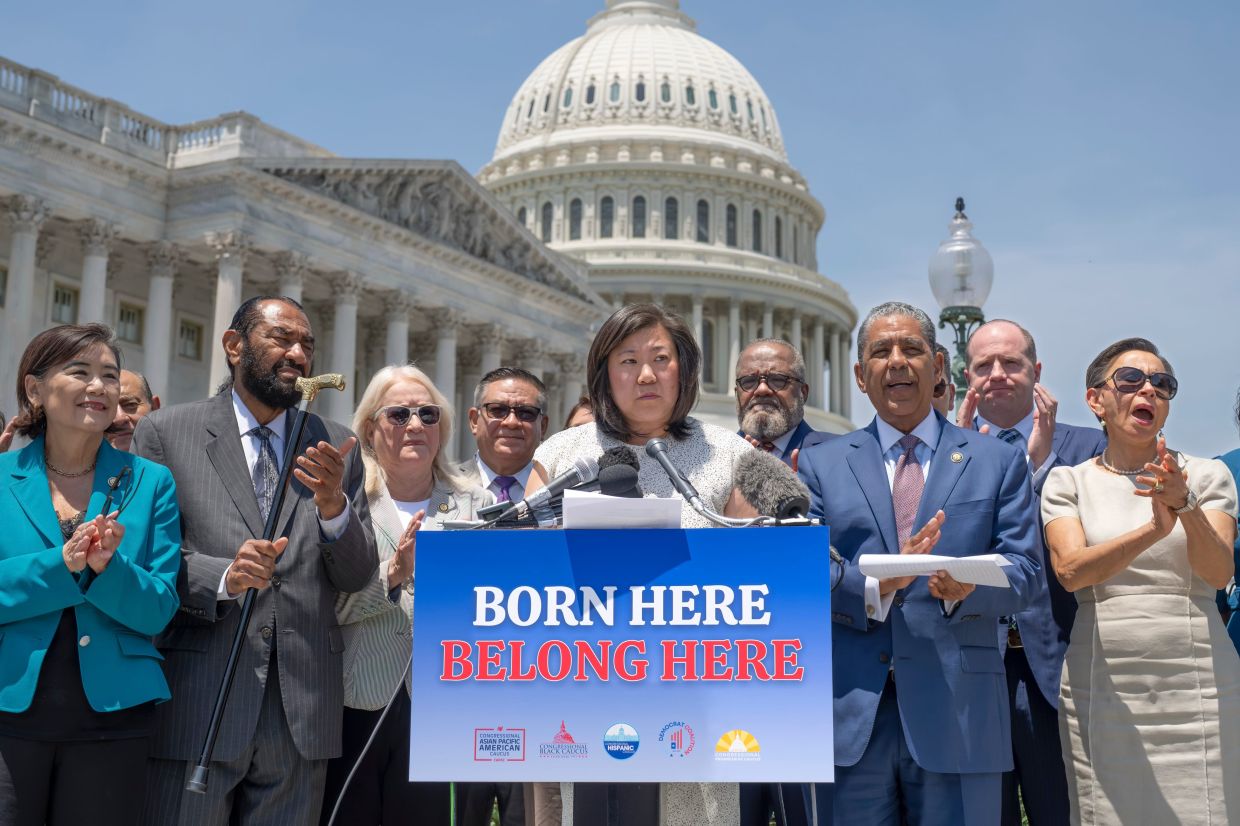
The United States Supreme Court has dealt a significant blow to one of Donald Trump's flagship immigration policies, striking down his executive order that would have denied citizenship to children born in the country to undocumented parents or those holding temporary visas. The decision, delivered by a 6-3 majority in the case Trump vs Barbara, reinforces that birthright citizenship remains a constitutional right that cannot be easily dismantled through executive action alone.
Trump had signed the executive order in early 2025 with the intention of fundamentally reshaping America's approach to citizenship, targeting not only undocumented immigrants but also lawfully present foreign nationals. The policy would have affected children whose parents held highly skilled work visas such as H-1B or L-1 designations, as well as those on student visas, dependent visas, temporary labour visas, and achievement visas—categories that the US Citizenship and Immigration Services classifies as "lawful but temporary." The order would have created an exception only for cases where at least one parent held US citizenship.
The court's decision fundamentally hinges on the interpretation of the 14th Amendment's Citizenship Clause, a provision enacted in the aftermath of the Civil War to protect the rights of formerly enslaved people and racial minorities. Chief Justice John Roberts, writing for the majority, articulated a vision of citizenship as the foundational right enabling individuals to participate fully in the political community. His opinion emphasised that the Framers of the 14th Amendment deliberately extended citizenship promises to "every free-born person in this land," a principle the court determined remains binding today.
The constitutional history undergirding this decision traces back to the landmark 1898 Supreme Court case involving Wong Kim Ark, a Chinese-American whose parents were non-citizens. After Wong was denied re-entry to the United States following a visit to China, officials invoked the Chinese Exclusion Act to argue he lacked citizenship because of his parents' immigration status. The Supreme Court's ruling in that case established that birth on US soil confers citizenship regardless of parental nationality—a principle that has endured through subsequent eras of immigration restriction and civil rights challenges.
For Southeast Asian observers, Wong Kim Ark's descendants have particular resonance in the current debate. Norman Wong, a great-grandson, remarked that his ancestor never sought to become a symbol in the citizenship debate, but rather "only a cook" who "stood up for what was right." The family's statement underscores how individual cases can shape generations of policy and legal understanding, a lesson relevant across the region where immigration and citizenship questions remain contested.
The Trump administration had framed its executive order around concerns regarding so-called birth tourism, a phenomenon allegedly linked to nationals from China and other countries. The Justice Department memo issued following the court's decision directs federal prosecutors to prioritise investigations into birth tourism schemes, suggesting the administration intends to pursue these cases through enforcement mechanisms rather than blanket policy changes. A 2024 prosecution of Michael Wei Yueh Liu and Jing Dong, who operated a scheme charging Chinese clients tens of thousands of dollars to facilitate births in the US, exemplified the specific practices the administration views as threats to citizenship's integrity.
Solicitor General D. John Sauer, presenting Trump's position during Supreme Court oral arguments in April, characterised birthright citizenship as having "spawned a sprawling industry," with what he described as "uncounted thousands of foreigners from potentially hostile nations" arriving to give birth. This rhetorical framing reflects a broader securitisation of immigration policy within the Trump administration's second term, linking traditional enforcement concerns to national security anxieties.
Despite the court's rejection of his executive order, Trump has signalled his intention to pursue birthright citizenship restrictions through alternative mechanisms. In social media posts, he congratulated China's government and characterised the Supreme Court's decision as "too bad" for the country, while asserting that Congress could achieve his policy objectives through legislation without requiring a constitutional amendment. Trump called on Congress to "start TODAY" on ending birthright citizenship, promising "Complete and Total Support" for such efforts.
This legislative pathway remains theoretically available but faces substantial practical obstacles. Any effort to overturn the 14th Amendment's Citizenship Clause through statute would likely face immediate constitutional challenges, as the clause's protections against state action cannot be unilaterally repealed by legislation alone. The Trump administration's confidence in a legislative solution reflects either optimistic assumptions about congressional alignment or a willingness to pursue legally uncertain strategies.
For the Asian-American community, the ruling carries particular historical weight. Organisations including Stop AAPI Hate have emphasised that birthright citizenship has directly enabled the demographic growth and political empowerment of communities of colour in America. The group's statement highlighted that the Trump administration's attempt to restrict citizenship would have "essentially turned the maternity ward into a customs checkpoint," a characterisation that resonates with historical experiences of discriminatory immigration enforcement targeting Asian populations.
Krish O'Mara Vignarajah, president of Global Refuge, noted that birthright citizenship had previously survived both the Chinese Exclusion Act and Jim Crow era restrictions, suggesting its resilience as a constitutional protection. The organisation views the Supreme Court's decision as validation of a principle tested repeatedly throughout American history yet ultimately vindicated.
The decision creates immediate implications for ongoing immigration enforcement and family separation concerns. Children born to the targeted categories will retain automatic citizenship rights, eliminating a potential lever for family deportation proceedings. However, the Trump administration's intensified focus on birth tourism investigations suggests a shift toward prosecutorial approaches targeting both operators of such schemes and their clients.
For Malaysian and broader Southeast Asian readers, this case illustrates how immigration policy becomes intertwined with constitutional interpretation, citizenship rights, and demographic anxieties in developed economies. The outcome also demonstrates the enduring power of historical precedent—Wong Kim Ark's 126-year-old victory continues shaping contemporary debates, suggesting that fundamental constitutional protections, once established, prove remarkably difficult to dismantle despite significant political will and creative executive action.

