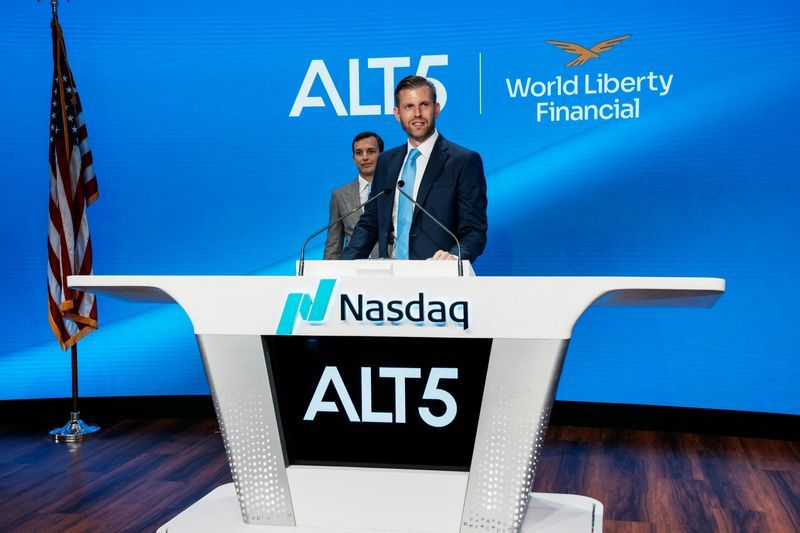
The United States Office of the Comptroller of the Currency has conditionally approved a bank charter application for World Liberty Trust Company, a cryptocurrency enterprise closely associated with President Donald Trump and members of his family. The decision, announced on a Friday in early August, represents a significant regulatory milestone for the crypto sector and reflects the Trump administration's welcoming posture toward digital asset companies seeking to operate within the traditional banking framework.
World Liberty Financial submitted its charter application in January, seeking authorization to establish a federally regulated trust bank. The conditional approval granted by the OCC does not constitute final approval but signals that the regulator has determined the application meets preliminary standards. If the charter receives ultimate approval at a future date, it would fundamentally reshape the operational capabilities of World Liberty, permitting the firm to manage customer assets, conduct settlement functions, and hold reserves under a single national license rather than through third-party custodians.
The distinction between a traditional bank charter and a trust bank charter matters significantly for institutional adoption. While a trust bank charter does not authorize deposit-taking or conventional lending activities, it grants crypto companies the ability to hold and manage assets on behalf of clients across all fifty states under federal rather than state-level regulation. This streamlined structure appeals to institutional investors and major financial market participants who require clear regulatory guardrails and unified compliance frameworks. For World Liberty Financial specifically, the charter would permit the firm to directly manage the USD1 stablecoin and custody the United States dollar reserves that back it, functions currently outsourced to cryptocurrency services provider BitGo.
Comptroller Jonathan Gould, appointed by Trump to lead the OCC in the previous year, has overseen a notable expansion in trust charter approvals for crypto companies. Ripple and Circle have similarly received preliminary approval for such charters under Gould's tenure, reflecting a broader regulatory philosophy favoring industry expansion and innovation within managed parameters. This approach contrasts sharply with the skepticism many financial regulators expressed toward cryptocurrency ventures during previous administrations, positioning the Trump administration as markedly friendly toward digital asset development.
The stablecoin landscape has become increasingly competitive globally, with implications for Malaysia and Southeast Asia's fintech ambitions. USD1 has experienced rapid growth since its public announcement in March 2025, now ranking as the fourth-largest stablecoin by market capitalization with approximately four billion dollars in total value. The approval of World Liberty's bank charter could accelerate adoption among institutional clients and traditional financial institutions seeking exposure to stablecoin infrastructure, potentially reshaping cross-border payment patterns in the Asia-Pacific region.
The Trump family's financial interests in World Liberty Financial raise governance and conflict-of-interest questions that Democratic lawmakers have highlighted publicly. Financial records indicate that USD1 has generated roughly fifty million dollars in earnings for the Trump family through the end of June 2026, while the broader World Liberty Financial enterprise has transferred more than one point six billion dollars to the president and his family as of April. These financial relationships underscore why some lawmakers expressed concern about the regulatory process, particularly regarding the involvement of Comptroller Gould, whom Trump appointed and who therefore answers to the administration.
The conditional approval includes several standard requirements designed to ensure ongoing prudential supervision. World Liberty Trust Company must maintain at least twenty million dollars in capital, notify regulators of significant business plan modifications, and employ a qualified internal audit manager meeting regulatory specifications. These conditions mirror expectations imposed on other financial institutions but have become points of contention given the political dimensions of the application and the Trump family's direct involvement in the company's founding and governance.
National security considerations emerged as an unexpected complication during the approval process. Two Democratic members of the Senate Banking Committee raised questions in February regarding reported international investment in World Liberty Financial, specifically a five-hundred-million-dollar stake acquisition tied to the United Arab Emirates' national security adviser. The OCC addressed these concerns by confirming that international investors do not function as principal shareholders and that the regulator had obtained passivity agreements from foreign investors pledging not to seek control or influence over the bank's operations. Eric Trump, the president's son, signed one such agreement in his capacity as president of a Trump family-affiliated investment vehicle.
Leadership and governance structures at World Liberty Financial reflect deep connections between the organization and Trump's longtime political and business associates. Zach Witkoff, the chief executive officer and president of World Liberty Trust Company, is the son of Steve Witkoff, who serves as Trump's special diplomatic envoy. The Witkoff family emerged as co-founders of World Liberty Financial alongside the Trump family in late 2024. Robert Witkoff, an insurance industry executive and brother to Steve Witkoff, was designated as a proposed director of the trust bank, while Scott Alper, president of the Witkoff family's real estate operations, was also nominated to the board. These interconnected relationships have drawn scrutiny from those concerned about whether regulatory decisions are influenced by political considerations rather than standard banking prudence.
Democratic critics have characterized the approval process as fundamentally compromised by structural factors and political alignment. The OCC, unlike most other major financial regulators, operates without a bipartisan board structure, concentrating decision-making authority in the hands of a single comptroller. Democratic lawmakers specifically pressed Comptroller Gould during a February congressional hearing to provide the unredacted version of World Liberty's charter application, arguing that the publicly released documents omitted crucial details regarding capital structure and detailed business operations. The OCC responded to approval criticisms by asserting that Gould and staff members adhered to statutory duties and ethical obligations, noting that career staff rather than political appointees conducted the technical review.
For Malaysian and Southeast Asian observers, the World Liberty Financial approval demonstrates how regulatory approaches toward cryptocurrency vary dramatically across jurisdictions and political administrations. While the United States moves toward integration of digital asset companies into the banking regulatory framework, Malaysia's Bank Negara and other regional central banks maintain more cautious approaches, emphasizing consumer protection and systemic stability. The approval also highlights how political relationships can influence financial regulation in mature democracies, a dynamic that Southeast Asian regulators and policymakers monitor closely when developing their own regulatory strategies.
The broader significance of World Liberty Financial extends beyond cryptocurrency policy into questions about the relationship between political leadership and financial regulation. Trump has positioned his crypto ventures as democratizing finance by offering alternatives to what he characterizes as restrictive traditional banking systems. The USD1 stablecoin serves as his family enterprise's flagship product, promoted as a stable, dollar-backed digital asset enabling access to blockchain-based financial services. Whether this regulatory blessing accelerates mainstream adoption of Trump-family crypto products or merely facilitates existing investor concentration remains uncertain, but the political economy underlying the decision warrants continued scrutiny.

