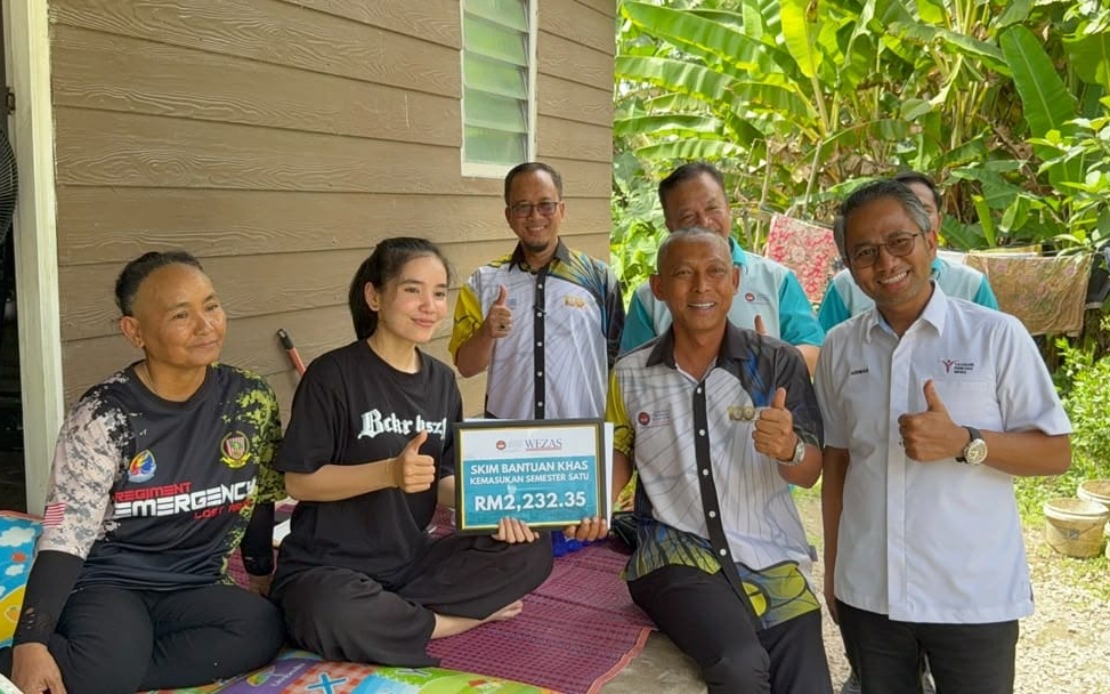
Three promising Malaysian students will begin their university education without the burden of immediate financial hardship, thanks to a collaborative assistance initiative involving Universiti Pendidikan Sultan Idris (UPSI), Yayasan Perkasa Siswa (YPS), and the Higher Education Ministry's Department of Higher Education. Among the recipients is Lovely Sabana Augustine, an exceptional STPM graduate whose appeal for help with registration fees and study preparation expenses resonated widely across social media before the university intervened to support her ambitions.
Sabana's journey towards enrolment at UPSI's Faculty of Human Sciences had been complicated by genuine financial constraints that threatened to derail her academic prospects entirely. Her personal circumstances reflect a challenge facing many high-achieving students across Malaysia: academic excellence alone does not guarantee the resources needed to transition into tertiary education. The situation gained public attention when her family's struggles became apparent, prompting UPSI and its partner organizations to take decisive action. Rather than allowing capability to remain dormant due to poverty, the three institutions recognized both a moral imperative and an institutional responsibility to nurture talent regardless of economic background.
Accompanying Sabana in receiving support are two other prospective UPSI students whose backgrounds equally merit institutional attention. Siti Nurdianis Nordin, who will pursue studies in the Faculty of Management and Economics, comes from a household dependent on irregular daily wages earned by her mother. Muhamad Ilias Danish, enrolling in the Faculty of Languages and Communication, experienced the loss of his father and has become instrumental in helping his mother maintain family stability. Each recipient faces distinct hardships but shares a common obstacle: insufficient resources to facilitate their entry into university life.
The assistance package totalling RM1,500 per student represents a carefully structured collaboration between multiple funding sources. The Centre for Waqf, Endowment, Zakat, Khairat, and Sadaqah (WEZAS), operating within UPSI's institutional framework, contributed RM500 per student, drawing on Islamic principles of collective responsibility for the vulnerable. Yayasan Perkasa Siswa complemented this with RM1,000 per recipient, positioning itself as what department officials describe as a frontline mechanism for safeguarding student welfare across Malaysia's public universities. This division of contribution underscores how different organizational sectors can coordinate effectively to multiply impact.
The intervention carries significance beyond the immediate financial relief it provides. Hirman Awang, director of the Department of Higher Education's Student Affairs Division, framed the assistance as tangible evidence of the Higher Education Ministry's strategic commitment to democratizing access. His statement emphasized that YPS functions as an active force preventing capable students from abandonment due to economic circumstance, and that the allocated funds target both registration requirements and essential living expenses during the critical transition period. Such positioning transforms aid from charity into a systemic approach recognizing that talent development constitutes national investment.
UPSI's institutional perspective, articulated by deputy vice-chancellor Prof Dr Norkhalid Salimin, emphasizes proactive identification and early intervention rather than reactive crisis management. The university's Student Affairs and Alumni Department and WEZAS maintain mechanisms to detect students facing difficulty, suggesting a structured approach rather than ad hoc response. Norkhalid's remarks indicate that UPSI views the support programme as foundational relationship-building, establishing from day one that the institution recognizes and accommodates student vulnerability. This philosophical stance positions financial aid as part of broader pastoral care rather than isolated charity distribution.
Sabana's particular circumstances deserve closer examination because they illuminate the intersection of personal tragedy, caregiving burden, and educational aspiration across Malaysia's lower-income households. Living in Tumpat, Kelantan with her mother Mek Kenui and three older siblings, Sabana comes from a household where her mother's employment as a school cleaner generates approximately RM800 monthly—a figure that becomes stretched when distributed across multiple dependents. The death of her father in 2017 fundamentally altered household economics and responsibilities, removing the second income source that might have otherwise existed. Her mother's additional involvement with RELA reflects how Malaysia's lower-income citizens often engage multiple roles simultaneously in attempts to maximize economic security, yet the structural constraints remain formidable.
The collaborative framework linking UPSI, YPS, and the Department of Higher Education represents institutional recognition that student welfare transcends individual university responsibility. By designating this assistance programme as strategic collaboration, the three entities signal commitment to systematic rather than sporadic intervention. The approach acknowledges that prospective students from economically disadvantaged backgrounds face multiple simultaneous barriers—not merely tuition but registration procedures, accommodation, materials, and living expenses during initial semesters when employment options remain limited. By coordinating support mechanisms, the partnership multiplies the likelihood that financial constraint ceases functioning as a barrier to educational access.
For Malaysian readers, this initiative carries implications extending beyond the three immediate beneficiaries. It demonstrates that public universities and government agencies possess both mechanisms and willingness to identify talented students whose circumstances risk preventing their progression into higher education. The visibility accorded to Sabana's case through social media amplification suggests that disadvantaged students increasingly possess pathways to secure attention and resources, provided their situations gain traction. However, the dependency on social media exposure and ad hoc identification also highlights gaps: systematic scholarship programmes and proactive poverty-targeted outreach might prevent deserving students from requiring emergency assistance in the first place.
The registration date of September 13 represents more than a procedural milestone for these three students. It marks the moment when institutional support translates into lived reality, when financial assistance actually enables attendance, and when educational potential transforms into concrete opportunity. The timing of UPSI's intervention—providing support before rather than after financial crisis forced withdrawal—demonstrates how early engagement prevents attrition. For Malaysian policymakers, this case study illustrates that modestly-scaled financial support, coordinated strategically and delivered promptly, can unlock human potential that otherwise remains dormant due to circumstance rather than capability.
Looking forward, the success of this collaboration may inform broader approaches to student support across Malaysia's higher education sector. As public universities increasingly recognize that excellence cannot emerge exclusively from privileged cohorts, collaborative frameworks involving endowment mechanisms, government agencies, and institutional goodwill become essential infrastructure. The involvement of WEZAS highlights how Islamic charitable principles, when operationalized through institutional structures, can function as systematic rather than sporadic assistance. Similarly, Yayasan Perkasa Siswa's positioning as a welfare frontline suggests that dedicated student support organizations, when properly resourced and coordinated with universities and government, significantly expand the reach and effectiveness of financial aid systems designed to preserve educational opportunity regardless of economic background.

