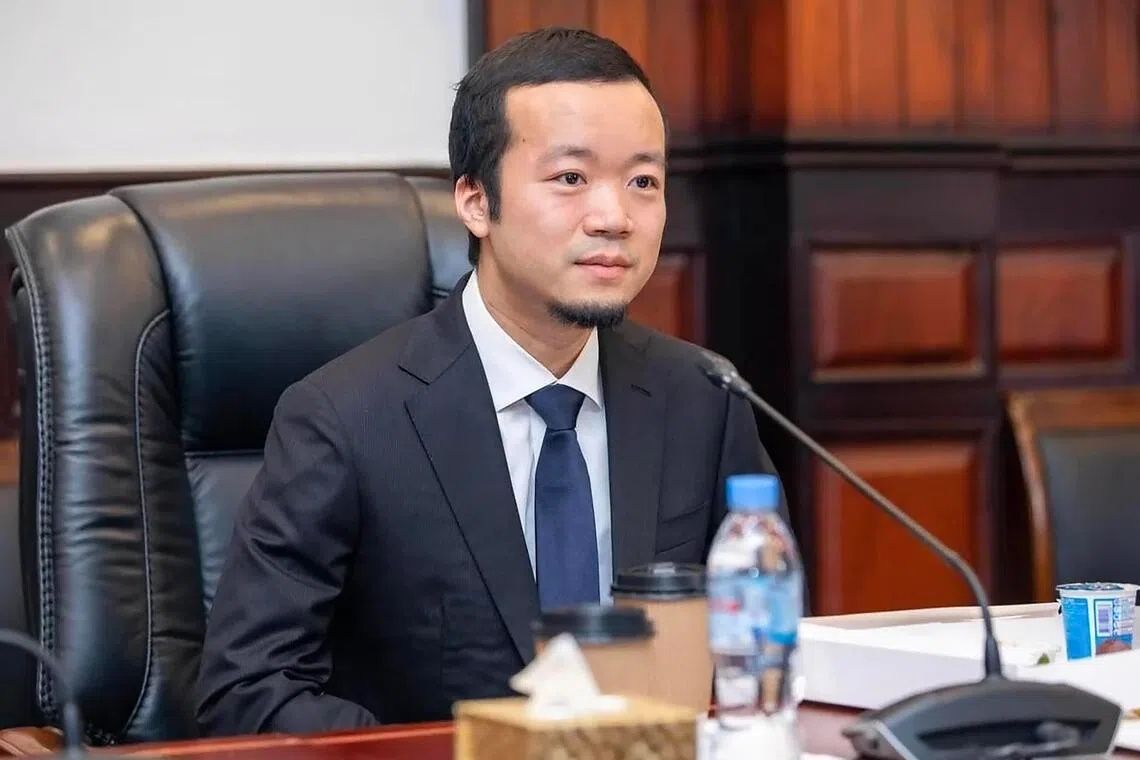
An international investigation has unveiled the identity and vast financial holdings of a key operative in what authorities describe as one of history's largest organised crime networks. Chen Sokly, born Chen Xing in Shanghai in 1986, served as a trusted lieutenant to scam kingpin Chen Zhi, heading the Prince Holding Group's risk control operations and allegedly orchestrating bribery campaigns and enforcement activities that sustained the global criminal enterprise. The joint inquiry by The Straits Times and the Organised Crime and Corruption Reporting Project (OCCRP) spent six months combing through official records, property deeds, and corporate filings across multiple jurisdictions to unmask the second major co-conspirator named in a US indictment filed on October 8, 2025—an indictment that ultimately led to the seizure of 127,271 bitcoins valued at approximately US$15 billion, one of the largest financial crime forfeitures in history.
The investigation reveals the sophisticated mechanisms through which the Prince Holding Group laundered billions of dollars extracted from foreign nationals trapped in illegal scam compounds throughout Cambodia. Sokly's role extended far beyond financial management; prosecutors allege he functioned as the syndicate's fixer, tasked with identifying and neutralising threats from law enforcement while simultaneously cultivating relationships with corrupt officials across multiple countries. The case against Sokly demonstrates how modern transnational criminal enterprises depend on individuals capable of navigating different legal systems, establishing phantom identities, and building networks of complicit officials who shield the organisation from investigation.
Sokly's operational strategy involved constructing multiple identities suited to different jurisdictions and social contexts. After obtaining Cambodian citizenship near the end of 2017—verified through the Cambodian government gazette—he adopted the name Chen Sokly, shedding his original Chinese identity. In Singapore's business circles, he cultivated a separate persona as Martin Chen, the cosmopolitan wealthy businessman. Investigators confirmed his identity by cross-referencing corporate histories, citizenship records in Cambodia and Cyprus, and previous residential addresses in Singapore and the United States. This compartmentalisation of identity allowed him to operate distinct financial networks while minimising the risk that law enforcement in one jurisdiction would connect his various activities to the larger criminal enterprise.
The indictment alleges that Sokly's primary function involved monitoring law enforcement investigations and engaging in what prosecutors describe as corrupt bargaining with foreign officials. In May 2023, according to the court documents, Sokly communicated with a Chinese government official who claimed ability to provide protection for Prince Group associates facing legal jeopardy. The arrangement reportedly extended to directing Chinese officials to instruct local police to extort businesses on behalf of the syndicate—a level of institutional corruption that suggests the Prince Group had penetrated state apparatus at multiple levels. Sokly's confidence in these relationships was so pronounced that he dismissed warnings about Cambodia's crackdown on scam compounds, reportedly assuring Chen Zhi that nothing would threaten the organisation given the officials he had secured.
Documents recovered by US authorities paint a picture of an organisation so convinced of its immunity that it maintained detailed records of its corruption network. A ledger allegedly kept by Chen Zhi itemised bribes paid to officials, including a yacht valued at over US$3 million that Sokly purchased for a foreign government official in 2019. The existence of such documentation reveals either extraordinary confidence in the group's protective layers or a fatal underestimation of law enforcement capability. Sokly's boasting to associates about the network's reach—claiming the global syndicate generated US$30 million daily through illicit activities—further suggests a criminal organisation that had grown complacent regarding its apparent invulnerability.
Beyond financial manipulation and corruption, Sokly allegedly employed violence to maintain the syndicate's dominance over competing scam operators. In July 2024, Chen Zhi directed another associate to contact Sokly regarding a group member who had allegedly stolen money from the organisation, effectively deploying him as an enforcer willing to address internal threats through intimidation or physical coercion. This multi-faceted role—simultaneously financial operator, corruption broker, and muscle—reflects Sokly's status as perhaps the single most important figure in the Prince Group hierarchy outside Chen Zhi himself. His ability to move seamlessly between these functions suggests psychological capacity for violence alongside sophisticated financial reasoning.
The investigation into Sokly's property acquisitions reveals the geographic spread of the criminal enterprise's asset base. In California, property records show Sokly purchased a residence in 2019 from Fang Zhizhen, a member of the Knight Attack Group, a cybercriminal syndicate that predated the Prince Group and operated in China. This transaction suggests overlapping networks between different criminal enterprises, potentially involving asset laundering through property transfers between associated criminals. Sokly subsequently sold the California property in 2024 for approximately US$4.5 million. More tellingly, in November 2025—just weeks after international sanctions swept down on the Prince Group—Sokly transferred ownership of a separate US$4 million property to his wife. Within a month, that property was placed into a trust operated by his spouse, a manoeuvre suggesting deliberate concealment of assets from potential forfeiture.
Singapore served as a crucial base for Sokly's operations, positioning the island as a critical financial hub for the Prince Group's regional activities. In 2017, Sokly announced his arrival with the purchase of an S$11 million apartment at 10 Leedon Heights, a prestigious residential address. The property, spanning 5,694 square feet, reflected the lifestyle expectations of a senior criminal operative managing billions in laundered proceeds. Several months later, he incorporated M Capital Global Holdings, investing just over S$5 million in equal partnership with his wife. The couple retain shareholding in this company, which continues operating in Singapore's corporate register. Over the subsequent two years, Sokly positioned himself as director of at least 16 Singapore-registered companies, though investigators found his name systematically removed from most positions between 2020 and 2023—a pattern suggesting deliberate distancing from operational entities once their utility had been exhausted.
The corporate infrastructure Sokly established in Singapore's financial district reveals the logistics of money laundering at scale. Companies listing Sokly as director shared a Shenton Way address, a location ST journalists visited in person. The electronic building directory showed two companies occupying a 12th-floor office, with no apparent operational connection to Sokly. Interviews with former employees, granted anonymity for safety reasons, indicated Sokly spent only two to three months annually in Singapore, typically devoting evenings to socialising with associates including Chen Zhi himself. During these sojourns, he maintained a fleet of luxury vehicles—including a Bentley and a seven-seater limousine—parked at his Leedon Heights residence. This pattern of seasonal presence combined with shadow corporate structures suggests Singapore served primarily as a financial washing machine through which illicit proceeds could be legitimised and transferred onward.
The implications of Sokly's Singapore operations extend beyond the immediate Prince Group investigation. The ease with which he established corporate entities, acquired premium property, maintained multiple identities, and operated shell companies for six years before exposure raises uncomfortable questions about the effectiveness of Singapore's financial crime detection mechanisms. While Singapore has invested heavily in anti-money laundering compliance, the Sokly case demonstrates how sophisticated international criminals can exploit gaps between jurisdictions, leveraging each nation's reliance on others to conduct verification. Malaysian authorities, given the proximity of Cambodia and Singapore to Malaysian borders and the region's role as a financial crossroads, should examine whether similar networks operate across Malaysian financial institutions.
The US indictment against Chen Zhi and the Prince Holding Group, filed on October 8, 2025, came just six days before the United States dropped sanctions against the organisation and its affiliates—a timing that official statements framed as coincidental but which investigators have questioned. The seizure of 127,271 bitcoins represented an unprecedented disruption to the syndicate's digital assets, though the question remains whether international cooperation has truly dismantled the network or merely interrupted its operations temporarily. Chen Zhi, identified as the organisation's head, remains believed to be at large, and Sokly is thought to be currently residing in the United States—jurisdictions where tracking fugitives with sophisticated resource networks poses persistent challenges. For Southeast Asian nations struggling with transnational organised crime, the case underscores the difficulty of pursuing criminals whose financial sophistication, geographic mobility, and access to corrupt officials often exceed the investigative capacity of regional law enforcement.
The broader context involves the scam compounds scattered throughout Cambodia that reportedly generated the wealth enabling Sokly's luxurious existence. These operations enslaved foreign nationals—primarily from Southeast Asia, China, and other Asian nations—forcing them to conduct investment fraud and romance scams against victims worldwide. The proceeds funnelled upward through networks like the Prince Holding Group, eventually materialising as Singapore penthouses, California mansions, yachts for corrupt officials, and cryptocurrency holdings. Sokly's identification and exposure may disrupt operational capacity temporarily, but without fundamental reforms addressing the corruption enabling such networks, follow-on criminal enterprises may simply replicate the model with modified personnel. For Malaysian policymakers and law enforcement, the case serves as an urgent reminder that financial crime increasingly transcends borders, requiring deeper integration of intelligence sharing, asset tracing, and mutual legal assistance frameworks across the region.

