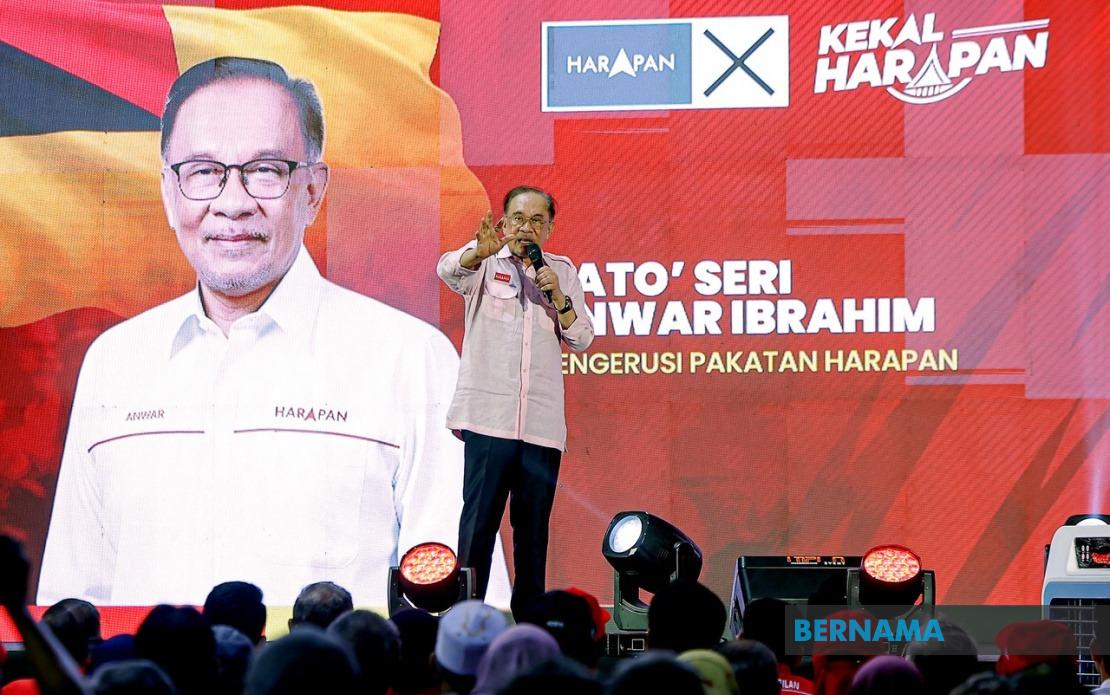
Prime Minister Datuk Seri Anwar Ibrahim sought to reassure Malaysians that the federal administration is on solid footing, stating publicly that the Unity Government coalition maintains its cohesion and strength at the national level. Speaking in Seremban, Anwar underscored the importance of preserving this institutional stability to safeguard Malaysia's economic trajectory and sustain investor confidence during what remains a politically fluid period.
The Prime Minister's remarks come at a juncture when Malaysia's political landscape continues to be tested by shifting alliances and competing electoral interests across different levels of governance. Anwar's emphasis on federal-level stability appears designed to distinguish between the pragmatic cooperation needed to run the country and the legitimate partisan competition that occurs during state-level electoral contests. This demarcation reflects an attempt to manage expectations and address concerns that political fractures could destabilise the national administration.
Anwar highlighted that cooperation among the coalition's constituent parties has been productive, pointing to the regular and orderly conduct of Cabinet meetings as evidence of functional governance. He specifically mentioned working alongside Minister of Agriculture and Food Security Datuk Seri Mohamad Sabu, Transport Minister Anthony Loke, and Deputy Prime Minister Datuk Seri Dr Ahmad Zahid Hamidi in recent ministerial gatherings. The invocation of these names signals cross-party collaboration, as these figures represent different political entities within the Unity Government framework.
The Prime Minister's distinction between federal and state-level dynamics reveals a nuanced understanding of Malaysia's federal structure. While parties within the coalition may compete vigorously at state elections—where regional interests and local constituencies dominate—Anwar suggested that such competition does not necessarily translate into federal-level instability. This compartmentalisation, if it holds, would theoretically allow the government to function effectively in matters of national economic policy, regulatory oversight, and foreign relations while permitting electoral competition in subnational contests.
The emphasis on economic considerations underscores the administration's prioritisation of growth and investment as measures of governmental success. Anwar stressed that political turbulence at any level could deter both domestic and international investors, who require predictability and continuity in policy frameworks. For a nation deeply integrated into regional and global supply chains, this concern carries genuine weight, particularly given the heightened economic uncertainty stemming from geopolitical tensions and commodity price volatility.
The PM's reference to elections appears to acknowledge an upcoming electoral cycle that could test the coalition's cohesion further. His expression of hope—invoking religious sentiment with "Insha'Allah"—that federal stability will persist after electoral contests suggests an awareness that post-election realignments could potentially fracture the current arrangement. This candid acknowledgment reflects political realism rather than mere optimism.
For Malaysian observers and regional analysts, Anwar's remarks serve multiple purposes. Domestically, they aim to provide reassurance to businesses and the general public that administrative continuity is not under imminent threat. Regionally, they signal to ASEAN partners and international stakeholders that Malaysia remains politically functional despite competing interests. The framing also subtly reinforces Anwar's role as a stabilising force capable of managing diverse political actors within a coherent framework.
The stability question has practical implications for Malaysia's ability to pursue medium-term economic initiatives, infrastructure projects, and legislative reforms. A fractured federal government could impede the passage of necessary legislation, complicate budget implementation, and generate policy inconsistency. Conversely, a stable coalition provides the predictability that enables long-term strategic planning and facilitates the continuity of initiatives across electoral cycles.
However, Anwar's assurances must be contextualised within Malaysia's political history, which has witnessed several coalition collapses and unexpected realignments. The durability of the Unity Government will ultimately depend on whether competing parties can manage their divergent interests and whether external pressures—such as electoral setbacks or leadership changes—remain manageable. The Prime Minister's confidence may reflect genuine institutional strength, or it may represent the customary optimism leaders project during periods of underlying fragility.
The government's success in maintaining this balance will carry significant implications for Malaysia's development trajectory. Sustained political stability at the federal level would enable focus on addressing structural economic challenges, investing in human capital development, and positioning Malaysia competitively within evolving regional economic architectures. Conversely, renewed instability could divert political energy toward coalition management rather than policy innovation.
Moving forward, the test of Anwar's assertions will lie in whether the Unity Government can navigate upcoming state elections without allowing localized contests to fundamentally alter the federal power equation. The Prime Minister's framing suggests confidence that institutional mechanisms and shared commitment to economic stability can transcend partisan competition, though time will ultimately determine whether this optimism proves justified.

