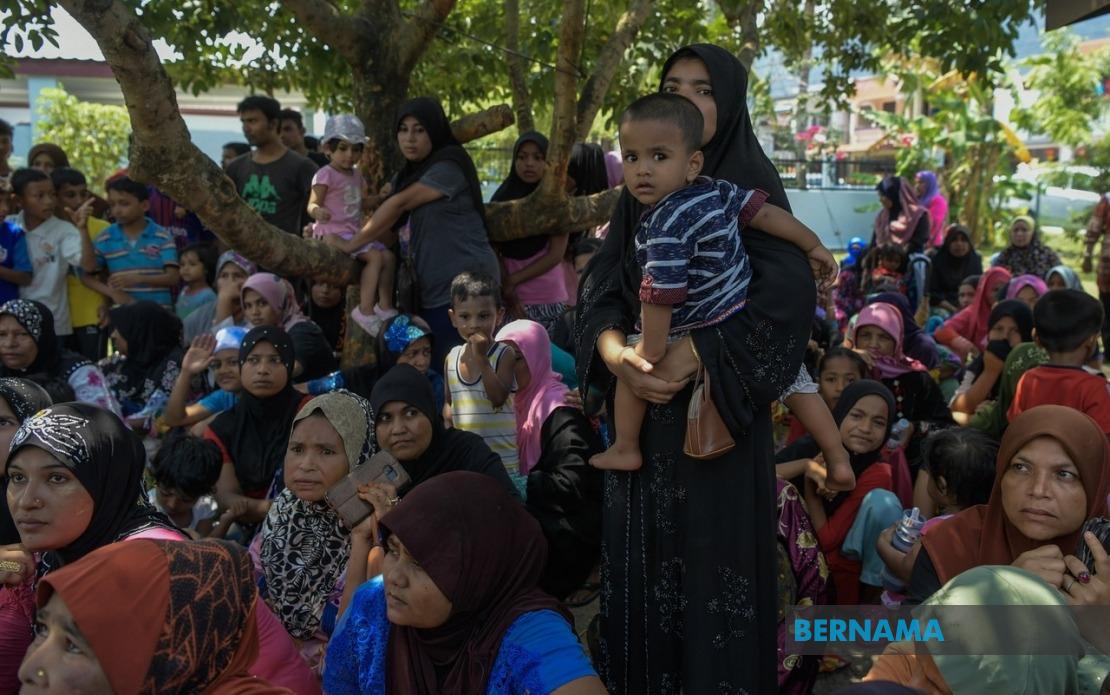
The government moved swiftly to address mounting public anxiety about refugee documentation and national security by clarifying the legal standing of United Nations refugee credentials. During a briefing on Malaysia's economic response to global challenges, Economy Minister Datuk Akmal Nasrullah Mohd Nasir underscored that holding a UNHCR card confers neither citizenship status nor protection from the country's legal framework, a distinction growing increasingly important as communities grapple with rising concerns about irregular migration patterns.
The minister's statement came during the National Economic Action Council meeting chaired by Prime Minister Datuk Seri Anwar Ibrahim, where the Home Ministry raised the refugee management issue in response to escalating public concern. The clarification addresses a persistent misunderstanding among both citizens and some refugee populations, where confusion about document status has occasionally created tension between refugee communities and local residents. By explicitly distinguishing between humanitarian documentation and citizenship or legal immunity, officials are attempting to restore public confidence in the government's capacity to maintain order while managing its international humanitarian obligations.
The Home Ministry has deployed what officials describe as a comprehensive framework for managing refugee populations more effectively. Through the Immigration Department, authorities are implementing the Refugee Registration Document Programme, which hinges on advanced biometric technology to capture, verify, and track refugee populations entering and residing within Malaysian territory. This systematic approach aims to replace ad-hoc processing with data-driven precision, allowing enforcement agencies to distinguish between documented refugees, irregular migrants, and individuals posing security threats.
Concerns about human trafficking networks and document fraud have prompted authorities to intensify cooperative enforcement operations across multiple agencies. The government plans to deploy integrated task forces designed specifically to dismantle smuggling operations, intercept trafficking syndicates, and prevent the illicit trade in forged documents that has become increasingly sophisticated. By pooling resources and intelligence across immigration, police, and border protection agencies, Malaysia aims to create an enforcement environment less hospitable to transnational criminal organisations that exploit vulnerable migrants and undermine state sovereignty.
Technology is becoming central to the government's security architecture. Officials have committed to deploying data analytics and monitoring systems that can identify suspicious patterns, flag high-risk individuals, and generate intelligence to support enforcement activities at borders and within population centres. These systems represent a significant shift toward predictive policing and risk assessment rather than relying primarily on reactive responses to reported incidents. For Malaysian residents and businesses, the implication is theoretically tighter control over undocumented populations, though implementation challenges in a country as geographically dispersed as Malaysia remain substantial.
The government has committed substantial financial resources to strengthen its enforcement capacity. An allocation of RM1.2 billion across several agencies will fund border control infrastructure, security improvements, and operational expenses related to migration management. This investment signals serious government intent to address what many Malaysians perceive as a security gap, though critics question whether funding levels are adequate for the scale of the challenge, particularly given Malaysia's long maritime boundaries and porous land borders in the peninsula and Borneo.
The Malaysian Border Control and Protection Agency is undergoing organisational expansion and operational acceleration to enhance its effectiveness. By streamlining command structures and expanding personnel deployment, the agency aims to establish more consistent and comprehensive border surveillance. This modernisation effort reflects recognition that existing capacity has been stretched by increasing migration pressures and more sophisticated evasion techniques used by smuggling networks. The expansion also signals Malaysia's determination to manage its borders more actively rather than allowing migration flows to proceed with minimal interference.
The refugee documentation issue has become entangled with broader concerns about social cohesion and resource competition in Malaysia's urban centres. Local communities, particularly in lower-income neighbourhoods where refugee concentrations are often highest, have expressed frustration about perceived strain on services and concerns about crime. By clarifying that refugee status confers no legal exemption, the government is attempting to reassure citizens that all residents—regardless of background—remain accountable to Malaysian law enforcement and the judicial system. This messaging is designed to prevent the emergence of parallel systems or perceptions that certain populations operate outside legal constraints.
The government's multifaceted approach also reflects Malaysia's position as both a major refugee-hosting nation in Southeast Asia and a state deeply concerned with maintaining sovereign control over population movements and security. With over one million refugees and asylum seekers officially registered with UNHCR, Malaysia faces genuine tension between humanitarian responsibilities and domestic security imperatives. Officials appear committed to demonstrating that these obligations are not mutually exclusive, though achieving that balance remains operationally complex and politically contentious.
For Malaysia's business community and ordinary citizens, the policy implications extend beyond migration management. The government's emphasis on data analytics, biometric systems, and integrated agency operations represents a broader trend toward surveillance-based governance that will likely expand beyond refugee-related activities. Companies operating in supply chain, hospitality, and labour-intensive sectors will need to adapt to more stringent identity verification requirements and reporting obligations. Employment of documented individuals will become easier to verify, potentially reshaping informal labour markets that have long relied on undocumented workers.
The minister's remarks also position the government to deflect criticism from human rights organisations concerned that security measures might infringe on refugee welfare or privacy rights. By framing the initiative as documentation and screening rather than blanket restrictions, officials are attempting to maintain the distinction between managed migration and restrictive asylum policies. Whether this distinction holds under implementation pressure remains uncertain, particularly if high-profile crimes involving refugees occur or public sentiment shifts further toward restriction.
Looking forward, Malaysia's approach will likely serve as a model for other Southeast Asian nations grappling with irregular migration and refugee populations. Success or failure in managing refugee documentation while maintaining security will influence regional migration policy for years. The government's willingness to invest in technology and institutional expansion suggests confidence that the problem is manageable through better systems rather than requiring fundamental policy shifts. How quickly these initiatives produce measurable improvements in border security and community confidence will largely determine whether the government succeeds in addressing what has become one of the region's most sensitive policy challenges.

