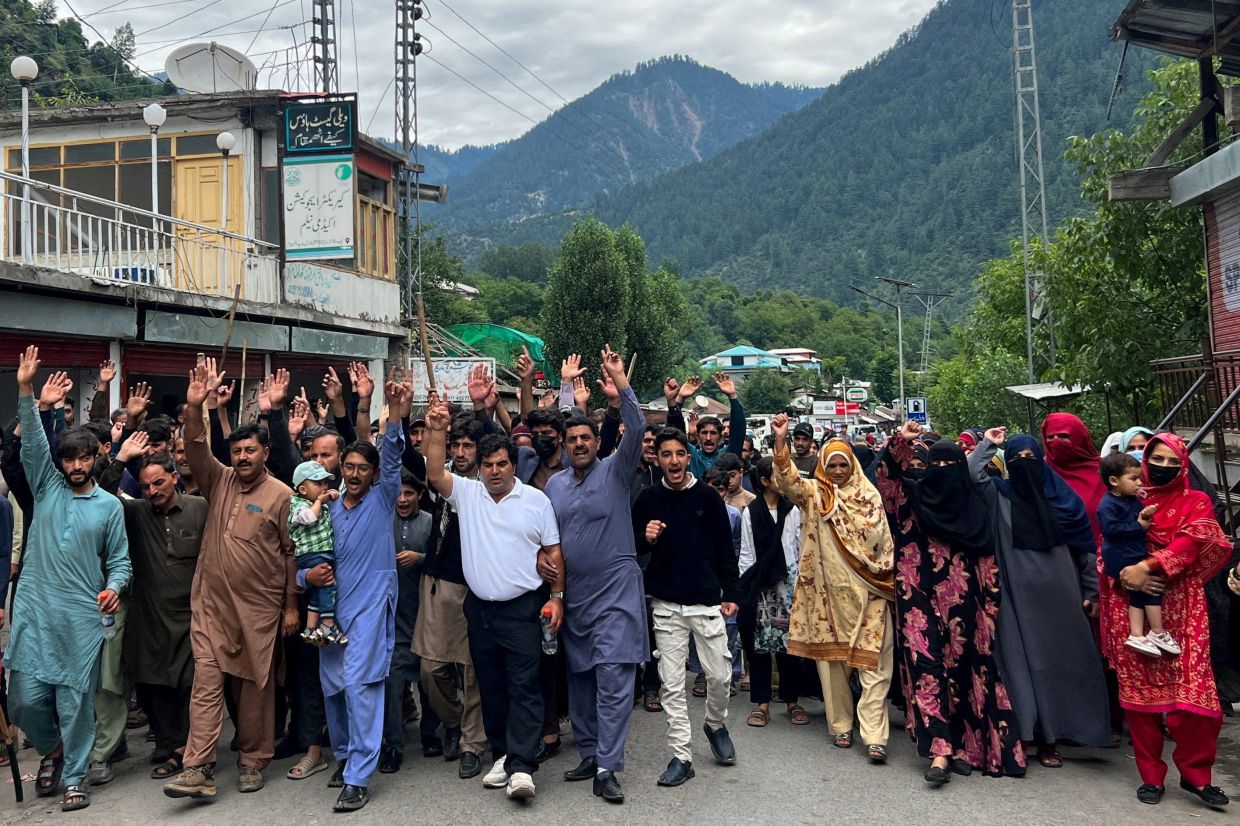
The United Nations has intensified pressure on Pakistani authorities to conduct impartial investigations into a mounting death toll in Pakistan-administered Kashmir, where security forces and protesters have clashed repeatedly in the lead-up to regional legislative elections scheduled for July 27. UN High Commissioner for Human Rights Volker Turk issued the appeal through his spokesman Jeremy Laurence at a Geneva briefing on Friday, citing alarming reports of fatalities spanning from June onwards. The directive signals growing international concern about the scale and nature of violence unfolding in this strategically significant region, where tensions between New Delhi and Islamabad have long created a volatile security environment.
According to UN officials, the death toll encompasses both civilian protesters and members of Pakistan's law enforcement agencies, highlighting the intensity of street confrontations that have gripped the territory. While exact numbers remain disputed, the deaths represent a significant escalation from previous unrest patterns in the region. The violence coincides with a broader political upheaval centred on the Joint Awami Action Committee, an anti-government coalition that has mobilised widespread demonstrations demanding comprehensive economic reform and improved governance standards. The JAAC's mobilisation has proven remarkably resilient despite Pakistani authorities designating the movement as a terrorist organisation under national security legislation last month—a designation that, according to UN analysts, lacks sufficient justification given the movement's stated political objectives.
The JAAC's emergence as a formidable protest force reflects deeper frustrations within Kashmir's population regarding economic stagnation and administrative shortcomings. By framing the movement as a security threat rather than a legitimate civil society organisation, Pakistani officials have effectively criminalised what the UN characterises as constitutionally protected forms of political expression and assembly. This approach carries particular significance for regional observers who note that such heavy-handed responses often amplify rather than diminish underlying grievances, potentially destabilising the electoral process itself. The UN has warned that blanket restrictions on gatherings and arbitrary arrests of JAAC leadership constitute serious infringements on fundamental freedoms enshrined in international human rights covenants to which Pakistan is a signatory.
Malaysian observers of regional geopolitics will recognise troubling parallels with protest suppression tactics employed elsewhere in Asia, where governments routinely invoke security legislation to neutralise political opposition. The Kashmir situation underscores how counterinsurgency frameworks designed for genuine security threats can be weaponised against ordinary citizens exercising democratic rights. The UN's intervention reflects a broader international consensus that such overreach breeds long-term instability by delegitimising state institutions and radicalising moderate segments of the population. For Pakistan, allowing the Kashmir elections to proceed amid such violence and civil liberties violations risks international criticism and potential sanctions, complications Islamabad can ill afford given its current economic fragility.
The region's history of violence adds context to current concerns. Previous clashes between JAAC supporters and police in September resulted in nine confirmed deaths, establishing a precedent for intense confrontations during periods of heightened political mobilisation. That violence erupted despite Pakistan's substantial security apparatus presence, demonstrating the difficulty of containing popular movements through force alone. UN human rights officials have specifically demanded transparent investigations into deaths from both sides—a provision that acquisition of credible evidence requires genuine cooperation from Pakistani security agencies, whose institutional culture has historically prioritised operational discretion over public accountability.
Interest restrictions represent an understudied dimension of the Kashmir violence that deserves particular attention in the Malaysian context, where digital governance remains contentious. By severing internet connectivity in specific areas, Pakistani authorities have effectively prevented residents from documenting alleged abuses, contacting family members, or accessing independent news sources. This information blackout creates conditions in which security force misconduct can occur with relative impunity, as journalists and human rights monitors face practical obstacles to investigation and reporting. The UN has rightly flagged these restrictions as disproportionate responses that compound existing freedoms violations, transforming technological infrastructure into an instrument of political control.
Pakistan's treatment of Kashmir reflects the territory's singular geopolitical significance within Pakistani strategic calculations. Since partition in 1947, Kashmir has remained a flashpoint for Indo-Pakistani rivalry, with control of the region carrying symbolic weight far exceeding its economic value. Both nations claim the territory in entirety, though de facto partition divides it into Indian-administered and Pakistani-administered zones, each featuring distinct administrative structures and security arrangements. Pakistan's military establishment views the region through a security lens shaped by decades of actual conflict with India, including multiple wars and sustained cross-border skirmishes. This perspective, however justified historically, frequently translates into security responses that prioritise stability over democratic participation, creating cycles of repression and radicalisation.
The timing of violence immediately preceding elections raises questions about whether Pakistani officials intentionally deployed heavy-handed security measures to suppress anti-government mobilisation. If such calculations occurred, they represent a dangerous erosion of democratic norms in a nation already struggling to consolidate civilian governance structures. International electoral observation missions would normally provide independent assessments of whether voting occurs under genuinely free conditions, yet pre-election violence can so thoroughly intimidate populations that formal voting procedures become largely meaningless. The UN's call for inclusive political dialogue acknowledges this dynamic, implying that sustainable governance solutions require addressing root causes of discontent rather than simply suppressing their manifestations.
For Malaysian policymakers and analysts monitoring South Asian developments, the Kashmir situation illustrates how security frameworks can metastasize into instruments of political control when unchecked by robust democratic institutions and independent judiciaries. The region's experience suggests that technological surveillance capabilities and emergency powers, once deployed, remain available for future governments regardless of stated initial purposes. Malaysia's own trajectory regarding digital governance and protest management offers cautionary lessons regarding such institutional drift. As Pakistan approaches its election, the international community's capacity to influence conduct remains limited, resting primarily on diplomatic pressure and the prospect of reputational costs. Ultimately, sustainable resolution of Kashmir tensions requires Pakistan to demonstrate that democratic processes can accommodate dissent without triggering security force escalation—a test that current events suggest remains unmet.

