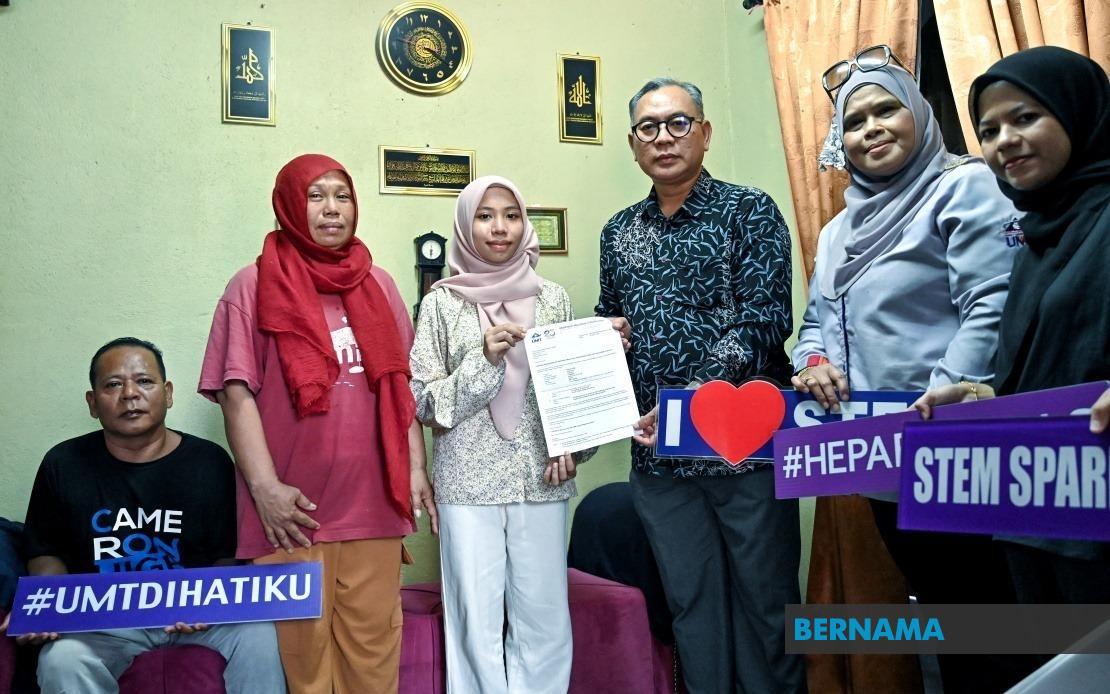
When 18-year-old Nurul Amira Abdul Hamid received her university offer, what should have been a moment of triumph threatened to become a heartbreaking setback. Her family lacked the means to cover enrolment and course fees, forcing her to contemplate declining an opportunity she had worked toward throughout her secondary education. Universiti Malaysia Terengganu (UMT) intervened at this critical juncture, transforming her prospects through targeted financial assistance that allowed her to pursue the one-year STEM Foundation programme leading to a Bachelor's degree in Science with specialisation in Nautical Science and Maritime Transportation.
The youngest of three children, Nurul Amira's household faced mounting pressures that made university attendance seem impossible. Her father, Abdul Hamid Othman, 58, struggled with health complications that reduced his earning capacity, while her mother, Asmah Che Ros, 53, managed household duties without external income. Following her completion of Sijil Pelajaran Malaysia (SPM) examinations, where she achieved three A-grades at Sekolah Menengah Kebangsaan Sri Kurau in Bagan Serai, Nurul Amira chose to enter the workforce rather than burden her parents further. Working at a retail goods store for RM1,300 monthly, she contributed directly to family expenses whilst contemplating whether higher education remained within reach.
Her proactive approach to resolving the dilemma proved decisive. Rather than accepting disappointment in silence, Nurul Amira contacted UMT directly to explain her circumstances and explore potential solutions. This direct communication opened pathways that institutional policies alone might not have revealed. The university responded affirmatively, securing the Al-Ikhlas Scholarship valued at RM500 in her name and arranging additional forms of assistance to substantially reduce her financial burden. Beyond the scholarship, UMT covered RM400 of her initial registration fees, demonstrating commitment to removing concrete barriers to enrolment.
UMT's intervention extended beyond one-time financial grants to encompass comprehensive living support throughout her academic journey. University leadership recognised that tuition fee assistance alone would prove insufficient if a student lacked resources for accommodation, meals, and study materials. By providing ongoing living allowances alongside scholarship funding, the institution enabled Nurul Amira to dedicate her attention entirely to coursework rather than navigating constant financial anxiety. This holistic approach reflects understanding that student success depends not merely on admission but on creating conditions where learning can flourish.
Universiti Malaysia Terengganu's Vice-Chancellor, Prof Dr Mohd Zamri Ibrahim, articulated the institution's philosophy during recent remarks about the assistance provided to Nurul Amira. He emphasised that UMT adopts an engagement-focused methodology by proactively meeting with students and families experiencing financial constraints. Rather than maintaining a passive stance where struggling students must independently navigate bureaucratic systems, the university positions itself as an active partner in problem-solving. This approach acknowledges that many talented young Malaysians face institutional systems that fail to accommodate their circumstances, and that universities possess both responsibility and capacity to bridge such gaps.
The Vice-Chancellor's public commitment extended to inviting all students facing affordability challenges to approach the university with confidence. He asserted that UMT would prioritise solutions through the various assistance mechanisms already embedded within institutional structures, signalling that financial difficulty need not result in educational exclusion. This messaging proves particularly significant in a Malaysian context where tertiary education remains economically inaccessible for substantial portions of the population, particularly those from rural or economically disadvantaged backgrounds. By publicly announcing willingness to accommodate such students, UMT potentially influences behaviour among other institutions and sends important signals to families that barriers can be overcome through dialogue.
The scale of UMT's intervention in this area appears more substantial than anecdotal assistance. During the current academic year, the institution has reportedly provided financial aid to more than ten students from economically disadvantaged family backgrounds. This suggests a structured, multi-student approach rather than occasional charitable gestures. The deliberate tracking of such assistance and public acknowledgement of this commitment indicates that UMT has institutionalised support for underprivileged students as part of core operations rather than treating it as peripheral social responsibility.
Nurul Amira's case illuminates broader patterns affecting Malaysian higher education access. The nation's secondary education system produces substantial cohorts of academically capable students, yet financial barriers prevent many from translating academic achievement into tertiary qualifications. Students who excel at SPM level—as Nurul Amira did with her three A-grades—should ideally progress to university regardless of family economic status. Yet absent intervention by institutions like UMT, able students regularly forego university education to work, reducing both individual lifetime earning potential and Malaysia's overall human capital development.
The maritime and nautical science specialisation that Nurul Amira will pursue holds particular significance for Malaysia. As a nation with extensive coastlines and a substantial maritime economy, Malaysia requires trained professionals in naval science, shipping, port operations, and maritime security. By enabling capable students to pursue such qualifications, UMT simultaneously serves individual advancement and national economic interests. The specialisation sits at the intersection of Malaysia's geographic advantages and skills gaps in maritime industries, making institutional investment in such students doubly valuable.
From a regional perspective, UMT's approach offers a model worthy of consideration by other Southeast Asian universities. Many countries across the region grapple with the tension between expanding higher education access and maintaining institutional financial sustainability. UMT's experience suggests that targeted assistance to qualified students from disadvantaged backgrounds need not overwhelm institutional budgets. By identifying struggling students early, engaging directly with families, and assembling assistance packages from multiple sources including named scholarships, universities can enable access without assuming unsustainable costs.
The human dimension of Nurul Amira's story carries weight beyond statistics. Her initial joy at receiving the university offer, followed by the despair of potential rejection, and finally the relief of institutional intervention, captures the emotional stakes involved in educational access for working-class Malaysian families. For her parents, watching their accomplished daughter progress to university despite their economic constraints provides validation that sacrifice and effort by the next generation receives recognition and support. These intangible benefits—hope restored, pathways opened, possibilities expanded—constitute outcomes difficult to quantify yet central to social mobility.
Looking forward, Nurul Amira's success will likely depend partly on whether UMT maintains the support that enabled her initial transition. Universities offering financial entry assistance sometimes fail to sustain such support through degree completion, leading to students withdrawing midway when funding lapses. UMT's stated provision of living allowances throughout her study period suggests institutional commitment to seeing her through to graduation. If this materialises, Nurul Amira will emerge as a university graduate equipped for professional roles in maritime industries, her potential no longer constrained by her family's economic starting point. Her trajectory would then exemplify how institutional commitment to equity produces tangible human development outcomes that benefit both individuals and Malaysian society broadly.

