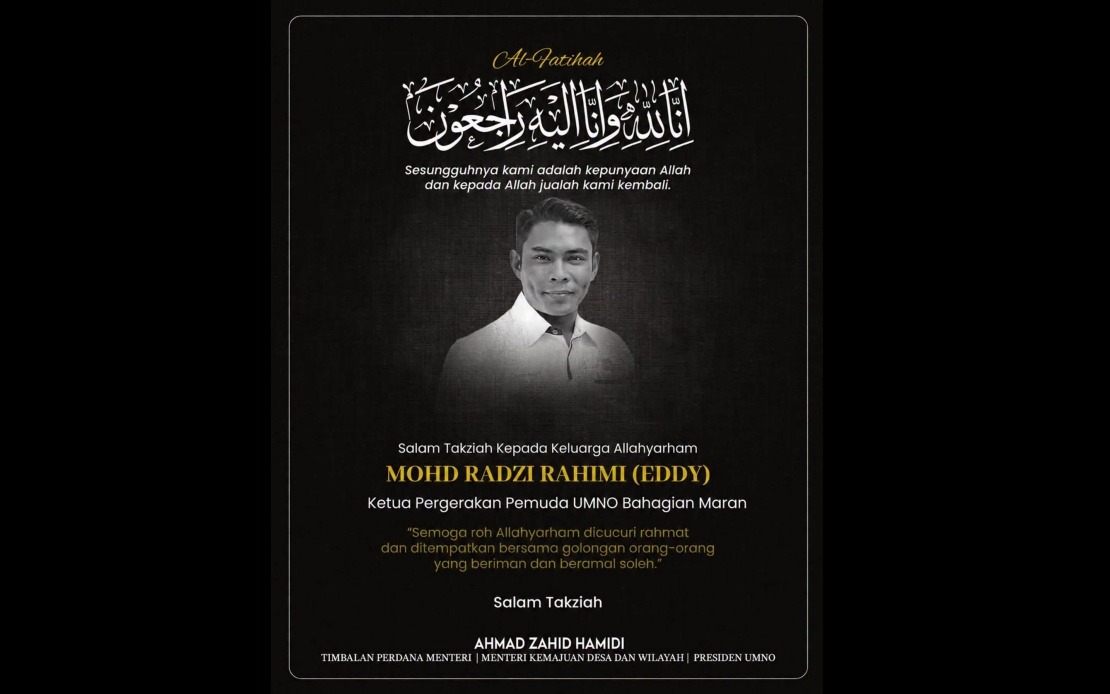
UMNO President Datuk Seri Dr Ahmad Zahid Hamidi has paid tribute to the memory of Maran UMNO Youth chief Mohd Radzi Rahimi following a devastating accident in Bentong that claimed multiple lives. The tragedy has sent shockwaves through the party hierarchy, with the senior statesman taking to social media to express his grief and solidarity with the bereaved family.
The accident, which occurred on August 3, claimed the lives of Mohd Radzi, his wife, and his brother-in-law when their vehicle was struck by a falling tree. A five-year-old child also perished in the incident, while another young boy believed to be the child's twin brother sustained injuries and was rushed to Bentong Hospital for medical treatment. The circumstances surrounding the tragedy underscore the unpredictable nature of road accidents in Malaysia, particularly in areas prone to inclement weather conditions.
In his statement conveyed through Facebook, Ahmad Zahid characterised Mohd Radzi's death as a significant blow to the broader UMNO organisation, particularly impacting the youth wing at both divisional and state levels. The UMNO president acknowledged the immense emotional toll the tragedy has exacted on Mohd Radzi's immediate family members, recognising that conventional expressions of sympathy may prove inadequate in the face of such profound loss.
Ahmad Zahid's public grief reflects the deep-rooted connections within UMNO's hierarchical structure, where youth leaders play crucial roles in party mobilisation and grassroots engagement. Mohd Radzi, at 40 years old, represented a vital bridge between party leadership and younger party members, tasked with channelling youthful energy into the party's electoral and organisational machinery. His premature death creates a void in the party's youth leadership that will require careful succession planning.
The Maran division, located within Pahang, represents one of the party's traditional strongholds in the state. The loss of a divisional youth chief there carries electoral implications, particularly as Malaysia approaches potential political contests. Youth wings serve as critical electoral assets for political parties, providing volunteer labour, voter mobilisation networks, and demographic representation in party councils and decision-making bodies.
Pahang UMNO, as a broader state organisation, has particularly felt the impact of this tragedy. The state has been central to UMNO's political calculations following recent political developments in Malaysia, and leadership transitions within state party structures can significantly influence intra-party dynamics and factional alignments. The timing of Mohd Radzi's death during what may be a critical period for party repositioning makes the loss even more consequential.
The tragedy also highlights broader road safety concerns in Malaysia, where vehicle collisions caused by falling objects, weather-related incidents, and poor infrastructure conditions continue to claim lives. The involvement of children in this particular accident adds a layer of community-wide concern about transport safety standards and emergency response capabilities in smaller towns and rural areas.
Ahmad Zahid's invocation of religious consolation through his reference to Allah SWT reflects common Malaysian cultural practices in expressions of condolence, extending beyond political boundaries into the realm of shared spiritual values. This religious dimension of his public statement serves to universalise the grief, appealing to the broader Muslim community of which most UMNO members are part.
The death of Mohd Radzi occurs within a broader context of UMNO's recent organisational challenges and leadership consolidation efforts. The party has undertaken various structural reforms and leadership transitions in recent years, and the loss of mid-level organisers and youth leaders can complicate efforts to rebuild party cohesion and grassroots strength. Successor appointments to key divisional and youth positions will become necessary, presenting opportunities for factional manoeuvring within the party hierarchy.
For Malaysian political observers, this incident underscores the human cost of road accidents that claim not merely individual lives but also disrupt institutional continuity within political organisations. The party will need to balance mourning with pragmatic succession planning, ensuring that the loss of institutional knowledge and leadership capacity does not undermine party effectiveness. The broader Malaysian public may view this tragedy as part of a larger conversation about road safety infrastructure and emergency preparedness in the country.

