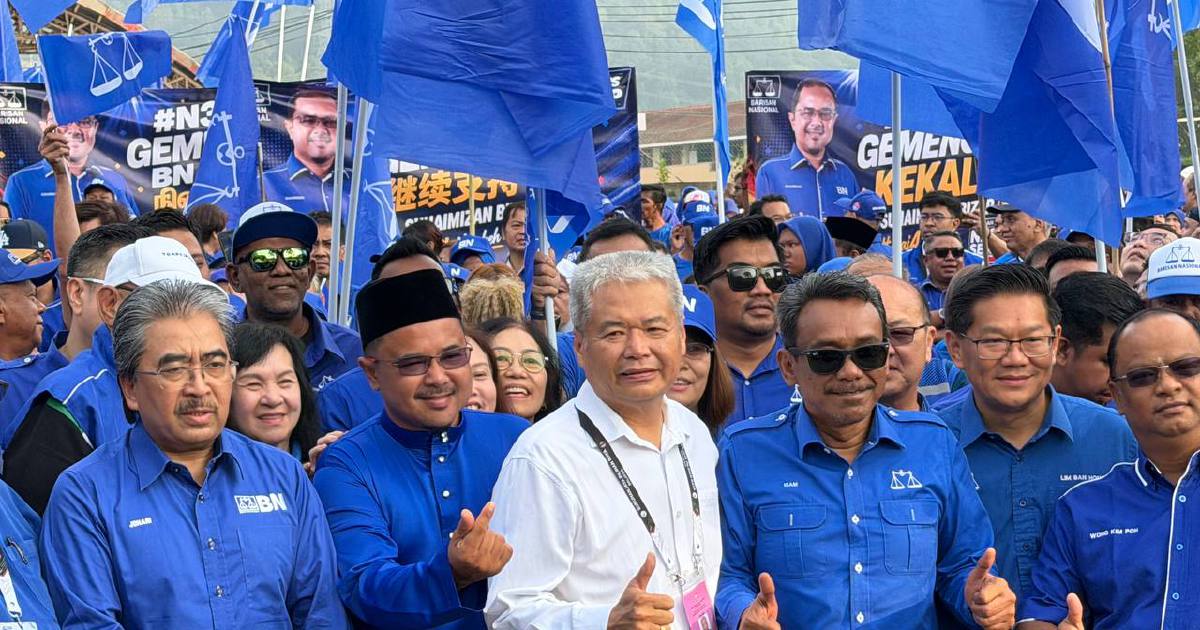
Umno's senior leadership descended on Tampin this morning in a coordinated show of strength, with vice-president Datuk Seri Johari Abdul Ghani and party treasurer Datuk Seri Tengku Adnan Tengku Mansor appearing at Dewan Perdana Tampin to accompany Barisan Nasional candidates filing their nomination papers for the Negri Sembilan election. The high-profile presence underscored the ruling coalition's intent to maintain its grip on the southern state, where electoral fortunes have grown increasingly uncertain amid broader shifts in Malaysian politics.
The appearance of both figures carries significant weight within Umno's internal hierarchy and reflects the party's determination to project unity at a critical juncture. Johari, who holds the second-highest position in Malaysia's largest political organisation, and Tengku Adnan, custodian of party finances, represent complementary dimensions of Umno's institutional authority. Their joint attendance suggests that the nomination process for Negri Sembilan candidates warranted coordination at the apex of party leadership, rather than delegation to lower-ranking officials.
Negri Sembilan holds particular strategic importance for Barisan Nasional, having served as a reliable coalition stronghold since independence. The state's political dynamics, however, have become more fluid in recent years, with opposition parties increasingly challenging BN's traditional dominance. The nomination phase represents a crucial moment for candidates to secure their positions and begin the intensive campaign period leading up to polling day. Having prominent party figures present serves both practical and symbolic purposes: it energises candidate morale, sends signals to grassroots workers about party confidence, and provides media moments that reinforce the coalition's organisational coherence.
For Malaysian readers accustomed to tracking intra-party dynamics and factional alignments, the attendance of these two senior figures carries additional interpretive weight. Both men have navigated Umno's fractious politics over recent years, and their collaborative appearance suggests a degree of coordination across different spheres of influence within the party apparatus. Umno's treasurer role, traditionally occupied by figures with significant financial and patronage networks, places Tengku Adnan in a position to influence how campaign resources flow to individual candidates and constituencies.
The context of this nomination event extends beyond the mechanics of electoral procedure. Negri Sembilan's governance in recent years has reflected broader regional patterns, including the challenge of maintaining political stability while managing economic and social pressures. The state government's capacity to deliver on constituencies' expectations regarding infrastructure, employment, and service delivery directly influences voter calculations. By positioning themselves prominently alongside candidates, Umno's leaders implicitly stake their party's record and vision for the state's future.
Barisan Nasional's electoral strategy in Negri Sembilan must account for several complicating factors beyond internal party management. The coalition comprises multiple component parties representing different communities and constituencies, requiring careful coordination to prevent vote fragmentation. Perikatan Nasional's activities in the state, including inroads by Pas and Bersatu, represent a significant challenge given that both these parties draw from overlapping electoral bases with Umno. The nomination process therefore marks the beginning of the coalition's effort to consolidate support and defend marginal seats.
The Dewan Perdana Tampin venue itself holds administrative significance as a key nomination centre, likely serving multiple parliamentary or state constituencies. The choice to concentrate party leadership there early in the nomination period suggests deliberate orchestration of the campaign narrative. Media presence at such events generates coverage that extends the reach of the messaging well beyond those physically present, amplifying the signals that senior leadership intends to transmit about party readiness and candidate quality.
Regional observers monitoring Malaysian politics will note that the appearance reflects BN's persisting ability to mobilise organisational structures and senior personnel despite the coalition's fluctuating electoral fortunes nationally. Negri Sembilan, whilst not historically decisive in determining federal outcomes, nevertheless serves as a bellwether of grassroots sentiment within the Malay-Muslim majority demographic that forms the core of Umno's support base. Strong performance here might reinvigorate the coalition's confidence ahead of more consequential electoral contests.
The nomination proceedings themselves establish the formal framework for the subsequent campaign period, with timing, candidate selection, and the overall organisational tempo all communicating implicit messages to voters about which races the ruling coalition considers genuinely competitive. The attendance of figures like Johari and Tengku Adnan at Tampin implicitly signals that multiple constituencies in the area merit elevation to serious campaign priority. This targeting of resources and attention shapes the eventual competitiveness of individual races and influences which battles will ultimately prove decisive in determining the state election's outcome.
Looking ahead, the next weeks will reveal whether this demonstration of Umno leadership unity translates into cohesive ground operations, effective messaging, and candidate performance during the campaign itself. Nomination attendance, whilst symbolically important, ultimately proves secondary to the quality of campaign execution, candidate messaging, and the coalition's capacity to address voter concerns about governance and service delivery that accumulate over an electoral cycle.

