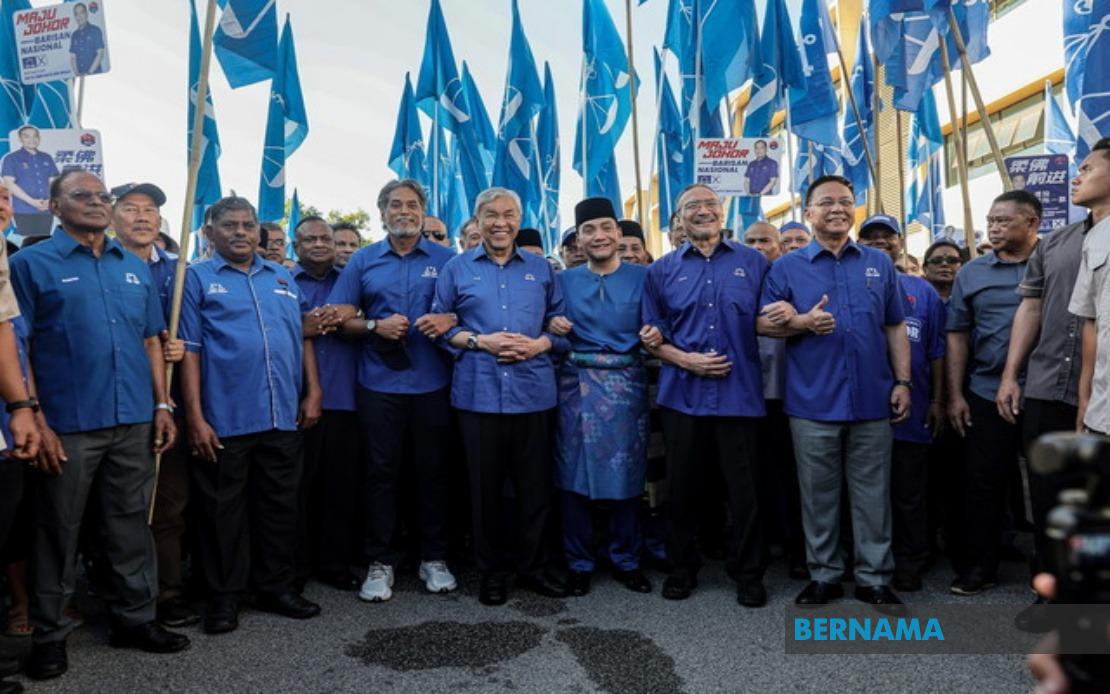
Johor's ruling coalition showed a united front as Barisan Nasional chairman Onn Hafiz Ghazi formally entered the state election race on Wednesday morning, submitting his nomination papers at the Muafakat Hall of the Simpang Renggam District Council at 9.10 am. The move marked the official commencement of what is shaping up to be a fiercely contested battle for control of the southern state, with the incumbent Machap assemblyman seeking to retain his seat amid broader coalition ambitions.
The high-profile turnout of UMNO's upper echelon underscored the significance of the Johor contest within the party's broader political strategy. UMNO president Datuk Seri Dr Ahmad Zahid Hamidi, Sembrong MP Datuk Seri Hishammuddin Tun Hussein, and former minister Khairy Jamaluddin all travelled to Simpang Renggam to stand alongside Onn Hafiz during the nomination filing. The presence of these senior figures, each commanding substantial influence within UMNO's machinery and the broader federal government apparatus, sent a deliberate message of organisational cohesion and determination to retain Johor as a critical BN stronghold.
The gathering also featured former Johor Menteri Besar Datuk Seri Hasni Mohammad, whose appearance reinforced the connection between the incumbent state leadership and established BN networks in Johor. Hasni's involvement signalled continuity with the previous state administration and provided an institutional bridge between the present campaign and the party's historical base of support in the state. This layering of political seniority—combining current federal office holders, state-level figures, and elder statesmen—reflected the meticulous choreography that typically accompanies high-stakes electoral contests within Malaysia's dominant coalition.
The nomination centre became a focal point of grassroots enthusiasm as supporters gathered in the surrounding area, their presence made visible through traditional campaign markers such as party colours, banners, and flags. This ground-level energy, evidenced by the crowds assembling to witness the formal filing, suggested that campaign machinery had already been mobilised in anticipation of the election proper. For BN, particularly UMNO, maintaining such visible enthusiasm is essential to demonstrating to grassroots members and the broader electorate that the party retains organisational vitality and popular backing.
Onn Hafiz's nomination filing represents a critical juncture in Johor's electoral calendar, as the state election represents one of the most strategically important polls in the Malaysian political system. Johor has historically served as a crucial power base for UMNO and BN, and control of the state apparatus carries implications for resource allocation, patronage networks, and political momentum heading into broader federal calculations. The state's electoral significance is magnified by its geographic position, population size, and economic importance within Malaysia's federal structure.
The nomination process itself, while procedurally routine, carries symbolic weight within Malaysian electoral contests. The formal registration of candidates at designated nomination centres creates a concrete moment at which political parties can mobilise their support structures and communicate internal unity to the electorate. The attendance of multiple senior party figures transforms what could be a perfunctory administrative process into a media event and a signal of seriousness and commitment. For UMNO, a party that has undergone significant political turbulence in recent years, such visible displays of leadership cohesion carry particular value in reassuring members and supporters of the organisation's stability.
The election itself represents a test of BN's capacity to sustain its traditional dominance in Johor against opposition forces that have demonstrated increasing organisational sophistication. The decision to accompany Onn Hafiz with such a concentration of senior talent suggests that BN strategists recognise the potentially competitive nature of the contest and are determined to deploy their most capable figures in support of the incumbent administration. This resource commitment indicates the perceived stakes involved in the Johor election, both in terms of state-level governance and the broader positioning of BN within Malaysia's evolving political landscape.
The gathering at Simpang Renggam also provides a window into the current factional alignments within UMNO, with the prominent participation of Ahmad Zahid, Hishammuddin, and Khairy suggesting cohesion among important party constituencies. These three figures represent different constituencies within UMNO's broader coalition—Ahmad Zahid as party president, Hishammuddin as a senior federal minister with deep institutional roots, and Khairy as a modernising voice within the party. Their joint appearance alongside Onn Hafiz suggests an alignment around the need to secure Johor, transcending some of the internal disagreements that have periodically surfaced within UMNO's ranks.
For Malaysian voters in Johor and beyond, the nomination filing marked the practical beginning of the campaign period, signalling that the state would occupy significant media and political attention in coming weeks. The scale and visibility of BN's nomination-day mobilisation provides early indications of the resources and attention that the coalition intends to devote to retaining its control of the state government. As the election campaign progresses, the patterns established during nomination filings often provide reliable indicators of which parties view the contest as strategically critical and which possess the organisational capacity to mount sustained campaigns.

