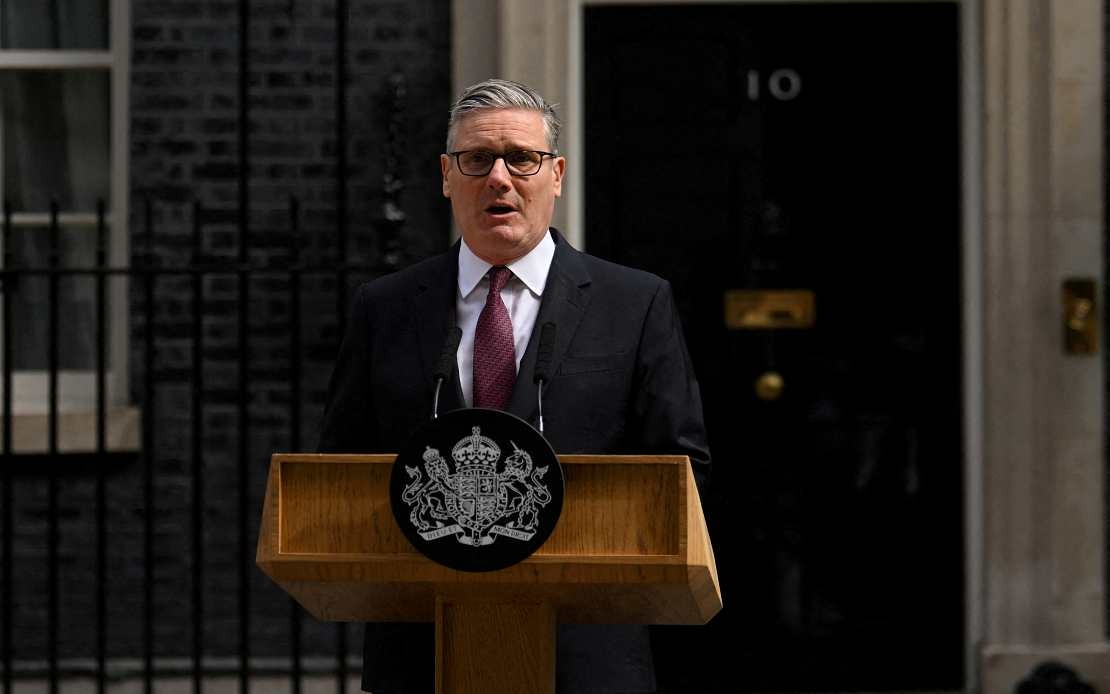
Prime Minister Keir Starmer announced on Monday that he will resign as leader of the Labour Party, with a new leader expected to take office by the time parliament returns in September. The decision marks a dramatic reversal in fortune for a leader who secured a commanding electoral mandate less than two years ago, when voters appeared eager to restore stability to British governance after years of Conservative-led turbulence.
Starmer's commitment to depart represents the culmination of escalating internal party pressure that had been building steadily over recent months. The situation reached a critical point on Friday when Andy Burnham, the Mayor of Greater Manchester, decisively won a parliamentary seat in a closely watched by-election, defeating a candidate fielded by Nigel Farage's Reform UK party. This electoral success energised Labour members who believe Burnham possesses the skills and political acumen needed to reverse their party's declining fortunes and reconnect with an increasingly frustrated electorate.
The contrast between Starmer's fall and his earlier triumph illustrates the precarious nature of political capital in contemporary Britain. Once celebrated as a reformer pledging to end decades of political dysfunction, Starmer has experienced a dramatic collapse in public approval ratings. Polling data now shows him registering approval levels lower than any other serving British prime minister—a stunning decline that reflects widespread public disappointment with the government's inability to meaningfully improve living standards or restore functionality to stretched public services.
Burnham, a seasoned politician with established credentials in Westminster, brings a different public profile to potential leadership. Known for his communication abilities and streetwise political instincts developed through his Greater Manchester mayoral tenure, he represents a generational alternative within the party hierarchy. However, questions linger about his detailed policy vision across critical government portfolios. Beyond his rhetoric about delivering structural economic transformation and addressing the cost-of-living crisis affecting ordinary British households, Burnham has not articulated comprehensive positions on foreign policy, economic management, or defence strategy.
The fiscal predicament confronting any incoming Labour leader presents formidable constraints that may limit genuine policy options. Britain currently bears the heaviest borrowing costs among major Group of Seven economies, a consequence of accumulated sovereign debt burdens, elevated debt-servicing expenses, and lacklustre economic expansion spanning multiple years. These structural vulnerabilities have forced policymakers into difficult trade-offs between essential public investment—particularly in defence capabilities—and fiscal consolidation demanded by international bond market participants.
Financial markets remain sceptical about a potential Burnham administration, particularly given his previous statements questioning Britain's dependence on investor confidence. Burnham remarked in September that the country needed to break free from being "in hock to the bond markets," a comment that raised concerns among institutional investors. Major financial institutions like Citibank have warned that Burnham would inherit an exceptionally tight fiscal position offering minimal latitude for transformative policy implementation, despite his apparent appetite for substantial change.
The underlying crisis driving Starmer's departure reflects deeper malaise afflicting British democracy. Successive governments have failed to deliver tangible improvements to household finances, restore adequate funding for healthcare and education, or establish coherent immigration policies capable of addressing public anxieties about demographic change. This cumulative failure has generated legitimate anger among voters who perceive systemic dysfunction despite repeated changes in political leadership.
The pace of executive turnover at 10 Downing Street has reached historically extraordinary levels. Starmer will be Britain's seventh prime minister since the 2016 Brexit referendum, a concentration of leadership changes unparalleled across nearly two centuries of parliamentary history. This volatility underscores the profound difficulty any government faces in satisfying an increasingly sceptical and disappointed electorate confronting stagnant real wages, deteriorating public infrastructure, and a perceived loss of national competence.
Observers including political advisory organisations like Eurasia have suggested that a managed transition during the summer months would optimally serve Britain's broader interests. This arrangement would permit Starmer to participate in scheduled UK-European Union reset discussions planned for July, while providing Burnham adequate preparation time for assuming executive responsibilities. The orderly approach, proponents argue, could also offer breathing room for the party machinery to conduct a formal leadership selection process rather than managing a crisis-driven succession struggle.
Starmer's announcement that he will support whoever emerges from the leadership contest signals his desire to facilitate an orderly democratic process within party structures. Yet the decision to depart marks a sobering assessment of political viability in an environment where public confidence has eroded fundamentally. For Malaysian observers and Southeast Asian policymakers watching Westminster developments, the British experience offers cautionary lessons about the fragility of electoral mandates and the immense difficulty of implementing meaningful reform when financial market constraints and public scepticism converge.