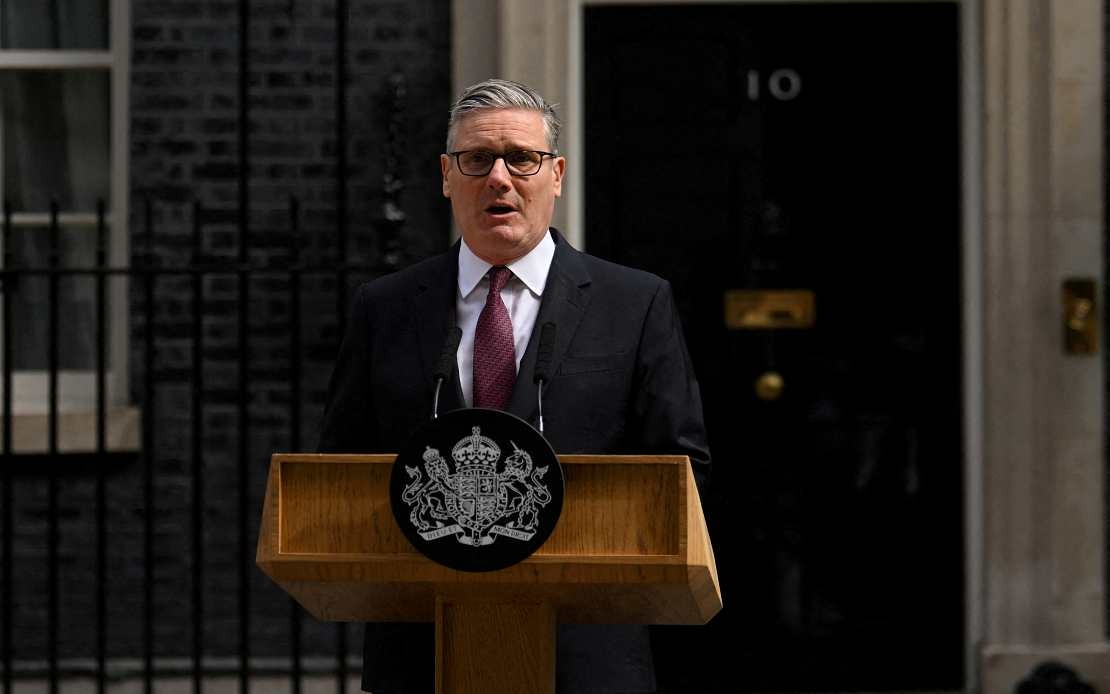
British Prime Minister Keir Starmer delivered a forceful call on Monday for the rapid restoration of ceasefire arrangements between Iran and the United States, as tensions in the strategically vital Strait of Hormuz intensify following a weekend exchange of military strikes. Speaking at a joint press conference in Paris alongside leaders from France, Germany, and Ukraine, Starmer condemned what he characterised as Iranian attacks on merchant vessels and regional partners, insisting that such actions must cease immediately and that diplomatic channels must be reopened.
The timing of Starmer's intervention underscores the gravity of the situation for Western allies and global trade. The Strait of Hormuz remains one of the world's most critical maritime chokepoints, with roughly one-fifth of all globally traded oil passing through its waters annually. For Southeast Asian economies like Malaysia, Singapore, and Indonesia that depend heavily on Middle Eastern energy supplies and rely on stable shipping corridors for their own exports, any prolonged disruption carries immediate economic consequences. The narrow waterway's vulnerability to disruption has long been recognised as a strategic vulnerability in global commerce, and recent developments suggest those risks are becoming acute rather than theoretical.
Starmer's statement directly condemned Iran's assault on commercial shipping operations and attacks affecting Gulf nations allied to the West. He positioned Britain alongside France and Germany in emphasising the need for unrestricted freedom of navigation through the strait—a principle that carries weight beyond diplomatic rhetoric, as it underpins the entire system of international maritime law that governs global trade. His assertion that "we are ready" to deploy naval assets represents a tangible commitment to enforce this principle, signalling Western determination to keep the waterway open despite Iranian efforts to restrict passage.
The escalation appears to have been triggered by a renewal of US-Iran hostilities over the weekend. President Donald Trump announced that the United States would reinstate a blockade targeting Iran and would charge vessels a fee for safe passage through the Strait of Hormuz—a declaration that fundamentally alters the calculus of regional maritime commerce. This approach marks a significant departure from established international norms governing freedom of navigation and suggests a more confrontational stance toward containing Iranian influence in the region.
The current crisis carries echoes of an earlier conflict that formally concluded in June. Iran had effectively sealed the Strait of Hormuz during the US-Israeli military campaign that commenced in late February, creating severe disruptions to global energy markets and triggering concerns about wider regional escalation. A memorandum of understanding intended to terminate that conflict was signed in June, raising hopes that the critical waterway would fully reopen and that a period of relative stability might follow. Those hopes now appear premature, with the situation deteriorating faster than international stakeholders anticipated.
For Malaysia and other Southeast Asian nations, the implications extend well beyond immediate shipping disruptions. The region's economies are deeply integrated into global supply chains dependent on Middle Eastern energy and stable transit corridors. Any prolonged instability in the Strait of Hormuz threatens to elevate fuel costs, disrupt manufacturing schedules, and create broader inflationary pressures across the region. Additionally, if Western military assets are mobilised to enforce freedom of navigation, the risk of direct confrontation between major powers in a crucial strategic zone rises significantly, creating second-order risks that could ripple across Asia-Pacific shipping lanes and insurance markets.
Starmer's emphasis on negotiations reflects recognition among Western capitals that military escalation, while a last resort, would carry catastrophic consequences for global stability and prosperity. His insistence that dialogue must centre on "remaining issues" suggests that the June ceasefire framework, while incomplete, provides a foundation upon which to rebuild accord. However, the gap between formal agreements and practical implementation remains substantial. Both Washington and Tehran have shown willingness to resume hostilities, indicating that trust has eroded significantly and that any new arrangement would require robust verification mechanisms and international guarantees.
The involvement of France and Germany in Starmer's joint statement signals European concern about the trajectory of US-Iran relations and the broader Middle Eastern situation. Europe, which has significant economic interests in stable regional conditions and which imports substantial energy supplies, faces pressure to contribute diplomatically and potentially militarily to preventing full-scale conflict. Yet European capitals also recognise the limitations of their leverage over both Washington and Tehran, creating a delicate balancing act between maintaining transatlantic solidarity and pursuing independent diplomatic initiatives.
The mention of Ukrainian leadership in the coalition meeting adds another layer of complexity. While Ukraine's primary focus remains its own survival and territorial integrity, the broader Western coalition coordination on the Iran question reflects how geopolitical challenges have become increasingly interconnected. Support for Ukraine requires maintaining cohesion among Western allies, and that cohesion becomes strained if Middle Eastern crises consume diplomatic attention and military resources.
For Southeast Asian policymakers, the unfolding situation presents both challenges and opportunities. The region's commitment to non-alignment and its strategic hedging between great powers means that nations like Malaysia must carefully calibrate their positions. Supporting freedom of navigation aligns with regional interests in stable shipping corridors, yet overt alignment with Western efforts to contain Iran could complicate relationships with other significant regional players and with Iran itself, which maintains considerable influence in the Islamic world and in energy markets.
The coming weeks will prove decisive in determining whether Starmer's diplomatic appeal succeeds or whether renewed escalation becomes the default trajectory. International mediators, potentially including countries with good relations with both Washington and Tehran, will be essential to bridging the gap. The stakes extend far beyond the immediate combatants, touching every economy dependent on Middle Eastern energy and on the functioning of global maritime commerce. For Southeast Asia, closely monitoring these developments and preparing contingency plans for extended shipping disruptions represents a prudent course of action.

