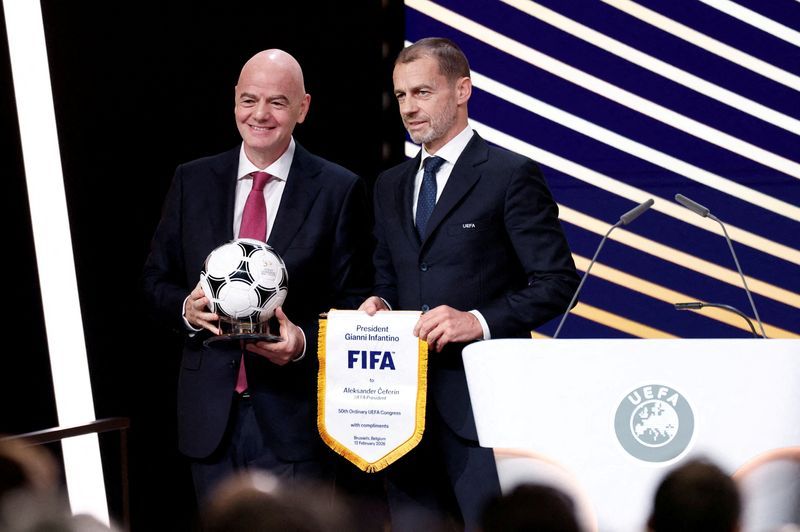
UEFA has initiated legal proceedings in the United States to gather evidence for a Swiss criminal investigation into FIFA President Gianni Infantino's handling of a controversial commercial rights proposal that threatened to destabilise global football. The European confederation has asked a federal court in Florida for permission to obtain testimony and documents from FIFA entities based in that state, materials it intends to use in support of a criminal complaint being prepared in Switzerland. The move represents an unprecedented escalation in tensions between world football's governing body and its most influential continental confederation.
At the centre of the dispute lies the FIFA Forward Enterprise (FFE) proposal, an ambitious scheme that would have transferred commercial rights linked to the men's and women's World Cups and the Club World Cup into a newly created subsidiary. According to UEFA's court filing, Infantino conceived this plan in secret alongside a small circle of advisers and outside investors, fundamentally circumventing FIFA's established governance structures. The confederation alleges that the FIFA Council, regional confederations, and FIFA's 211 member associations were deliberately excluded from the development process, contrary to FIFA's constitutional requirements for such consequential decisions affecting the organisation's commercial assets.
The alleged misconduct forms the basis of what UEFA describes as criminal mismanagement under Article 158 of the Swiss Criminal Code. UEFA's legal challenge specifically targets two Florida-based FIFA entities: FIFA (AMERICAS), Inc. and FWC2026 US, Inc., from which it seeks discovery of documents and testimony illuminating how the FFE transaction was conceived, structured, valued, and approved. This cross-border legal strategy reflects the complexity of investigating FIFA's operations, which span multiple jurisdictions and involve intricate financial arrangements. For Malaysian and Southeast Asian observers, the case underscores how governance failures at international sporting institutions can trigger formal legal mechanisms and challenge executive authority previously considered largely insulated from external oversight.
The FFE proposal itself centred on attracting external investment capital to bolster football development programmes worldwide. Infantino previously characterised the initiative as a "golden opportunity" to expand funding for grassroots and developmental activities. However, UEFA's analysis of the financial structure raises fundamental questions about whether FIFA genuinely needed external investors. The European body points out that FIFA maintains billions of dollars in reserves—monies it argues rightfully belong to member associations rather than serving as collateral for private investor stakes. This raises a crucial question about institutional purpose: why would the FIFA President seek outside capital at the expense of member association control and financial transparency?
The commercial valuation underlying the FFE proposal particularly concerns UEFA. According to the filing, investors were prepared to pay $4.2 billion for their stake, implying a total enterprise value of approximately $20 billion for FIFA's commercial rights. UEFA contends this valuation substantially underestimated the true worth of these assets and that the transaction bypassed standard procedures such as open competitive bidding or independent valuation assessment. Rather than permitting the market to establish fair value, the negotiation apparently occurred behind closed doors with a handpicked investor group led by Thrive Eternal, an investment vehicle controlled by Joshua Kushner and affiliated with Thrive Capital. This selective process deprived FIFA's membership of transparency and competitive discipline ordinary financial institutions would impose.
The proposal's genesis in July crystallised resistance across world football with remarkable speed. UEFA's 55 member associations convened in emergency session on July 30 and unanimously resolved to withdraw from all FIFA competitions, including the World Cup, unless the FFE plan was abandoned. This extraordinary show of unity—securing unanimous support from a diverse group of national associations with varying interests and political orientations—demonstrated the severity of concerns about procedural integrity and governance violations. The threat of European withdrawal from FIFA competitions would have been catastrophic for the organisation's financial stability and sporting calendar, forcing Infantino to reverse course within 24 hours. By July 31, FIFA formally abandoned the proposal.
Despite withdrawal, UEFA insists that critical questions remain unresolved. The confederation has demanded comprehensive external investigation into how the proposal was developed and advanced, explicitly rejecting FIFA's capacity to investigate itself. UEFA also raised concerns about reported internal dissent within FIFA's bureaucracy, noting that staff members complained they had been misled and that FIFA Secretary General Mattias Grafstrom appeared to have been deliberately excluded from drafting discussions. These allegations suggest institutional dysfunction extending beyond the proposal itself, indicating potential systemic governance weaknesses that could permit future abuses of presidential authority. For Southeast Asian football associations—many of which depend on FIFA's financial distributions and competitive structures—such governance failures threaten the organisation's legitimacy and decision-making capacity.
Infantino, who announced his intention to seek a fourth term in the March 2027 presidential election, retains substantial political support despite the FFE controversy. The African and South American confederations have maintained backing, and the Saudi Arabian Football Federation explicitly endorsed his continued leadership. This geographic split in political support—with Europe opposed and Africa and Asia-Pacific regions more supportive—reflects competing interests within FIFA's membership. Wealthier, more developed football nations tend to oppose Infantino's initiatives, whereas less-resourced confederations may view him favourably due to his efforts to distribute FIFA revenues more broadly through development programmes. This dynamic creates a complex political landscape for the March 2027 election and affects how FIFA reform processes might unfold.
UEFA has committed to pursuing every available institutional, political, and legal avenue to secure governance reforms and restore constraints on presidential authority. The confederation has also warned that should Infantino contest the 2027 presidency, UEFA would coordinate with partner confederations to present member associations with reform-oriented alternative candidates. This represents a direct political challenge to Infantino's anticipated re-election bid and signals UEFA's intention to reshape FIFA's power structures fundamentally. The Swiss criminal investigation, coupled with UEFA's legal discovery efforts in American courts, creates reputational and legal jeopardy for Infantino personally and may influence how member associations weigh leadership alternatives when the election approaches.
For Malaysian and Southeast Asian football stakeholders, this unfolding saga carries profound implications. The dispute exposes tensions between FIFA's centralised presidential authority and the collective interests of its dispersed membership. How FIFA resolves governance questions—whether through genuine democratic reform or through compromise that preserves executive discretion—will shape the organisation's credibility and effectiveness in serving its constituent members. Malaysian football administrators watching these developments will assess what protections exist for smaller confederations' interests in global football governance structures and whether FIFA's institutional checks and balances can prevent future proposals that benefit narrow circles at the expense of broader membership interests.

