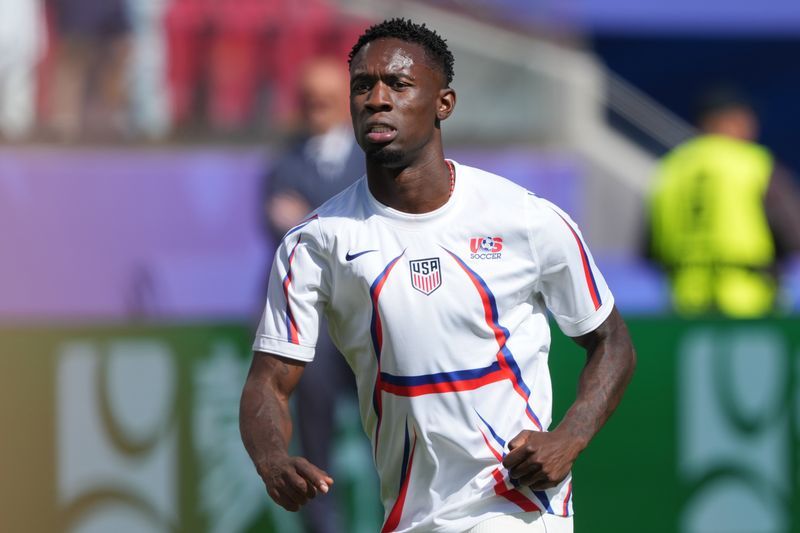
European football's governing body UEFA has launched a scathing critique of FIFA's handling of the Folarin Balogun disciplinary case, describing the decision to suspend the American striker's red-card ban as fundamentally damaging to the sport's credibility. The controversy erupted after US President Donald Trump personally contacted FIFA president Gianni Infantino requesting that the organisation review Balogun's dismissal from a World Cup match, prompting FIFA to take the extraordinary step of delaying implementation of the player's automatic suspension through a probationary period spanning one year.
In a statement released on Monday, UEFA expressed profound dismay at what it characterised as an entirely unprecedented action by world football's governing body. The European confederation asserted that FIFA had "crossed a red line" by essentially rewarding political pressure rather than adhering to established disciplinary protocols. UEFA's particularly pointed language—describing the decision as "incomprehensible and unjustifiable"—signals the depth of concern within European football circles that FIFA has compromised its impartiality in favour of geopolitical considerations.
The stakes underlying UEFA's complaints extend well beyond a single player's participation in one match. The European body emphasised that when regulatory certainty becomes negotiable based on external pressure, the foundational integrity upon which all competitive sport depends begins to erode. This concern resonates particularly strongly in European football, where strict adherence to rules has traditionally been viewed as essential to maintaining fair competition across diverse leagues and tournaments. UEFA's statement articulated a broader anxiety that FIFA's willingness to accommodate presidential intervention sets a dangerous precedent that could invite similar appeals whenever powerful nations face disadvantage through standard disciplinary measures.
Balogun, who had contributed three goals during the tournament before his dismissal, was sent off following a video assistant referee review for an incident during the United States' round-of-32 victory against Bosnia. The specific infraction involved dragging his cleats across the back of Bosnia defender Tarik Muharemovic's leg and onto his foot—a contact that the on-field referee deemed sufficiently serious to warrant a red card. Under normal World Cup regulations, this automatic suspension would have prevented Balogun from participating in Monday's highly consequential round-of-16 encounter against Belgium.
FIFA's solution—suspending implementation of the ban while technically keeping the red card on the player's record—created a peculiar middle ground that satisfied nobody. The decision neither fully exonerated Balogun nor maintained the standard consequences for violent conduct, instead introducing an unprecedented category of conditional disciplinary status. This approach appeared designed to defuse immediate political pressure without openly reversing the original decision, yet it achieved neither objective and instead amplified controversy surrounding the decision-making process itself.
The Belgian football association's response underscored the international dimension of FIFA's misstep. The Royal Belgian Football Association stated it was genuinely astonished by the outcome, recognising that Belgium's prospects in the tournament were materially affected by the unavailability of a penalty dispensed according to established rules. According to reporting by The Athletic, Belgium subsequently submitted a formal appeal to FIFA, seeking clarification or reversal of the suspension decision and registering official protest against what the association viewed as discriminatory treatment based on political rather than sporting considerations.
Trump's direct intervention into FIFA's decision-making process represented an unusual intrusion of national executive authority into international sports governance. By personally requesting that Infantino reconsider Balogun's case, the US President created the appearance—if not the reality—that FIFA's independence had been compromised. This dynamic proved particularly problematic given FIFA's long-standing struggles to maintain credibility following previous scandals involving corruption allegations, opaque governance, and perceived favouritism toward larger football markets.
The Balogun affair also illuminates broader tensions within international football regarding how the sport balances sovereignty and standardisation. FIFA maintains regulatory authority over World Cup competition precisely because member nations agreed to subordinate their immediate interests to universal rules that theoretically apply equally to all participants. When those rules are suspended for one nation following diplomatic pressure, other members rightfully question whether FIFA can impartially govern the tournament or whether its regulatory framework has effectively become negotiable through political channels.
For Malaysian readers and Southeast Asian football followers, this episode carries implications for how regional players and teams might expect to be treated under FIFA's jurisdiction. The Balogun decision suggests that FIFA's commitment to consistent rule enforcement may be weaker than officially claimed, and that national government intervention—if exercised by sufficiently influential actors—could alter disciplinary outcomes that were already determined through established procedures. This concern gains weight in a region where smaller football nations might hope to compete on genuinely equal terms with larger global powers.
The credibility questions raised by this incident extend into FIFA's broader governance framework at a moment when the organisation faces increasing scrutiny over integrity issues. European football's powerful response, articulated through UEFA's uncharacteristically forceful statement, suggests that continued weakness or perceived bias in FIFA's decision-making could fragment football's international governance structure. UEFA member nations have demonstrated repeatedly that they will pursue alternatives—whether continental competitions or regulatory autonomy—if FIFA cannot maintain standards that they consider essential to the sport's credibility.

