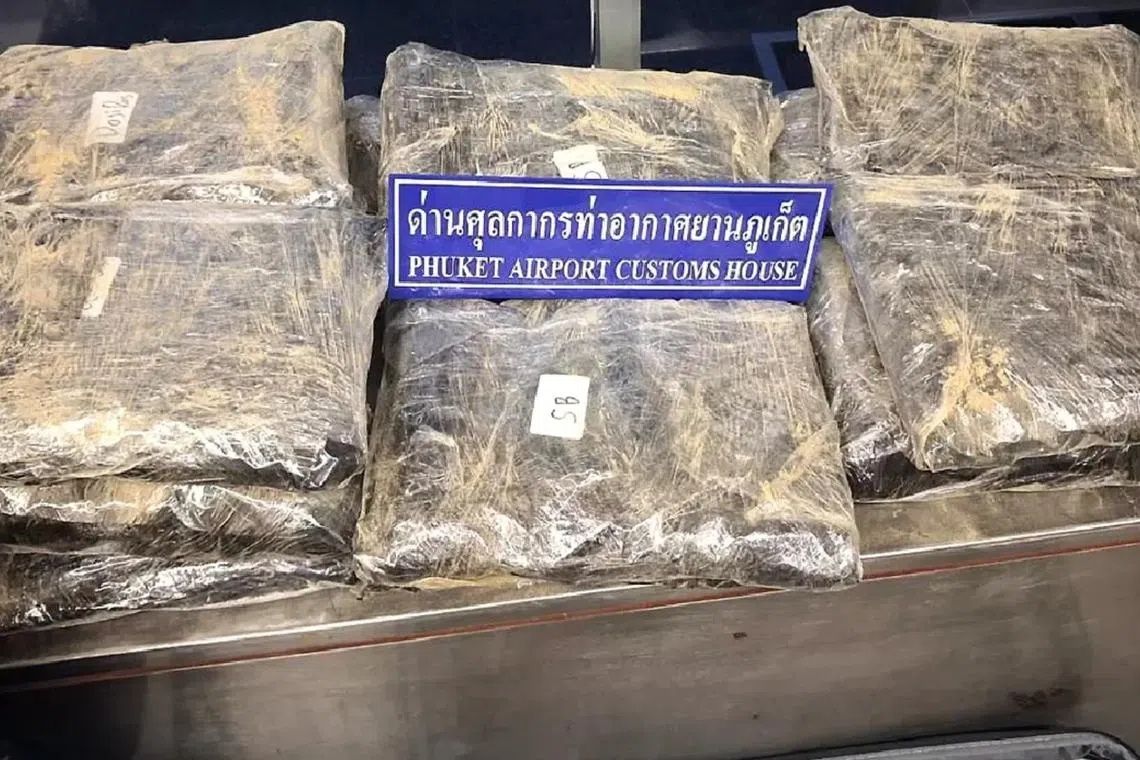
Phuket's international airport became the site of a significant drug smuggling operation on Thursday when customs and police officers uncovered 32 kilograms of cannabis concealed across two separate suitcases belonging to women attempting to leave Thailand. The parallel arrests, executed by staff from Phuket Airport Customs House working alongside Sakhu Police Station in the international departures terminal, signal intensifying enforcement efforts to stem the flow of controlled substances through Southeast Asia's transportation hubs. The discoveries underscore the persistent challenge airports across the region face in combating organised narcotics trafficking, which continues to exploit traditional smuggling routes despite mounting security measures.
The first suspect to be detained was Levannah Chelsea Guzman, an 18-year-old Filipino national, who was apprehended at approximately 11 in the morning. Officers inspecting baggage encountered a black Pierre Cardin suitcase that triggered suspicion, leading them to conduct a thorough examination. Within the luggage, they discovered 14 vacuum-sealed packages containing cannabis flowers, collectively weighing 14.5 kilograms including the packaging material. Upon interrogation, Guzman acknowledged full ownership of both the suitcase and its entire contents, a confession that would form a substantial part of the legal case against her.
The charges filed against Guzman encompass multiple legislative breaches reflecting Thailand's multifaceted approach to drug control and border enforcement. Her alleged infraction of attempting to transport goods internationally without completing proper customs clearance procedures violates the Customs Act BE 2560 (2017), the foundational statute governing the movement of merchandise across borders. Additionally, authorities invoked the Narcotics Code, which forms Thailand's primary legal framework for controlling substances classified as dangerous drugs. The Protection and Promotion of Traditional Thai Medicine Wisdom Act BE 2542 (1999) was also applied, reflecting Thailand's regulatory position regarding cannabis's status within traditional medicine contexts.
A further two hours elapsed before officers detected a second smuggling attempt. At approximately 1 in the afternoon, customs inspectors became alert to irregularities in a green Swish Navy wheeled suitcase that belonged to Penpitcha Phutsiang, a Thai national. Opening the bag revealed 16 additional vacuum-sealed packages of cannabis flowers, with a combined weight of 17.6 kilograms. The substantial quantity immediately flagged this as a significant trafficking operation rather than personal use, necessitating elevated investigative protocols. Phutsiang similarly admitted ownership of the suitcase and its cannabis contents when confronted by authorities.
The charges against Phutsiang mirrored those levelled at Guzman, encompassing identical legislative violations under Thai narcotics and customs law. Both women faced prosecution under the Public Health Ministry's 2025 notification on controlled herbs concerning cannabis, a recent regulatory instrument that demonstrates Thailand's evolving regulatory stance toward the plant. The application of this specific 2025 notification indicates that Thai authorities are treating cannabis flowers as controlled substances requiring strict licensing and monitoring, notwithstanding the plant's complex legal status in Thailand where certain derivatives have been decriminalised for medical purposes.
The proximity of these two arrests in time and location raises questions about whether the women were operating independently or as part of a coordinated smuggling network. The similar concealment methods, suitcase types selected, and departure timing suggest possible coordination, though authorities have not publicly disclosed whether investigations have uncovered connections between the two suspects. Such parallel attempts occurring within hours of each other are not uncommon in established trafficking corridors, where criminal organisations may deploy multiple couriers to increase the probability that some shipments reach their destination undetected.
These arrests represent a continuation of Thailand's border control intensification programme, which has placed particular emphasis on airport security. Phuket International Airport, as one of Southeast Asia's busiest international gateways and a major hub for both tourism and air freight, remains an attractive target for narcotics smugglers seeking to move products toward markets in East Asia, Australia, and beyond. The airport's role as a connection point in regional supply chains makes it a critical enforcement location. Thai authorities have publicly committed to heightened scrutiny of departing passengers' baggage, implementing protocols designed to identify suspicious luggage patterns and suspicious behaviour indicative of smuggling attempts.
The implications for travellers transiting through Thai airports extend beyond Phuket, as the enforcement approach demonstrated here reflects nationwide policy. Malaysia's own airport operators and customs authorities maintain comparable vigilance, creating a regionwide environment where cannabis trafficking faces substantial enforcement risk. For Malaysian citizens or residents, awareness of the severe penalties applicable in Thailand and across Southeast Asia remains crucial. Possession with intent to distribute cannabis attracts lengthy custodial sentences and substantial fines in virtually all jurisdictions throughout the region, with Thailand consistently imposing sentences of several years imprisonment for trafficking-related offences.
The cannabis market itself has undergone significant transformation across Southeast Asia in recent years. While Thailand has permitted limited medical and research applications of cannabis derivatives, recreational use and unregulated cultivation remain strictly prohibited. The stringency with which authorities prosecute export attempts reflects broader regional concerns about cannabis serving as a gateway commodity in poly-drug trafficking operations. Networks that move cannabis internationally frequently also handle methamphetamine, heroin, and synthetic drugs, making airport interdiction operations crucial to disrupting broader criminal enterprise structures.
For Malaysian stakeholders in aviation, pharmaceuticals, and international trade, the Phuket incidents underscore the importance of compliance regimes and due diligence protocols. Airlines operating regional routes must ensure adequate crew training in recognising suspicious luggage and passenger behaviour. Ground handling operators require robust systems for preventing contraband insertion into baggage systems. The cases also highlight why Malaysian businesses and individuals must exercise extreme caution when accepting goods for shipment or agreeing to transport items across borders, as plausible deniability provides minimal legal protection when contraband is discovered in one's custody.
The investigation into both arrests continues at Sakhu Police Station, where additional inquiries into potential trafficking network connections, source locations, and intended destinations may yield further operational intelligence. Thai authorities typically share pertinent information with ASEAN partner nations through established narcotics enforcement channels, potentially alerting Malaysian authorities to trafficking patterns or network members operating within Malaysian jurisdiction. The coordinated approach among Thailand, Malaysia, and other regional states remains essential for disrupting transnational smuggling operations that exploit porous borders and shared transportation networks.

