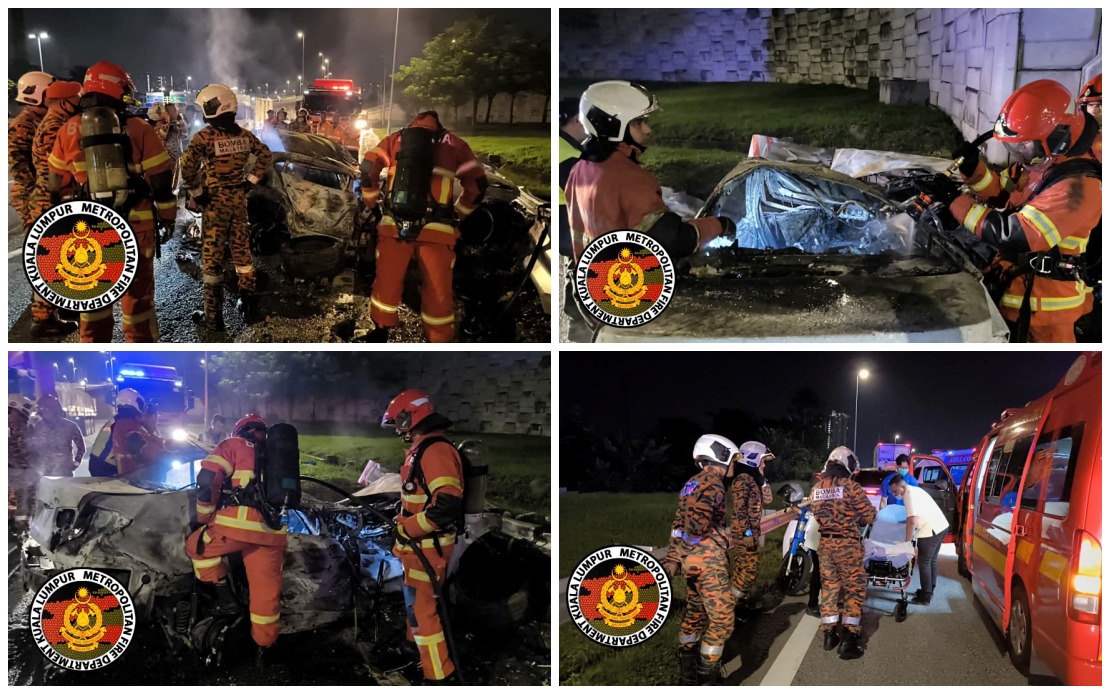
A tragic accident on the Duta-Ulu Kelang Expressway in Kuala Lumpur claimed two lives early Wednesday morning when a BMW 328i Sport veered off the roadway, struck a concrete divider, and erupted into flames. The vehicle was travelling along the Jalan Kuching exit ramp when the incident occurred, leaving investigators grappling with questions about what led to the devastating collision. Authorities confirmed that both occupants in the front of the vehicle perished in the blaze, while a rear passenger from neighbouring Singapore sustained only minor injuries and received treatment at Kuala Lumpur Hospital.
According to ACP Mohd Zamzuri Mohd Isa, chief of the Kuala Lumpur Traffic Investigation and Enforcement Department, early findings suggest the driver was travelling from Jalan Duta towards Selayang when excessive speed precipitated loss of control. The vehicle subsequently skidded across the carriageway before colliding with the left-hand road divider. The impact and resulting damage appear to have created immediate fire hazard conditions, with both victims becoming trapped as flames engulfed the sedan. The intensity of the blaze complicated rescue efforts and rendered the immediate evacuation of the two front occupants impossible.
The two deceased were identified as Malaysian nationals pursuing higher education abroad and domestically. The driver, a 22-year-old male, was enrolled at Queensland University of Technology in Australia, representing the growing number of Malaysian students seeking tertiary qualifications in international institutions. His 21-year-old front-seat companion was a student at Sunway University, one of Malaysia's established private higher education providers. Their deaths represent a sobering reminder of the vulnerability of young people on the nation's busy road networks, particularly during early morning hours when traffic conditions and driver fatigue present compounding risks.
The surviving passenger, a 20-year-old male from Singapore, managed to evacuate or was extracted from the vehicle before the flames spread to the rear sections. His presence in the vehicle as a third occupant raises questions about the distribution of passengers and vehicle loading at the moment of impact. Medical assessment indicated minor injury status, suggesting either his seating position afforded greater protection or the success of rapid evacuation protocols prevented more serious harm. His survival provides investigators with a crucial witness account of events leading to and immediately following the collision.
Police have initiated formal investigation procedures under Section 41(1) of the Road Transport Act 1987, the statutory framework governing serious road traffic incidents. Identification of the two charred victims will proceed through DNA analysis, a necessary step given the extensive thermal damage to remains. The forensic process, while thorough, typically requires several days to complete, delaying formal notification to grieving families and international coordination with Australian authorities regarding the Queensland University student's next of kin.
Detectives are pursuing multiple investigative avenues to reconstruct the sequence of events. Closed-circuit television footage from surrounding expressway infrastructure is being reviewed to establish the vehicle's trajectory, speed profile, and any potential interaction with other traffic before the collision. The surviving passenger has provided statements to police, offering eyewitness perspective on driving behaviour and any factors he observed preceding the crash. These interviews, conducted during his hospitalisation and recovery, represent the most direct testimonial evidence available regarding causation.
The incident occurred during early morning hours when the DUKE expressway typically experiences lighter traffic flows compared to peak periods, yet conditions that favour higher-speed travel by drivers who may be fatigued or inattentive. The timing raises questions about why three occupants were travelling together at that hour and what constituted their journey purpose. Whether the 22-year-old driver was commuting, returning from social activities, or engaged in other purposes remains part of the investigative scope.
Authorities have launched a public appeal for additional evidence, specifically requesting dashcam footage from vehicles that may have been in the vicinity during the incident's occurrence. Kuala Lumpur's growing prevalence of dashcam usage among motorists has proven invaluable in numerous traffic investigations, providing objective recordings of events that witnesses might misremember or overlook. The Traffic Police Station at Jalan Tun H.S. Lee and neighbouring police facilities have been designated as contact points for members of the public offering assistance.
The tragedy underscores persistent road safety challenges confronting Malaysian highways, particularly regarding excessive speed as a contributing factor to fatal incidents. The DUKE expressway, a major commercial and commuter route connecting multiple zones within the Klang Valley metropolitan region, sees considerable daily traffic volume. While expressway infrastructure incorporates modern safety features, human factors—including driver judgment, vehicle control capability, and adherence to speed limits—remain critical determinants of crash outcomes.
For international students and their families, particularly those from Australia and Singapore, the incident highlights the importance of road safety awareness when driving in unfamiliar environments. Malaysian driving conditions, traffic patterns, and road regulations differ from those in several Commonwealth nations, requiring adjustment periods for expatriate drivers. The presence of a Singaporean passenger in a Malaysian vehicle operated by an Australian-enrolled driver reflects the transnational mobility increasingly common among Southeast Asian student populations, though such cross-border travel carries inherent risks when navigation and traffic adherence fall short of required standards.
The incident will likely prompt Sunway University and Queensland University of Technology to review their duty-of-care responsibilities regarding student safety, particularly concerning vehicle travel and transportation arrangements. Educational institutions increasingly provide guidance on safe driving practices and vehicle selection for international student cohorts, recognising that accidents abroad create complex legal, diplomatic, and pastoral care dimensions beyond domestic incidents.
Police investigations remain ongoing, with formal charges or determinations of liability pending completion of forensic analysis, CCTV review, and comprehensive witness interviews. The case file will eventually transition from initial investigation to determination of whether circumstances warrant any prosecution or if the incident is classified as an unfortunate accident. Until investigations conclude, the bereaved families must await final confirmation of identity and circumstances while grieving the loss of two young Malaysians whose international educational pursuits ended tragically on a Kuala Lumpur expressway.

