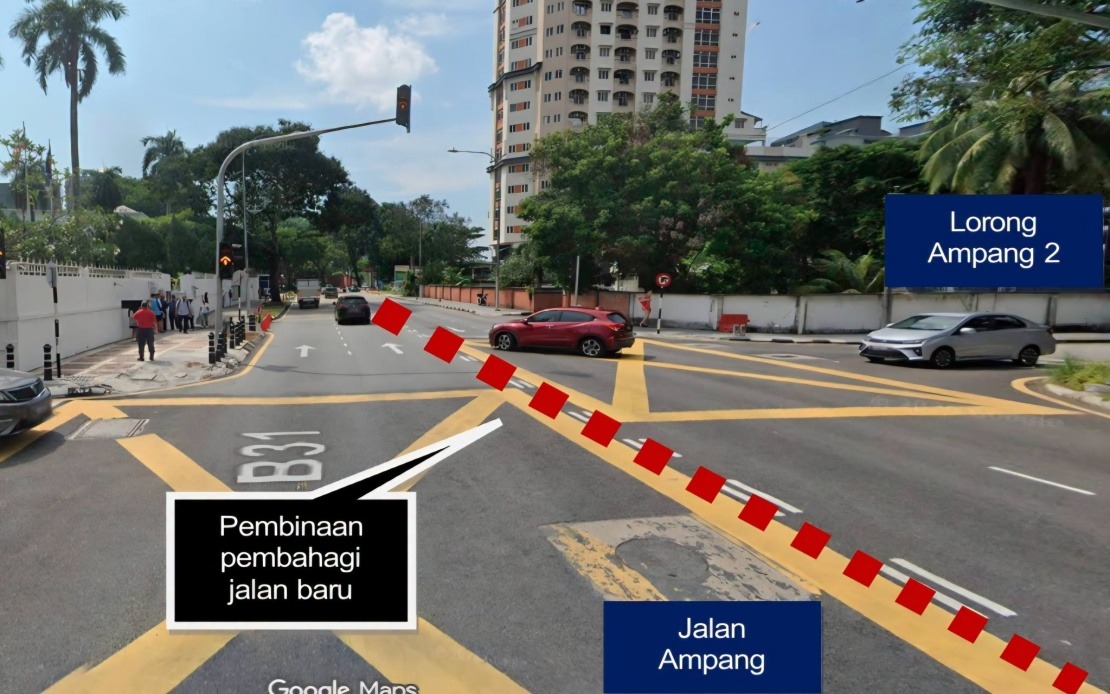
Starting today, two traffic light intersections on Jalan Ampang in Kuala Lumpur will cease operations permanently. The closure affects the intersection in front of the Royal Thai Embassy and the Lorong Ampang 2 junction, with both closures forming part of a significant infrastructure development initiative overseen by Kuala Lumpur City Hall (DBKL). The authority confirmed the permanent nature of these closures in an official statement, signalling a fundamental restructuring of how traffic moves through this major arterial corridor in the city.
The broader context of these closures is the 3.2-kilometre Jalan Ampang upgrade project, an ambitious undertaking that will reshape the road from its intersection with Jalan Tun Razak all the way to the Middle Ring Road 2 (MRR2). This comprehensive modernisation scheme represents a significant investment in reconfiguring one of Kuala Lumpur's key traffic thoroughfares, reflecting the city administration's commitment to addressing congestion and infrastructure deficiencies that have long characterised this corridor.
DBKL has articulated the project's core objectives as threefold: enhancing the operational efficiency of the road network, elevating safety standards for all users, and creating smoother traffic movement along what remains a critical commercial and residential artery. These goals align with broader urban planning strategies being pursued across Southeast Asian cities grappling with rapid motorisation and congestion challenges similar to those affecting Kuala Lumpur.
The physical improvements planned under the upgrade are extensive and detailed. The project encompasses the installation of road dividers, an expansion to two-way four-lane configurations, the redesign of pedestrian facilities to prioritise comfort and safety, and upgrades to street lighting infrastructure. These enhancements represent a shift towards more modern urban road design principles that balance vehicle throughput with pedestrian accessibility and safety considerations increasingly central to contemporary city planning.
The closure of the traffic light intersections is strategically linked to these broader infrastructure changes. By eliminating these signalised junctions and introducing road dividers, DBKL expects to substantially reduce traffic weaving—the potentially dangerous lateral movements vehicles make across lanes—which represents a significant source of congestion and accidents at busy urban intersections. The authority projects that this intervention will lower intersection-related delays and facilitate more consistent traffic progression along the corridor, benefits that extend beyond immediate users to the broader regional road network.
To mitigate disruption during this transition, DBKL has established alternative routing protocols for affected road users. Those travelling from the direction of the Royal Thai Embassy towards Ampang are now directed to execute U-turns at Jalan Tun Razak, while drivers heading towards the city centre can perform U-turns at Jalan Ampang Hilir. These designated alternative routes have been determined through traffic engineering analysis to distribute displaced traffic across the surrounding network effectively, though the effectiveness of these measures will likely become apparent only as the project progresses.
For Malaysian drivers accustomed to the existing intersection configuration, the transition will require behavioural adjustment. The closure represents a fundamental change in how one navigates this section of the city, potentially affecting commuting patterns for hundreds of thousands of vehicles monthly. The psychological and logistical impact on regular users should not be underestimated, particularly for those whose daily routines have long incorporated these now-defunct intersections.
DBKL has emphasised the importance of strict adherence to newly installed traffic signage and road markings throughout the transition period. The authority's emphasis on compliant behaviour reflects awareness that infrastructure changes of this magnitude depend heavily on user cooperation and understanding. Clear communication and visible signage will be critical in preventing accidents and ensuring the alternative routes function as intended.
The Jalan Ampang upgrade initiative sits within a broader pattern of road network modernisation across the Klang Valley region, where traffic congestion remains a persistent challenge despite various infrastructural interventions over recent decades. This specific project demonstrates a willingness to undertake significant permanent changes to established road configurations, suggesting that planners view the current network geometry as fundamentally inadequate for present and projected traffic demands.
From a regional perspective, the project offers insights into how Southeast Asian cities are addressing infrastructure challenges. The emphasis on systematic improvements—dividers, lane expansion, pedestrian facilities, and lighting—reflects lessons learned from congestion management in cities across the region and globally. Malaysia's approach mirrors strategies adopted in Bangkok, Singapore, and other regional hubs that have prioritised network modernisation over simply adding capacity.
The closure will likely intensify pressure on alternative routes during peak periods, at least temporarily. While DBKL has provided designated detours, drivers should anticipate congestion on Jalan Tun Razak and Jalan Ampang Hilir during typical morning and evening rush hours. The duration of this discomfort period depends on the project timeline, which has not been detailed in available information.
The project represents a calculated trade-off: short-term disruption and inconvenience for medium to long-term improvements in traffic efficiency and safety. Whether this calculation proves justified will depend on project execution quality, adherence to timelines, and the ultimate traffic performance of the reconfigured corridor once fully operational. For now, Kuala Lumpur road users must navigate these changes while the city works to modernise critical infrastructure serving millions of journeys annually.

