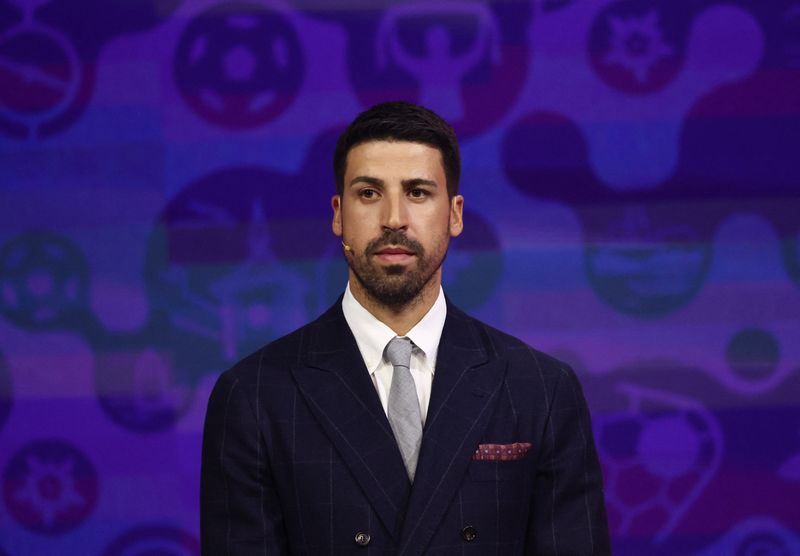
Sami Khedira, who lifted the World Cup with Germany in 2014, has offered a thoughtful perspective on a phenomenon becoming increasingly common in international football: siblings representing different countries at the tournament. Speaking at the Home of Football museum in New York, the veteran midfielder argued that rather than presenting a dilemma, such divisions embody the diversity and interconnectedness defining contemporary sport. His own experience—with his brother Rani competing for Tunisia at the World Cup, the country of their father's heritage—has shaped his worldview on identity, nationality, and belonging in an era when personal histories rarely align with traditional borders.
Khedira's stance reflects a deeper truth about modern football and society. Born and raised in Germany to a German mother and Tunisian father, he has navigated questions about his own identity throughout his career, encountering scepticism about his Germanness based on his name and appearance while simultaneously being perceived as foreign in Tunisia. Rather than viewing this duality as conflict, he frames it as enrichment. Both cultures inhabit his world naturally, neither requiring subordination to the other. His philosophy extends beyond personal sentiment; he sees in his brother's choice for Tunisia a legitimate expression of heritage and emotional connection that coexists peacefully with his own allegiance to Germany. This nuanced understanding challenges the outdated notion that patriotism demands singular, exclusive loyalty.
The 2026 World Cup will showcase this new reality in unprecedented fashion. Eight pairs of brothers are competing across the tournament, with four sets playing alongside one another for the same nation and four representing different countries. The cases span continents and contexts. Inaki and Nico Williams, both Athletic Bilbao players, have diverged internationally, with Inaki choosing Ghana and Nico representing Spain. Guela and Desire Doue similarly split their loyalty between Ivory Coast and France, while Derrick Luckassen and Brian Brobbey, brothers through their mother but carrying different paternal surnames, play for Ghana and Netherlands respectively. Harry and John Souttar divide between Australia and Scotland. Meanwhile, Theo and Lucas Hernandez both represent France, Jurrien and Quinten Timber the Netherlands, and Laros and Deroy Duarte Cape Verde, with Leandro and Juninho Bacuna flying Curacao's colours.
The emotional resonance of these decisions became viscerally clear to Khedira when he witnessed the Doue brothers sing both the French and Ivorian national anthems before their countries' friendly match earlier this month. That image crystallised football's capacity to transcend sport and communicate something profound about human experience. Rather than viewing the brothers' divided allegiances as conflicted or compromised, Khedira recognised it as beautiful testimony to multiculturalism's power. He emphasised how football, given its global reach and emotional intensity, could project this message to audiences worldwide. The sport's ability to celebrate rather than condemn such diversity offered a counternarrative to increasingly nationalist political movements elsewhere.
Khedira also highlighted how football's structural evolution has enabled greater representation for historically marginalised nations. The expanded 48-team World Cup format has created pathways for countries such as Cape Verde, Curacao, and Haiti to compete on football's grandest stage, challenging the traditional dominance of established footballing powers. Simultaneously, he observed that African and Asian nations are narrowing the performance gap with Europe and South America, driven by investment in grassroots education, coaching development, and infrastructural improvements. However, he acknowledged that Europe bears responsibility beyond simply benefiting from dual-nationality players' contributions. Wealthier confederations should actively support development at its source, fostering sustainable improvements rather than merely extracting talent from emerging nations.
Yet Khedira recognised the genuine complexity facing young players courted by multiple federations. The pressure on adolescents navigating such momentous decisions—where federation officials, family expectations, and personal inclination intersect—cannot be overstated. He stressed that the choice between nations cannot be dictated by politics, pressure, or heritage alone; it must ultimately reflect an individual's intuitive sense of belonging. Reflecting on his own decision at eighteen, Khedira emphasised how challenging it was to select a community while still developing his identity and understanding the implications of such a choice. The emotional and psychological weight of representing a nation extends far beyond sporting ambition, yet young players often face these decisions before possessing the maturity to fully comprehend their significance.
Khedira advocated for respecting players' agency in these matters. He noted that his consultation with Tunisia's football federation stemmed from courtesy rather than obligation, and he emphasised that young players deserve space to make deeply personal decisions without coercion. The footballer's position carries particular authority, given his own lived experience navigating these very tensions. His message to football's governing bodies and families is clear: allow players to follow their instincts rather than imposing predetermined outcomes. This approach honours both the individual's autonomy and the legitimate claims that multiple nations may have on a player's identity.
The implications of Khedira's perspective extend beyond football into broader societal conversations about immigration, multiculturalism, and national identity. At a moment when many Western nations are retreating into more exclusionary definitions of citizenship, football offers a countervailing model. Players like the Doue brothers or Williams brothers demonstrate that meaningful connection to multiple nations need not be zero-sum; one's love for a country of birth need not diminish respect for a parent's homeland. This model particularly resonates across Southeast Asia, where cross-border families, labour migration, and regional integration create similar scenarios where individuals carry multiple national and cultural identities.
For Malaysian football enthusiasts, Khedira's insights carry specific relevance. Malaysia, positioned at the intersection of multiple cultural and religious traditions, has long grappled with questions of identity and belonging. The nation's own footballers, some with mixed heritage or family connections across the region, might benefit from similar frameworks that celebrate rather than problematise dual identities. Furthermore, Southeast Asian nations increasingly compete in expanded international tournaments, creating opportunities for players of regional descent or dual nationality to represent countries throughout the bloc. Khedira's endorsement of such diversity could encourage local federations to adopt more inclusive approaches to player selection and identity.
Ultimately, Khedira's argument transcends sport while remaining rooted in football's realities. He envisions a game that reflects the world as it actually exists—mobile, interconnected, and characterised by complex identities that refuse neat categorisation. Rather than lamenting the loss of imagined homogeneity, he celebrates football's capacity to accommodate and even showcase this diversity. The eight sets of brothers competing at the 2026 World Cup will not represent a crisis but rather a portrait of modern humanity. Their presence on football's grandest stage validates millions of people navigating similar questions about identity and belonging. In Khedira's vision, football doesn't solve these tensions; rather, it provides a space where they can coexist, be honoured, and ultimately be understood as sources of strength rather than division.