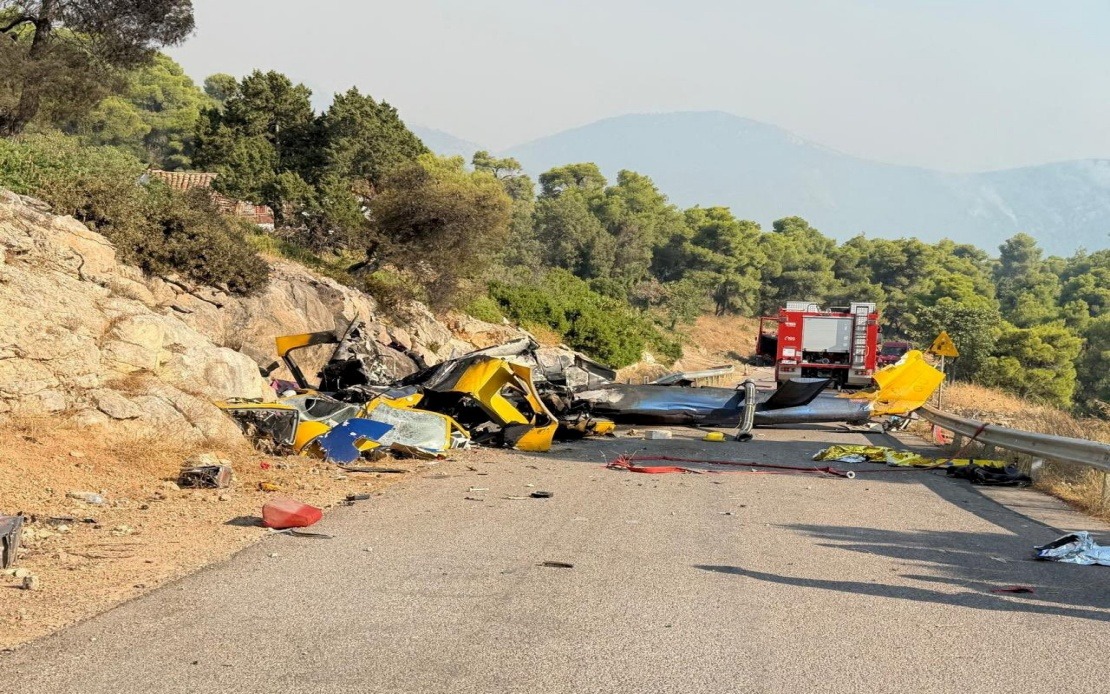
Greece's firefighting operations suffered a tragic setback on Sunday when two Bell helicopters conducting aerial water-bombing missions collided mid-air over western Attica, resulting in two fatalities and injuring at least one survivor. The incident has raised fresh concerns about the hazards facing emergency responders as the Mediterranean nation grapples with an unprecedented wildfire season fuelled by intense heat and dry conditions.
According to Fire Service spokesperson Vassilis Vathrakogiannis, a Danish pilot and a Greek firefighting coordinator perished in the collision near the coastal settlement of Psatha. The two survivors—a British pilot and another Greek firefighting coordinator—were recovered from the crash site, though one sustained injuries in the accident. Both helicopters had been operating with reduced crews of two personnel each, reflecting the critical shortage of available resources during Greece's ongoing fire emergency.
The two Bell helicopters were contracted specifically to support Greece's emergency response to the sprawling wildfire engulfing the Attica and Boeotia regions. These privately-rented aircraft represent essential assets in Greece's aerial firefighting arsenal, enabling crews to deliver water and flame retardants to areas inaccessible by ground-based equipment. The loss of both machines will further strain an already stretched national firefighting capacity at a moment when multiple major fires demand simultaneous attention across the country.
The precise cause of the collision remains under investigation by Greek authorities, though initial reports indicate the helicopters were actively engaged in firefighting operations when contact occurred. Such accidents during emergency response operations underscore the inherent risks that aviation crews accept when conducting low-altitude manoeuvres in challenging atmospheric conditions. The proximity required for effective water-bombing operations, combined with reduced visibility from smoke and heat shimmer, creates an inherently dangerous environment for helicopter pilots attempting to coordinate simultaneous drops over the same fire zone.
Greece's wildfire crisis has intensified markedly in recent weeks, with successive heatwaves pushing temperatures to record levels across the Eastern Mediterranean region. The combination of prolonged drought, high winds, and elevated ambient temperatures has created conditions ideal for rapid fire propagation, forcing authorities to mobilise every available resource including civilian and military aircraft. The incident highlights how extreme weather patterns linked to broader climatic shifts are placing unprecedented strain on traditional emergency response infrastructure.
For regional observers in Southeast Asia, this tragedy carries particular relevance. Malaysia and neighbouring countries increasingly face similar wildfire challenges, particularly during the dry season when transboundary smoke pollution regularly affects the region. The collision underscores the operational pressures and safety risks inherent in aerial firefighting, suggesting that nations developing or expanding air-support capacity for emergency management must invest substantially in coordination systems, pilot training, and modern avionics to prevent such accidents.
The incident also raises questions about the sustainability of relying on contracted civilian helicopter services for emergency response. Many countries, including Greece, have progressively privatised certain emergency aviation functions to reduce public expenditure. However, the accident reveals potential vulnerabilities in this approach, particularly when commercial operators lack comprehensive training in coordinated multi-aircraft operations or when contractual arrangements limit crew sizes below safety-critical thresholds.
Greek authorities have launched a comprehensive inquiry into the collision, examining communications between the helicopters, weather conditions at the time, and operational procedures governing simultaneous aerial firefighting missions. The investigation will likely influence future protocols governing aircraft spacing, communication requirements, and decision trees for suspending operations when hazards exceed acceptable levels. Such findings typically inform international best practices adopted by other nations facing similar wildfire challenges.
The deaths of the Danish pilot and Greek coordinator represent the human toll of emergency response work conducted under extreme duress. Firefighting helicopter crews, whether in Greece or elsewhere, voluntarily accept substantial personal risk to protect communities and infrastructure threatened by uncontrolled fire. Their sacrifice underscores why nations must prioritise adequate funding for training, equipment maintenance, and operational safety systems rather than pursuing cost-cutting measures that compromise emergency response effectiveness.
Looking forward, Greece's experience will likely prompt regional and international reviews of wildfire response protocols. The European Union may convene discussions on harmonising standards for multi-national firefighting operations, particularly as climate change intensifies cross-border fire risks across Mediterranean nations. For Malaysia and Southeast Asian countries observing these developments, the incident reinforces the imperative to strengthen domestic coordination mechanisms and invest in modern early warning systems that reduce dependence on high-risk aerial operations during peak fire seasons.

