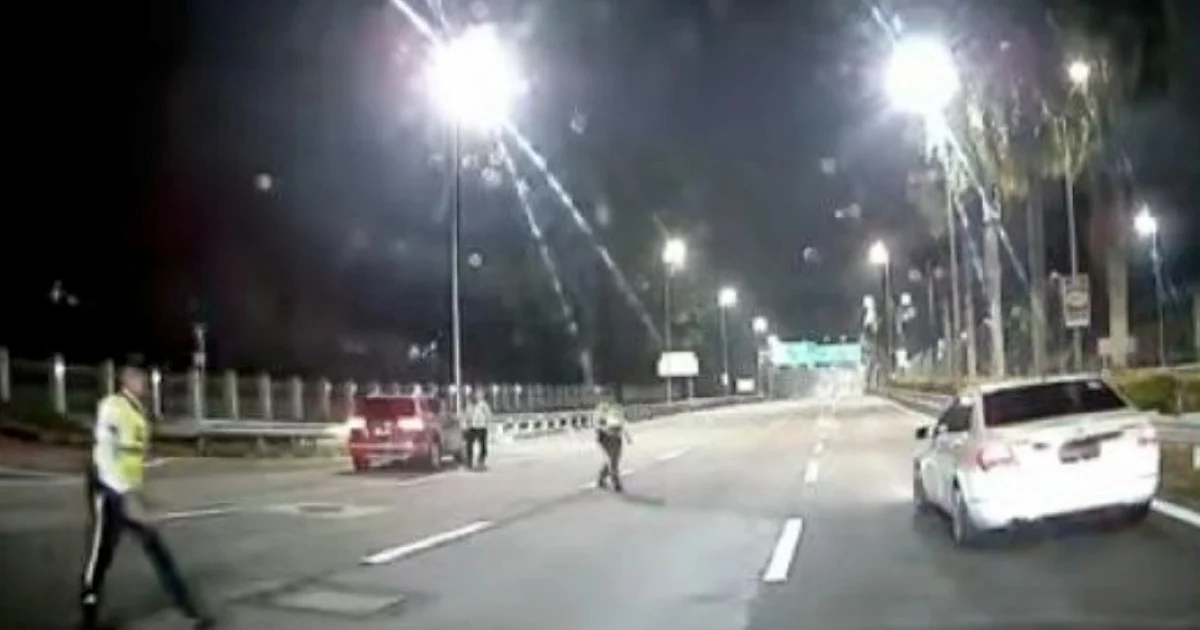
A twenty-year-old driver has been arrested and is currently assisting police with their investigation into a dramatic incident that unfolded on the Sprint Expressway near the National Institute of Public Administration (Intan) in Kuala Lumpur. The incident, which drew substantial public attention through social media channels, centred on the driver's decision to breach a police roadblock whilst operating a white Mercedes vehicle before attempting to evade authorities along the expressway.
The circumstances surrounding the incident reveal a dangerous moment of motorist defiance. Rather than complying with instructions to stop at a lawful police checkpoint, the driver accelerated through the roadblock, creating potential hazards for law enforcement personnel stationed at the location. The subsequent flight along one of Kuala Lumpur's major traffic arteries transformed a simple roadblock stop into a high-speed pursuit scenario, raising serious safety concerns for other road users who may have been traversing the expressway at the time.
The Sprint Expressway incident represents a troubling trend of drivers attempting to evade police checks, a phenomenon that has become increasingly visible through viral video content shared across Malaysian social platforms. These breaches of roadblocks create significant operational challenges for traffic and criminal investigation divisions tasked with maintaining highway safety and enforcing driving regulations. Each such incident requires substantial police resources to coordinate pursuit operations and investigate the underlying reasons for the motorist's actions.
Police detention procedures have commenced to enable thorough questioning of the suspect regarding his motivations and the circumstances leading to his decision to breach the checkpoint. Investigation officers will seek to determine whether the driver was aware of outstanding traffic violations, wanted for other offences, or was operating an unlicensed vehicle. The thoroughness of this investigative phase proves critical in establishing the full factual matrix of the incident and any associated criminal conduct.
The viral nature of this incident underscores how Malaysian road incidents increasingly become subjects of public discourse through digital means before official investigative conclusions emerge. While such visibility can serve as a deterrent to reckless driving, it also creates pressure on law enforcement to respond swiftly and transparently. The public's appetite for details about roadblock breaches reflects broader concerns regarding highway safety and the effectiveness of traffic enforcement mechanisms throughout Kuala Lumpur's road network.
From a law enforcement perspective, roadblock breaches pose multifaceted challenges. Officers at checkpoints face split-second decision-making scenarios when motorists attempt to accelerate through barriers. The potential for physical injury to personnel and collateral damage to public safety escalates dramatically when drivers prioritise flight over compliance. Departments managing such incidents must carefully balance immediate pursuit instincts against calculated risk assessment, considering congestion conditions, vehicle types, and presence of other road users.
The involvement of the Sprint Expressway specifically adds complexity to this matter. As a major arterial route serving commuters and commercial traffic, the expressway experiences consistent volume throughout business hours. An incident involving high-speed pursuit in this corridor creates ripple effects across the broader transportation network, potentially causing congestion and affecting thousands of commuters. Traffic management during and after such incidents requires coordination between expressway operators and law enforcement agencies.
Motives behind roadblock evasion vary considerably across reported incidents in Malaysia. Some drivers possess valid reasons rooted in legal concerns, such as awareness of outstanding summonses or vehicle defects. Others simply react impulsively without rational calculation of consequences. A smaller subset deliberately provokes confrontations with authorities. Determining which category encompasses this particular incident will shape both the severity of charges and broader understanding of road safety enforcement challenges.
The detention phase now underway will involve comprehensive background verification examining the driver's licence status, vehicle registration documentation, insurance compliance, and any previous traffic or criminal history. Investigators will also interview the driver regarding his intentions at the moment he encountered the roadblock and the reasoning underlying his decision to accelerate through rather than submit to routine inspection. Should investigation uncover additional criminality such as stolen vehicle involvement or warrant-related matters, charges may expand beyond traffic violations.
This incident carries implications for Malaysian road safety discussions and traffic enforcement strategy. While aggressive pursuit tactics can apprehend offenders, they introduce significant hazards. Conversely, permitting roadblock breaches without consequence creates incentives for other motorists to attempt similar evasions. Finding this balance remains an ongoing challenge for traffic police departments nationwide, particularly along high-speed expressway corridors where consequences of lost control escalate rapidly.
The case also highlights the enduring effectiveness of public reporting mechanisms in assisting police investigations. Video evidence captured by witnesses or dashcam footage provides crucial documentary evidence supporting official inquiries. As Malaysian roads increasingly feature surveillance infrastructure, such incidents leave digital traces facilitating investigator access to timeline and sequence information previously requiring elaborate witness testimony.

