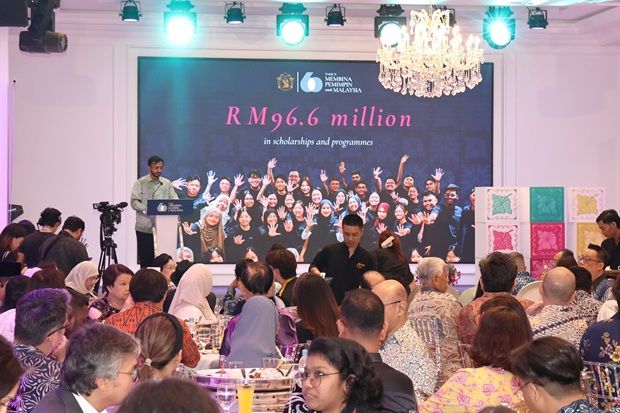
The Tunku Abdul Rahman Foundation (YTAR) reached a significant milestone on August 13 with celebrations at Bangunan Sultan Abdul Samad, marking six decades of commitment to expanding educational opportunities across Malaysia. What began as a grassroots initiative honouring the nation's founding Prime Minister has evolved into a flagship national institution, reflecting the enduring belief that youth development represents the cornerstone of national progress.
The foundation's origins reveal a uniquely Malaysian story of collective purpose. When the idea emerged to establish an education fund dedicated to Tunku Abdul Rahman Putra al-Haj, the newspaper Utusan Melayu launched a public fundraising campaign on the former Prime Minister's birthday, mobilising ordinary citizens to contribute to this vision. The campaign ultimately gathered more than M$60,170.20—an amount equivalent to approximately RM380,000 in contemporary currency—demonstrating the grassroots enthusiasm for investing in the nation's young people during the early post-independence period.
The transformation from community initiative to formal institution came through governmental recognition of education's strategic importance. Tan Sri Mohamed Khir Johari, who served as Education Minister at the time, recognised the foundation's potential and presented a proposal to the Federal Government. This led to the enactment of the Tunku Abdul Rahman Foundation Fund Act 1966 (Act 43), establishing YTAR as a statutory body with a clear mandate to facilitate access to higher education for deserving Malaysians. The legislative framework transformed what might have remained a temporary charitable endeavour into a permanent mechanism for national talent development.
The foundation's approach directly aligned with nation-building priorities during Malaysia's formative decades. By providing loans and scholarships, YTAR enabled Malaysian youth to pursue tertiary education beyond the country's borders, with many recipients subsequently returning to contribute their expertise across government, commerce, academia, and the professions. This cycle of investment and return proved particularly valuable during the period when Malaysia possessed limited domestic higher education capacity, forcing aspiring students to seek opportunities abroad. The foundation functioned as both financial enabler and expression of national confidence in youth potential.
Six decades of consistent operation have yielded measurable results. YTAR has provided support to more than 12,000 Malaysian youth spanning all ethnic and religious communities, distributing a cumulative RM96.6 million across scholarships, loans, financial assistance, and employability programmes. This reach demonstrates the institution's role not merely as a scholarship provider but as a comprehensive talent development ecosystem. The breadth of beneficiaries—from diverse backgrounds and pursuing varied fields—underscores the foundation's commitment to inclusive nation-building rather than narrowly defined objectives.
National Unity Minister Datuk Aaron Ago Dagang, speaking at the 60th anniversary ceremony, articulated how YTAR's mission has broadened beyond its original parameters. The foundation now functions as a talent identification and development engine, recognising potential, creating pathways for access, and nurturing capabilities among Malaysian youth. Dagang used the occasion to call upon corporate Malaysia to integrate education and talent development more systematically into their corporate social responsibility frameworks, suggesting that the private sector adopt the foundational commitment that YTAR has embodied for six decades. This appeal reflects ongoing recognition that human capital development requires sustained, multi-sectoral commitment.
Kularetnam Vijayakumar, YTAR's chief executive officer, emphasised that the institution's resilience stems from collective custodianship rather than individual leadership. He traced the foundation's enduring philosophy to its origins, when Malaysian citizens united behind the conviction that education represents transformative force capable of reshaping individual lives and national trajectory. This institutional memory proves particularly significant in contemporary Malaysia, where educational access remains contested and where alternative visions of development compete for resources and attention. YTAR's consistent 60-year commitment to merit-based support regardless of ethnicity or religious affiliation represents a contrarian vision in some respects, grounded in Tunku Abdul Rahman's own foundational beliefs about inclusive nation-building.
Datin Sri Sharifah Menyalara Syed Hussein, Tunku's granddaughter and YTAR chairperson, offered intimate insight into her grandfather's educational philosophy. She explained that Tunku conceptualised education not narrowly as academic attainment but comprehensively as the development of character, purpose, and capacity for meaningful social contribution. This philosophical framework distinguishes YTAR's approach from purely credentialist scholarship provision. The foundation consciously positions itself as cultivating future leaders and citizens equipped not simply with qualifications but with values alignment and social consciousness. Over six decades, the organisation has progressively expanded beyond financial support mechanisms to encompassing holistic youth empowerment through capital access, opportunity creation, and skills development.
Two scholarship recipients highlighted at the anniversary ceremony embodied the foundation's transformative impact across different fields. Ch'ng Kim See, who received her scholarship in 1967 during financial hardship, subsequently became one of Malaysia's most eminent librarians with recognised regional expertise in Southeast Asian history and library science. She described receiving the scholarship as providential intervention at a moment of acute vulnerability, enabling her continuation of university education when other funding sources had been exhausted. Her subsequent career demonstrates how educational investment at critical junctures can catalyse decades of professional contribution and scholarly impact. Dr Zakaria Ali, similarly recognised as a pioneering figure in Malaysian fine arts, traced his scholarship journey to an American instructor's advocacy on his behalf, resulting in interview and ultimately award that launched his distinguished career as painter, writer, and academic. Both alumnus narratives stress that scholarship provision functioned as catalyst rather than conclusion, enabling recipients to realise potential that might otherwise have remained dormant.
The alumni network of Tunku Scholars—now spanning multiple generations—occupies positions throughout Malaysian society, from education and civil service through law, medicine, and frontline leadership roles. This distributed impact across sectors and disciplines reflects the foundation's non-partisan, merit-based selection methodology and its belief in youth potential regardless of anticipated career trajectory. The collective achievement of these graduates constitutes perhaps YTAR's most substantial legacy, representing human capital development and capability creation that directly strengthened national institutional capacity across decades.
As YTAR contemplates its trajectory beyond 60 years, organisational leadership emphasises evolution rather than static commemoration. Sharifah Menyalara articulated this distinction explicitly, noting that while memorials encourage retrospection, living institutions demand forward engagement with foundational principles. This framing positions YTAR not as historical artefact celebrating past achievements but as continuing vehicle for realising Tunku's vision of youth-centred development. The foundation's ongoing evolution from financial aid provision toward comprehensive empowerment programming reflects this commitment to substantive rather than ceremonial perpetuation of institutional purpose.
Immediate initiatives underscore this forward orientation. The National Unity Minister announced that nominations for the 2026 Pingat Tunku Award would open on August 31, extending through September 30. Significantly, the foundation introduced self-nomination eligibility for the first time, inviting graduates from both public and private higher education institutions throughout Malaysia to recognise their own contributions and leadership. This democratisation of nomination procedures represents recognition that merit and meaningful contribution extend beyond institutional gatekeepers' identification, reflecting institutional confidence that Malaysian youth across diverse educational backgrounds possess capability worthy of recognition and further investment.

