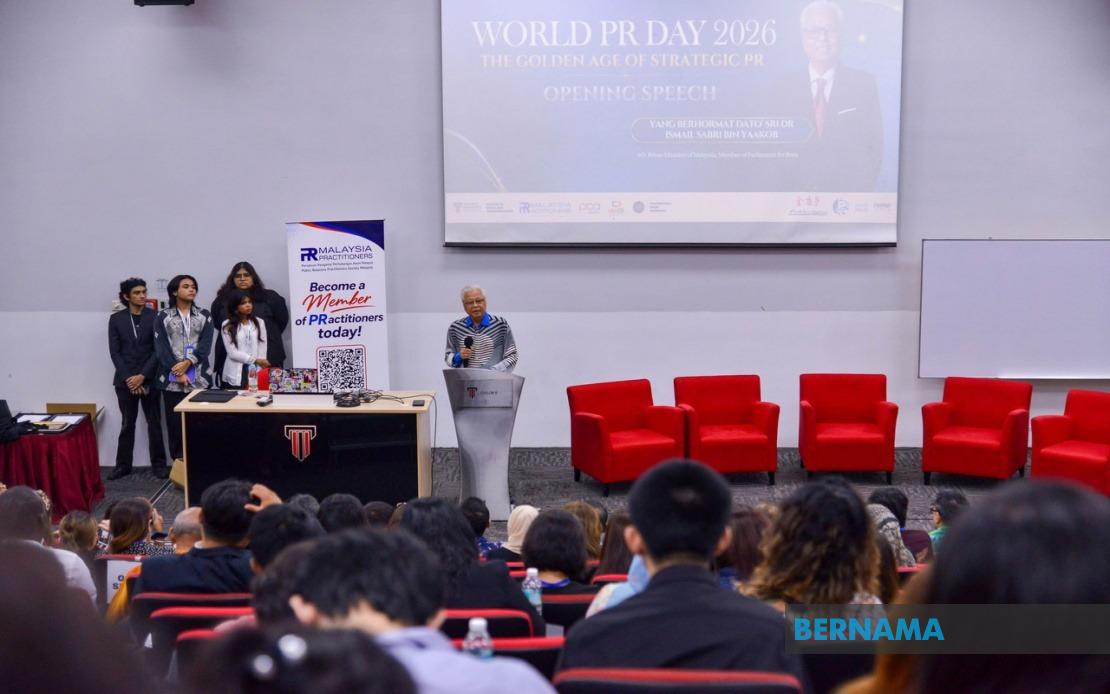
The landscape of institutional trust has fundamentally shifted in the twenty-first century, according to Datuk Seri Dr Ismail Sabri Yaakob, who underscored that the contemporary business environment transcends mere economic competition. Speaking at the launch of World PR Day 2026 celebrations at Taylor's University in Subang Jaya on July 16, the former Prime Minister articulated a compelling thesis: in an era of unprecedented digital connectivity, the capacity to cultivate confidence through transparent and principled communication represents the defining competitive advantage for organisations across all sectors.
Ismail Sabri contended that an organisation's valuation has undergone a profound metamorphosis in recent years. Beyond traditional metrics of financial performance and operational achievements, stakeholders now rigorously scrutinise how institutions communicate during both triumphant and turbulent periods. This paradigm reflects a broader societal recognition that reputational capital—built and maintained through honest dialogue—has become indispensable to long-term viability and market positioning. The former premier framed this evolution in global terms, asserting that whereas the twentieth century revolved around economic competition between nations and corporations, the current century is characterised fundamentally by competition for public confidence, a competition that hinges entirely upon communication grounded in authentic principle rather than mere rhetoric.
The professionalisation of public relations work has undergone substantial transformation, Ismail Sabri observed. PR practitioners have transcended their historical role as information disseminators, evolving instead into strategic architects who actively participate in constructing organisational narratives and safeguarding institutional reputation. This expanded mandate demands considerably greater sophistication and responsibility than the function traditionally entailed. Modern communications professionals must navigate complex stakeholder ecosystems, anticipate reputational hazards, and craft messaging that withstands scrutiny in an environment where information spreads instantaneously across multiple platforms.
Drawing upon his experience navigating the COVID-19 pandemic as Prime Minister, Ismail Sabri offered concrete testimony to communication's strategic significance in policy implementation. Throughout the health crisis, he recounted undertaking almost daily engagements with media representatives to articulate shifting standard operating procedures and clarify governmental decisions. This sustained engagement was not perfunctory; rather, it served as a critical mechanism for transmitting reliable information and thereby preventing public confusion during a period of acute uncertainty. The pandemic experience illuminated a fundamental truth: communication functions not merely as an administrative chore for conveying policy decisions, but as a vital instrument for cultivating public confidence in institutional leadership and competence.
The technological dimension of modern communication introduces both unprecedented opportunities and formidable challenges, Ismail Sabri cautioned. Public relations practitioners must acquire proficiency in artificial intelligence technologies that enable rapid analysis of public sentiment and audience perception. However, this technological sophistication must remain tethered to enduring human values and ethical principles. The adoption of advanced analytical tools should enhance rather than supplant human judgment and moral reasoning in communications strategy.
Simultaneously, the digital environment has generated novel threats to informational integrity that demand urgent attention. The proliferation of fabricated content, manipulated media, deepfake technologies, and the sheer informational abundance characterising contemporary digital discourse have compromised the public's capacity to distinguish verified facts from falsehoods. This erosion of epistemic consensus creates particular vulnerability for institutions that lack robust communication protocols and credibility reserves. In such an environment, organisations with strong track records of truthful engagement possess a decisive advantage.
Recognising these systemic challenges, Ismail Sabri expressed support for the Malaysian government's initiative to develop an AI Governance Bill designed to address unethical conduct and establish clear digital ethics standards. This legislative undertaking responds directly to escalating concerns regarding misinformation proliferation and technological misapplication. The regulatory framework aims to create guardrails around artificial intelligence deployment while preserving innovation, targeting particularly the mechanisms through which false narratives and manipulated content undermine public discourse and institutional credibility.
The former Prime Minister's remarks carry particular resonance for Malaysian audiences and Southeast Asian policymakers grappling with their own communication challenges. The region faces mounting pressure from disinformation campaigns, polarising social media dynamics, and rapid technological change that outpaces institutional adaptation. His emphasis on integrity as a foundational communication principle provides a roadmap for organisations seeking to maintain legitimacy amid such turbulence. Malaysian companies, government agencies, and civil society organisations operating in increasingly digital environments would be well-advised to examine their communication strategies through the lens of principle-driven transparency.
Moreover, Ismail Sabri's framework speaks to a distinctive Malaysian context wherein diverse stakeholder communities require sensitive, culturally-attuned communication that respects different perspectives while maintaining factual accuracy. The integrity he emphasises is not merely procedural compliance but a deeper commitment to honest engagement across societal divides. In a multicultural democracy like Malaysia, such communication integrity becomes particularly consequential for social cohesion and institutional effectiveness.
The implications for Malaysia's communications profession are substantial. As PR practitioners increasingly become custodians of institutional credibility in the digital sphere, their role demands not only technical sophistication but genuine ethical grounding. The profession's capacity to resist pressures toward spin, distortion, or strategic dishonesty will significantly influence how effectively Malaysian institutions navigate the trust deficits afflicting institutions globally. Ismail Sabri's intervention suggests that organisations seeking to build resilient reputations should invest in communications leadership that refuses to sacrifice integrity for short-term messaging advantages.
Looking forward, the challenge for Malaysian organisations encompasses both technology adoption and values reinforcement. The AI Governance Bill initiative represents governmental recognition that technological advancement requires ethical guardrails, but such regulatory frameworks succeed only when embedded within organisational cultures genuinely committed to truthful communication. The former Prime Minister's thesis ultimately argues that in a hyperconnected world where reputational damage travels globally at digital velocity, integrity-driven communication is not a peripheral consideration but rather central to organisational survival and stakeholder confidence.

