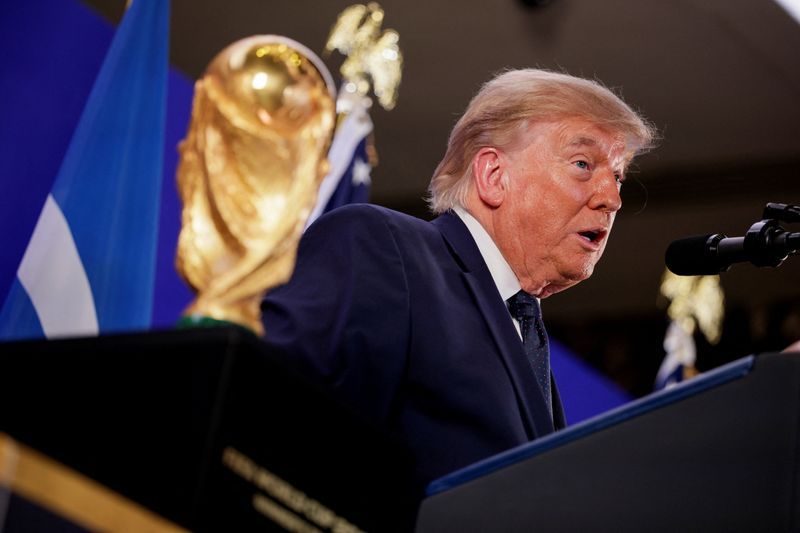
Donald Trump is poised to reclaim centre stage at Sunday's World Cup final between Argentina and Spain at New York/New Jersey Stadium, where he will sit alongside FIFA President Gianni Infantino and present the trophy to the victors. This high-profile appearance marks a return to the tournament that has already consumed considerable political capital for the American president, who has found himself at the epicentre of one of the competition's most contentious episodes and is now eyeing another hosting opportunity for the United States in 2038.
The president's involvement in the tournament's governance surfaced when he publicly acknowledged requesting Infantino to review a red card issued to American striker Folarin Balogun, a move that triggered widespread criticism and raised uncomfortable questions about political interference in sporting decisions. The incident crystallised concerns among football authorities and observers about the appropriate boundaries between state power and athletic competition, particularly as the tournament operates under intense international scrutiny.
Trump and Infantino exchanged effusive compliments on Friday during a reception at Trump Tower in Manhattan, where FIFA established a regional office last year. Before approximately 300 guests, including Brazilian football icon Ronaldo and various FIFA dignitaries, Infantino credited Trump's administration for the tournament's unprecedented success. The relationship between the two figures has deepened considerably, with Trump frequently hosting the FIFA President at the White House's Oval Office, signalling a working partnership that extends beyond ceremonial functions.
The 2026 World Cup has indeed shattered attendance records, positioning itself as the tournament's most commercially successful iteration. Yet this accomplishment has not insulated the competition from political turbulence. A year before the tournament commenced, American cities grappled with justifiable concerns about reassuring international visitors anxious about Trump's immigration policies and travel restrictions affecting multiple nations. The administration's aggressive stance on border security threatened the inclusive atmosphere typically associated with global sporting events that depend on cross-border participation and goodwill.
Further complicating preparations, Trump threatened to relocate matches away from Democratic-controlled municipalities, a manoeuvre FIFA firmly rejected by stipulating that venue decisions lay entirely within the governing body's purview. This power struggle underscored the persistent friction between political ambitions and sporting autonomy. During Friday's reception, Trump floated the possibility of hosting another World Cup but with a conspicuous modification: the exclusion of Mexico and Canada, the tournament's co-hosts, suggesting a desire for unilateral American hosting prestige that disregards established partnerships.
Trump's gravitational pull toward high-profile sporting events has intensified over the past 18 months as his approval ratings during his second presidential term experience measurable decline. His appearance at last year's Ryder Cup on Long Island generated enthusiastic reception from American spectators, delivering the affirmation and visibility the president consistently pursues. However, his sports-event appearances have generated decidedly mixed reactions elsewhere, providing insight into the fractured nature of contemporary American political sentiment.
At Game 3 of the NBA Finals last month, Trump encountered vocal booing from sections of the crowd, a stark contrast to the Ryder Cup experience. Similarly, his attendance at the US Open men's tennis final at Flushing Meadows last year precipitated operational chaos as enhanced presidential security protocols delayed match commencement, stranding thousands of ticketed fans outside the venue and generating considerable public frustration. These incidents demonstrate that Trump's presence at sporting events remains profoundly polarising, capable of transforming the spectator experience itself into a contentious matter.
The upcoming World Cup final presents logistical and editorial challenges for Fox Sports, the American broadcaster wielding only limited control over visual coverage. Fox utilises a global feed for match distribution, meaning decisions about whether to capture Trump seated adjacent to Infantino remain beyond the network's authority. Play-by-play announcer John Strong articulated this constraint candidly, explaining that timing and framing of presidential appearances occur unpredictably, forcing broadcasters into a passive position regarding representation of one of America's most divisive political figures.
The composition of the television audience watching Sunday's final virtually guarantees split reactions to Trump's visibility. Strong recognised this demographic reality directly, noting that substantial segments will feel energised by his attendance whilst others will regard his on-screen presence with considerable displeasure. This polarisation reflects the deeper American political landscape, where Trump functions as a figure incapable of inspiring neutral responses—viewership will parse his appearance through irreconcilable ideological lenses.
For Southeast Asian observers and Malaysian football enthusiasts, Trump's role at the World Cup final illustrates how deeply contemporary geopolitics permeates sporting institutions. FIFA's deference to American political interests—evident in the tournament's unprecedented North American hosting and the accommodation of presidential involvement in officiating matters—demonstrates the hierarchy of power within global football governance. The spectacle of a sitting president presenting the World Cup trophy represents a significant departure from football's historically centrist administrative model, raising questions about how developing nations and smaller footballing nations navigate interactions with major powers within sporting frameworks.
The broader controversy surrounding Trump's involvement also serves as a cautionary tale regarding tournament hosting and political stability. Malaysia and other Southeast Asian nations considering future World Cup bids should recognise how hosting rights become entangled with incumbent political leadership, potentially compromising sporting integrity and international participation. The experience of 2026 suggests that selection committees must establish clearer firewalls between political authority and tournament administration, protecting the competition's universal appeal and credibility regardless of which nation ultimately holds hosting rights.

