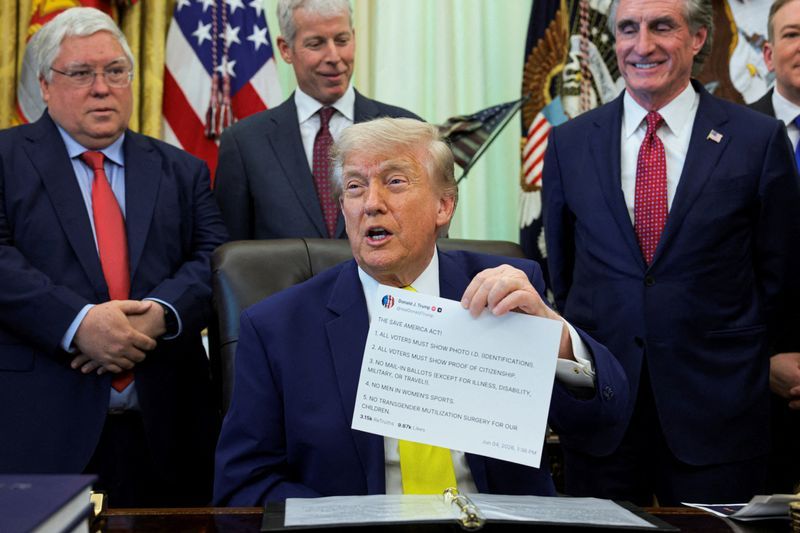
Two prominent media organizations have initiated legal action against the Truth API service, which charges subscribers substantial fees for advance access to posts from Donald Trump and other senior U.S. government officials on the Truth Social platform. The Intercept and the Freedom of the Press Foundation filed the complaint in Manhattan federal court, seeking to halt what they characterize as a scheme that grants wealthy insiders preferential access to market-moving announcements before the general public. The service, launched by Trump Media & Technology Group on August 1, operates on a tiered pricing model reaching up to $100,000 per month, providing subscribers early viewing of posts from ten high-profile Truth Social accounts, with Trump's personal account serving as the flagship offering.
The lawsuit arrives just four days after Democratic Senators Elizabeth Warren of Massachusetts and Adam Schiff of California formally petitioned the U.S. Securities and Exchange Commission to investigate whether the Truth API service undermines market integrity. Their correspondence explicitly raised concerns that the arrangement could enrich wealthy Wall Street participants and insiders while creating improper financial benefits for Trump himself. The timing of the SEC complaints and subsequent legal action underscores growing scrutiny of how government officials are leveraging social media platforms to communicate market-sensitive information, a practice with profound implications for financial fairness and equal access to official announcements.
The plaintiffs argue the service constitutes what they describe as a "profoundly corrupt" arrangement, particularly given Trump's substantial financial stake in Truth Media. As the company's largest shareholder, Trump holds approximately 41.3 percent of the organization, representing roughly $950 million in value held through his Donald J. Trump Revocable Trust. His oldest son, Donald Trump Jr., serves as a company director and oversees the trust arrangements, creating an interwoven family financial interest in the platform's commercial success. This ownership structure means that whenever a subscriber pays for premium early access, Trump directly benefits from those subscription revenues, establishing what critics contend is an inherent conflict of interest between his role as president and his commercial interests.
The legal complaint centers on constitutional grounds, asserting that Truth API violates the First Amendment by creating unequal access to presidential announcements. The plaintiffs argue that all citizens possess a fundamental right to equal and timely access to government communications, particularly those addressing matters of national importance or carrying implications for markets and public welfare. Beyond this constitutional dimension, the lawsuit specifically targets the White House's alleged practice of posting official government announcements exclusively on Truth Social while the paid feed exists, effectively gatekeeping important information behind a paywall. The complaint references Trump's substantial post volume during his current administration, noting that between 9,000 and 11,000 of his Truth Social posts and reposts went unaccompanied by traditional White House statements, meaning they existed only on the proprietary platform.
Trump's history of using Truth Social to communicate information with direct market implications strengthens the legal challenge's foundation. Throughout his presidency, Trump has repeatedly disclosed sensitive announcements regarding tariffs, trade policies, and Middle East developments on the platform before or instead of through official government channels. Financial markets have demonstrably moved on the basis of these announcements, creating genuine opportunities for those with advance knowledge to trade ahead of public information. The Truth API service amplifies this concern by creating a mechanism through which wealthy subscribers can gain a measurable time advantage in receiving market-moving information, an arrangement that securities regulators and market watchdogs view with considerable skepticism.
The Trump Media response to the lawsuit dismisses the allegations as a weaponization of the courts against the company and its leadership. A company spokesperson emphasized that countless other platforms and news outlets, many operating subscription-based models, already disseminate Trump-related content and information. Trump Media's interim Chief Executive Kevin McGurn characterized the Truth API service as merely enabling subscribers to receive news "fractionally faster" than other audiences, suggesting the advantage represents only modest timing benefits. However, even modest timing advantages translate to meaningful economic value in financial markets, where microseconds can determine trading advantages. The company's framing of the service as merely informational convenience rather than a potential market-manipulation mechanism represents a fundamental disconnect with how securities regulators and legal advocates assess the arrangement's implications.
Beyond Trump himself, the Truth API service extends premium early access to posts from Vice President JD Vance, Health and Human Services Secretary Robert F. Kennedy Jr., FBI Director Kash Patel, and the official White House account. This broader application extends the conflict-of-interest concerns beyond Trump to the entire upper echelon of the executive branch, suggesting a systematic approach to monetizing government communications. Each of these officials possesses significant authority over areas directly affecting markets and public welfare, from financial regulation to public health policy to national security matters. Providing wealthy subscribers advance notice of their announcements creates cascading implications for fairness and democratic principle that extend well beyond any single official's commercial interests.
The regulatory environment surrounding this dispute adds another layer of complexity for Malaysian and regional readers assessing the broader implications. The SEC's current composition consists entirely of Republican commissioners, potentially affecting how aggressively the agency might investigate or pursue enforcement action against the Truth API service. This regulatory reality raises questions about institutional checks and balances on executive-branch market manipulation concerns, a dynamic with relevance to observers in markets and democracies worldwide. The case ultimately forces American legal and regulatory institutions to clarify fundamental principles about government access to public information, the permissibility of monetizing official communications, and the boundaries between private commercial interests and public office.
For Malaysia and other Southeast Asian economies, this dispute carries instructive implications regarding governance standards and the intersection of political leadership with commercial interests. As the case unfolds through American courts, it will establish legal precedents for how democracies should handle situations where government officials leverage their positions to generate personal financial returns from their official communications. The outcome could influence how regional governments and their officials approach digital platforms, information access, and the commercial exploitation of official announcements. The fundamental question of whether public office creates obligations to ensure equal citizen access to government communications represents a principle with universal application across democratic systems.

