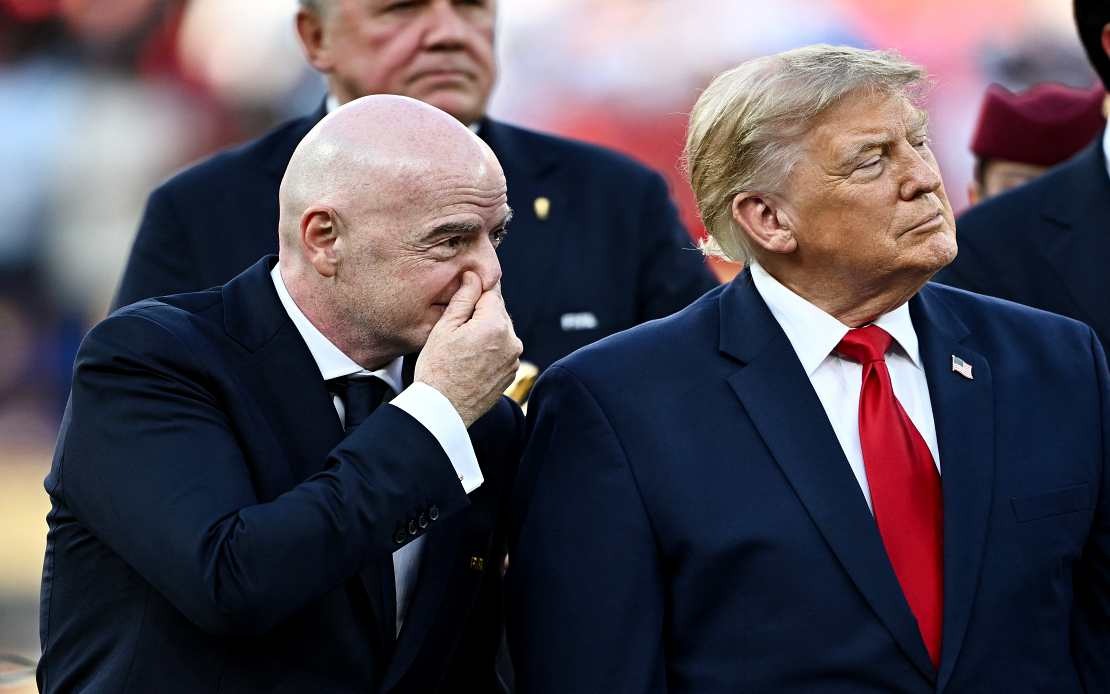
United States President Donald Trump has emerged as an unlikely defender of FIFA President Gianni Infantino, offering public endorsement at a moment when the football administrator faces significant pressure from multiple continental confederations. Trump's statement, posted on Truth Social, characterises Infantino as a leader of exceptional calibre whose departure would represent a critical loss for international football. The intervention underscores the geopolitical dimensions of governance disputes within global sports organisations and highlights the extent to which FIFA's internal politics can draw commentary from world leaders.
The controversy centres on FIFA's ambitious plan to raise US$4.2 billion through the sale of approximately 20 per cent stakes in a new commercial entity designed to manage the federation's media and commercial rights. This structure would have given private investors significant control over lucrative broadcasting agreements and sponsorship arrangements, fundamentally reshaping how FIFA monetises its principal assets. The proposal represented an unprecedented move toward privatisation within international football's governing body, reflecting broader trends toward commercialisation in global sports administration.
Opposition to the scheme crystallised through coordinated action by three major continental confederations. The Union of European Football Associations, the Asian Football Confederation, and the Confederation of North, Central American and Caribbean Football all published an open letter demanding an independent investigation into the transaction's circumstances and propriety. Their concerns extended beyond financial methodology to encompass governance transparency and the potential conflicts of interest embedded within such an arrangement. This unified stance from organisations representing dozens of national football associations globally demonstrated the depth of institutional unease.
Media reporting suggested that investment capacity for such stakes might derive from foundations linked to Joshua Kushner, brother of Jared Kushner, who served as Trump's son-in-law and senior advisor during the previous administration. This family connection created perception challenges regarding potential conflicts of interest and raised questions about the appropriateness of allowing individuals with direct ties to American political figures to acquire substantial influence over FIFA's commercial operations. The possibility of such a transaction occurring simultaneously underscored the commercial pressures confronting contemporary international sports governance.
Infantino's response to mounting criticism involved convening an emergency meeting with FIFA's senior leadership in early August. During this session, federation officials expressed continued support for the president despite acknowledged missteps. Infantino issued an apology specifically directed toward errors committed regarding the FIFA Forward Enterprise commercial project, attempting to salvage his position through acknowledgment of institutional failings. However, this defensive posture proved insufficient to stem the crescendo of opposition building across the football world.
European football authorities escalated their position by announcing a comprehensive boycott of FIFA competitions that would persist unless the commercial rights proposal underwent complete withdrawal. This ultimatum carried substantial weight given European leagues' dominance in global football's commercial ecosystem and their pivotal role in generating broadcast revenues. The threatened boycott represented an existential challenge to FIFA's most prestigious competitions and forced rapid recalibration of federation strategy.
Ultimately, facing this coordinated institutional resistance, FIFA announced the abandonment of its commercial rights privatisation scheme. Infantino declared that given the surrounding controversy, the federation had concluded that proceeding would prove untenable. This represented a significant strategic retreat, though the federation's decision to shelve rather than fundamentally restructure the proposal suggested that commercial expansion remained a longer-term objective. The episode revealed tensions between FIFA's desire for financial innovation and global football's resistance to governance arrangements perceived as lacking transparency.
Trump's intervention came after Infantino's already-announced reversal, positioning the American president's defence as a retrospective endorsement rather than consequential advocacy. Trump emphasised that the FIFA World Cup held under Infantino's stewardship had achieved unprecedented commercial success, generating record revenues and global viewership metrics. By quantifying FIFA's achievements during Infantino's tenure as approximately four times larger than previous tournaments, Trump attempted to establish a performance-based justification for maintaining leadership continuity.
The American president's statement that FIFA would struggle to replicate such success following Infantino's departure functioned simultaneously as both praise for the incumbent and warning regarding institutional disruption. This framing suggested that football's global economy had become sufficiently dependent on particular leadership configurations that organisational transitions posed material risks. However, for Malaysian and Southeast Asian readers, the episode illuminates how governance crises within international sports bodies increasingly attract intervention from major political actors, potentially compromising the independence traditionally associated with sports administration.
The AFC's participation in the confederations' joint opposition carries particular significance for the Asian football community, reflecting concerns that privatisation arrangements negotiated without regional consultation could undermine Asian leagues' commercial interests and representation within FIFA's decision-making architecture. The confederation's willingness to align with European peers on this issue demonstrated that governance transparency and institutional accountability transcended continental divisions within the global football ecosystem. Such solidarity among competing regional bodies suggested that commercial rights privatisation had crossed a threshold where perceived impropriety mobilised unprecedented organised resistance.
Looking forward, while the immediate commercial rights sale has been abandoned, underlying pressures for FIFA to generate additional revenue streams persist. The federation's financial model continues evolving in response to escalating costs associated with expanding World Cup tournaments and supporting development programmes globally. Future proposals will likely incorporate greater consultation mechanisms and transparency protocols, lessons derived from this episode's institutional backlash. For football governance in Southeast Asia, the episode underscores the importance of regional confederations maintaining vigilant oversight of decisions made at FIFA level that could affect member nations' commercial opportunities and competitive equity.
The broader implication of Trump's defence and Infantino's ultimate victory in retaining his position suggests that despite the governance controversy, international football's commercial incentives and incumbent institutional structures retain considerable resilience. However, the near-consensus opposition from continental confederations indicates that future reform initiatives will require substantially broader consensus-building and more rigorous governance safeguards. Malaysian and regional stakeholders in football's development must recognise that such governance disputes directly influence resource allocation, competition structures, and investment patterns affecting domestic football systems.

