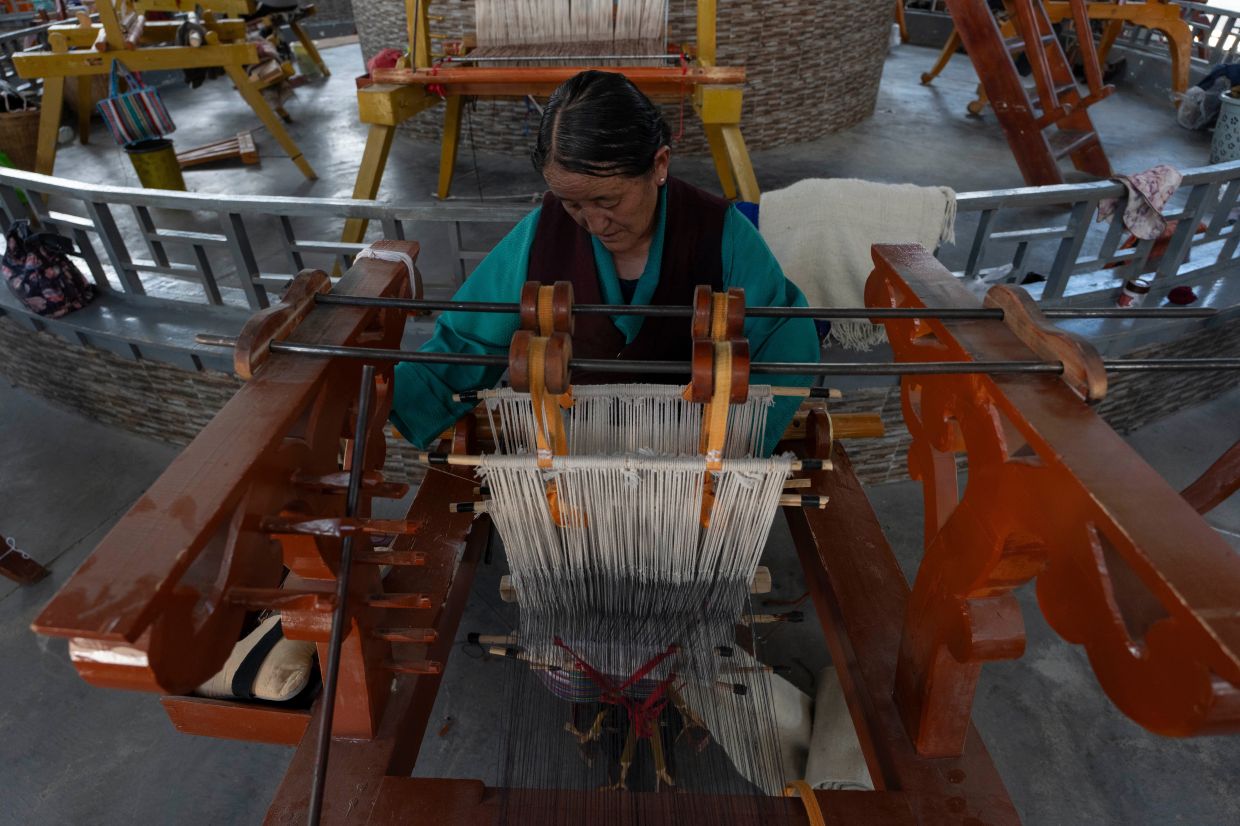
In a workshop nestled at the edge of the Tibetan plateau, more than a hundred hands move in practiced rhythm across wooden looms, shuttles gliding through columns of wool fibre in motions repeated countless times each day. This is the Ethnic Huaji Handwoven Cooperative in Shannan, where artisans continue one of Tibet's most enduring textile traditions—the weaving of Pulu, a dense woollen cloth that has wrapped the bodies of plateau dwellers for over a thousand years.
Founded in 2008 by Tibetan craftsman Pasang, the cooperative represents a determined effort to rescue a vanishing skill. When Pasang began his mission, the knowledge of how to produce Zeter, the finest variety of Pulu, was held by fewer than ten living masters. Through his initiative, the workshop now supports over 100 local workers, many of whom faced limited employment prospects, including individuals with disabilities who have found meaningful work and dignity within these walls. The enterprise demonstrates how cultural preservation and economic necessity can intersect to benefit entire communities.
Zeter distinguishes itself from standard Pulu through both its composition and quality. Weavers source the material from the softest wool on sheep—specifically from the neck and back regions—creating yarn that proves far more challenging to spin than that used for ordinary Pulu. This additional complexity yields a fabric notably lighter, more supple, and more refined than its traditional counterpart. The distinction carries historical weight: Zeter was precious enough to present as tribute to China's Ming dynasty imperial court, reflecting its elevated status within the region's cultural hierarchy.
Passang's path to becoming a guardian of this craft emerged organically from his family lineage. His parents transmitted the weaving knowledge to him, continuing a transmission chain that had narrowed to a thread by his generation. Recognising the urgency of preventing complete extinction, he established the cooperative as both a commercial enterprise and a school, ensuring that younger Tibetans could access instruction in techniques their grandparents took for granted. This pedagogical dimension transforms the workshop beyond a simple production facility into an educational institution safeguarding intangible cultural knowledge.
The Chinese government has recognised Pulu weaving as part of China's national intangible cultural heritage, a designation that provides institutional legitimacy to preservation efforts. Pasang expressed determination that succeeding generations will maintain the practice, though he acknowledged the ongoing struggle to attract young people to a craft that demands patience, physical discipline, and commitment in an era of faster-paced economic opportunities. His vision extends beyond mere survival of the technique—he envisions a living, evolving tradition that remains economically viable and culturally meaningful.
The raw materials themselves reflect the plateau's unique geography. Sheep grazing in and around Shannan, at an elevation of approximately 3,700 metres, produce wool with particular characteristics suited to traditional weaving. This altitude—higher than most commercial sheep-raising regions—creates distinctive conditions that subtly influence the fibre's properties, contributing to the final product's quality. The cooperative's location thus represents not arbitrary happenstance but rather a careful positioning within the landscape that has supported this craft for generations.
The workshop's physical space carries profound symbolic weight. Statues of King Songtsen Gampo, Tibet's seventh-century ruler, and his Chinese wife Princess Wencheng occupy the centre of the production area, surrounded by looms where weavers labour daily. According to local tradition, Wencheng herself introduced advanced weaving techniques to Tibet following her marriage to the king, embedding the craft within a narrative of cultural exchange and dynastic connection. In official Chinese historiography, their union represents the foundational relationship binding Tibet to the broader Chinese polity—a symbolic dimension that infuses even contemporary weaving with political and historical resonance.
Passang characterises Pulu's history through an integrative lens, describing the fabric as embodying the synthesis of Tibetan and Chinese cultural elements. This framing reflects the complex relationship between preserving distinct Tibetan traditions while acknowledging historical connections and contemporary political reality. The cooperative's location and operations exist within this multi-layered context, balancing authentic cultural transmission with the realities of operating within China's administrative and economic structures.
The cooperative's commercial operations extend beyond cultural sentiment into practical market dynamics. A showroom adjacent to the production workshop displays finished goods—scarves, shawls, jackets, bags, and accessories crafted from both Pulu and Zeter. Most sales remain concentrated within Tibet itself, though the enterprise has begun reaching customers throughout China, suggesting potential for broader market expansion. The products command respect as functional garments rather than mere cultural artifacts; they represent genuine textile utility combined with artisanal quality.
Tsering Yangchen's trajectory illustrates the cooperative's social impact. The 80-year-old woman relocated from another county seeking employment, facing the grim prospect of limited opportunities for someone at her life stage. The cooperative provided not merely a job but instruction, dignity, and continued contribution to society. She articulates the deeper meaning embedded within Pulu beyond its commercial value—these are garments made from pure wool, worn by the people who weave them, inseparable from daily life on the plateau. Her testimony demonstrates how cultural and economic preservation intertwine: maintaining traditional knowledge proves inseparable from creating sustainable livelihoods for vulnerable populations.
For Southeast Asian observers, the Ethnic Huaji Handwoven Cooperative offers instructive parallels to regional efforts preserving traditional textiles and handicrafts. Similar cooperatives throughout Malaysia, Indonesia, and Vietnam navigate comparable tensions between authenticity and commercialisation, between intergenerational knowledge transfer and market pressures. The Shannan model suggests that cultural heritage survives most robustly when integrated into functioning economic systems that provide dignified employment and community engagement. Yet the cooperative's success also depends on institutional recognition—designation as national intangible cultural heritage—indicating that preservation often requires governmental support and legitimacy alongside grassroots commitment.

