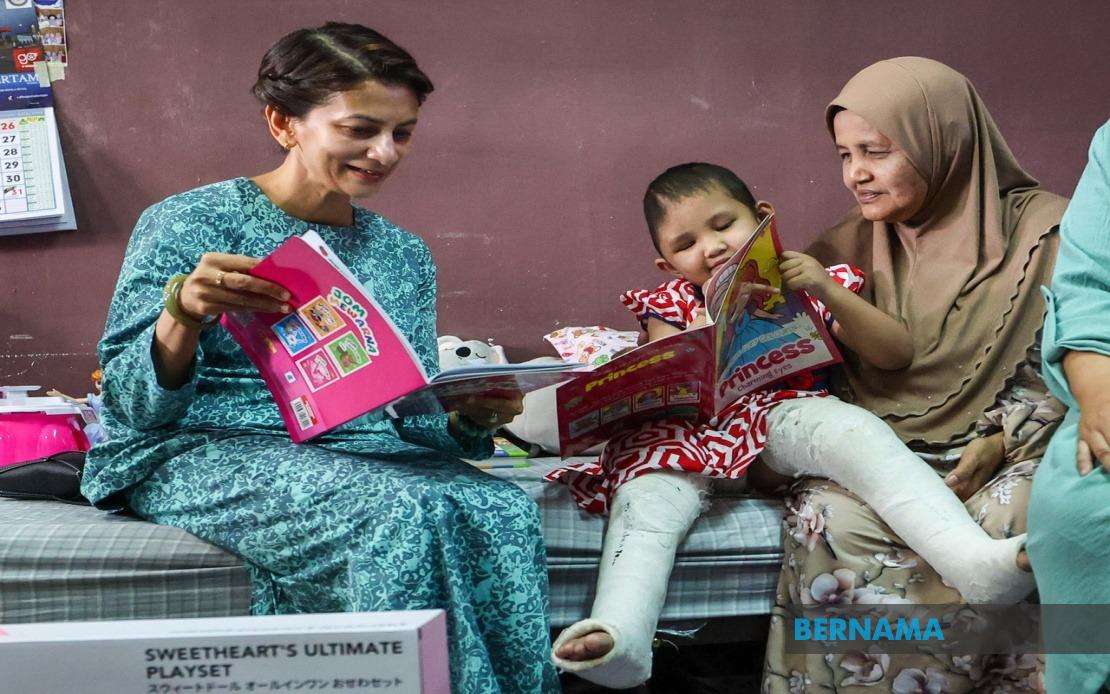
The remarkable recovery of three-year-old Aulia Sofia Ahmad Shafiq has emerged as a powerful symbol of resilience following a devastating collision last month that claimed the lives of six close relatives. The young survivor, who underwent nearly four weeks of intensive hospital treatment following the June 7 crash near Sungai Petani, was discharged from Sultanah Bahiyah Hospital in Alor Setar on July 2 and is now progressively regaining her strength under the watchful care of her paternal aunt, Siti Nor Atikah Ahmad Syukri, 32, in Bertam.
The trajectory of Aulia Sofia's recovery has confounded initial medical expectations and deeply moved those surrounding her. Her aunt described the child as "a miracle", recounting how physicians had initially held grave doubts about her prospects of survival given the severity of her injuries. Since her discharge, the young girl has demonstrated increasing activity and engagement with her environment, showing the kind of vitality and curiosity characteristic of healthy toddlers. The progress reflects not only modern medical intervention but also the supportive family environment into which she has been integrated, a crucial factor in paediatric trauma recovery.
Despite these encouraging signs, significant medical challenges remain ahead. Both of Aulia Sofia's legs sustained fractures in the collision, leaving her temporarily unable to walk. She is scheduled for a specialist orthopaedic appointment on July 26 to assess her rehabilitation prospects and determine the trajectory of her mobility recovery. Beyond the skeletal injuries, the child sustained considerable damage to her left eye, including a ruptured eyeball and associated head trauma. Medical professionals conducted emergency surgery to preserve the eye itself, though the outcome regarding her vision remains uncertain.
The question of whether Aulia Sofia will regain sight looms as a significant concern for her caregivers and medical team. Doctors have indicated that multiple scenarios remain possible: her vision could recover fully, become permanently blurred, or be lost entirely. Final determinations about her visual capacity will only emerge following additional detailed examinations, leaving her family in a period of cautious optimism tinged with anxiety about her long-term sensory development. This uncertainty reflects the complex nature of trauma-related eye injuries and the sometimes unpredictable nature of paediatric recovery.
The tragic collision itself occurred on the afternoon of June 7 when the family's newly acquired Proton X50 sport utility vehicle collided with a lorry along the route from Penang to Merbok at approximately 3:50 pm. The impact claimed the lives of Aulia Sofia's parents, Ahmad Shafiq Ahmad Shukri, 27, and Jamaliah Sannusi, 29, as well as her two-month-old brother Ahmad Mikail, her paternal grandmother Nora Mhd Husin, 55, her uncle Ahmad Fahim Ahmad Shukri, 27, and her cousin Iskandar Affan Ibrahim, seven. The loss fundamentally reshaped the family's structure and dynamics, concentrating responsibility for Aulia Sofia's care and upbringing with her aunt and uncle.
Aulia Sofia's psychological recovery has been marked by a delayed emergence from unconsciousness. The child regained consciousness approximately two weeks following the tragedy, a period during which family members maintained vigil while medical professionals worked to stabilise her condition. Following her awakening, her caregivers made the difficult decision to inform her of her parents' deaths, a conversation undertaken with sensitivity appropriate to her developmental stage and traumatic circumstances. Processing such profound loss at such a tender age presents ongoing psychological challenges that will likely shape her emotional wellbeing for years to come.
The royal family's engagement with Aulia Sofia's situation underscores the enduring role of Malaysia's monarchy in providing symbolic and tangible support during family tragedies. Tengku Sarafudin Badlishah ibni Al Aminul Karim Sultan Sallehuddin, Raja Muda of Kedah, accompanied by Raja Puan Muda of Kedah Che Puan Muda Zaheeda Mohamad Ariff and their daughter Tunku Zara Bahiyah, visited the child's home in Taman Bandar Bertam Putra to express their compassion. The visit transcended mere ceremonial gesture, with the royal party presenting material assistance to support Aulia Sofia's ongoing care and establishing a National Education Savings Scheme (SSPN) account to secure her future educational opportunities.
Siti Nor Atikah, who herself suffered the loss of her seven-year-old son Iskandar Affan Ibrahim in the same crash, expressed profound gratitude for the royal family's compassionate intervention. She characterised their visit as reflecting genuine concern for families navigating tragedy, a sentiment that resonates deeply within Malaysian society where royal patronage often provides crucial psychological and material support during community crises. The establishment of the SSPN account represents forward-thinking support that acknowledges Aulia Sofia's potential future educational aspirations despite her present circumstances.
The decision by Siti Nor Atikah and her husband Ibrahim Ghazali, 39, a lorry driver, to formally adopt Aulia Sofia and raise her as their own daughter speaks to the extended family obligations deeply embedded within Malaysian culture. The couple are progressing through legal guardianship procedures to formalise this arrangement, recognising that providing institutional clarity around Aulia Sofia's status serves her long-term interests and stability. Their existing children maintain close relationships with their cousins, and Ibrahim noted that Aulia Sofia has integrated comfortably into the household environment, surrounded by familiar faces and familiar routines that provide continuity and security following her traumatic experience.
The case of Aulia Sofia resonates more broadly across Malaysian society as a reminder of the fragility of family units and the capacity for compassion in response to tragedy. Her recovery trajectory, whilst medically incomplete and psychologically ongoing, offers a counternarrative to despair. At the same time, her circumstances illuminate the particular vulnerabilities of young children in road safety contexts and the lasting consequences of vehicular accidents, issues that continue to challenge Malaysian authorities despite ongoing public awareness campaigns and infrastructure improvements.
Moving forward, Aulia Sofia's developmental journey will require coordinated medical, psychological, and familial support spanning months and years. Her orthopaedic recovery, visual rehabilitation, and emotional processing of profound loss will unfold gradually, each milestone representing both progress and renewed challenges. The family's commitment to her care, supported by royal recognition and community awareness of her story, establishes a foundation for her recovery. Yet her experiences underscore the complex aftermath of tragedy that extends far beyond initial hospitalisation, touching every dimension of a child's emerging sense of self and place in the world.

