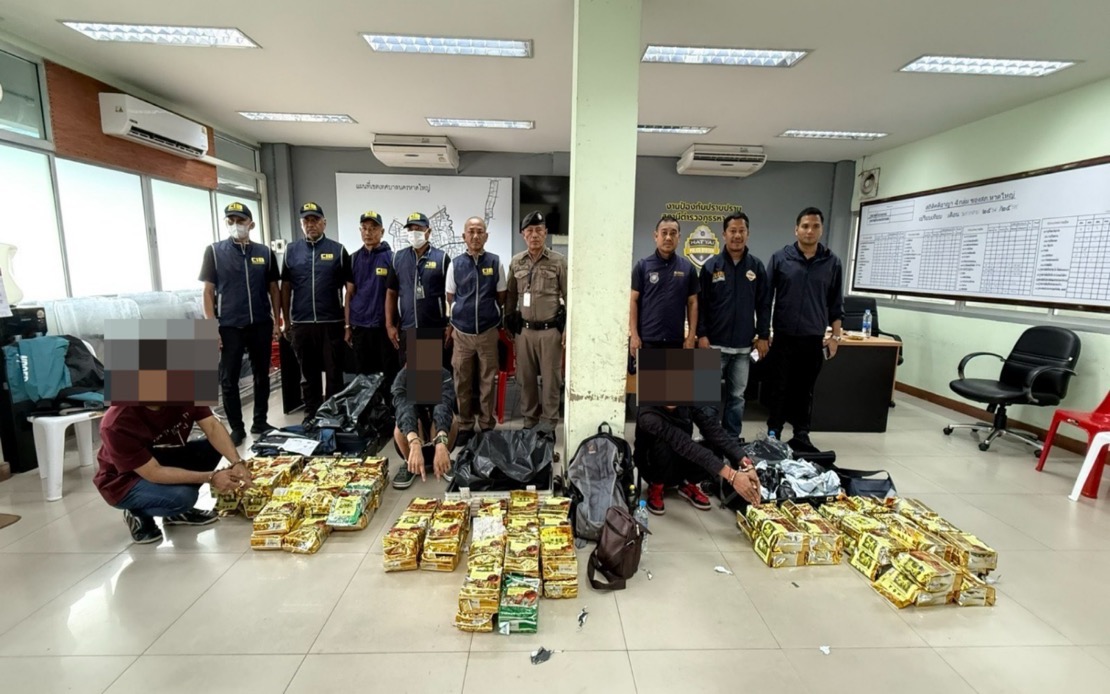
Three Malaysian men were detained at Hat Yai Railway Station in Thailand's Songkhla Province on July 31 after authorities discovered they were attempting to transport 87 kilograms of crystal methamphetamine (syabu) across the border into Malaysia. The contraband was concealed within three wheeled suitcases and three backpacks, indicating a sophisticated attempt to distribute the large quantity while evading detection.
The arrests culminated from coordinated surveillance and enforcement by multiple Thai law enforcement agencies. The operation, led by the "Tawan Hat Yai" unit, involved cooperation between the railway police, the Crime Suppression Division, the Anti-Trafficking in Persons Division, the tourist police, the Narcotics Suppression Bureau, and the Region 9 Office of the Narcotics Control Board (ONCB). According to Ratchapon Palakul, the director of Region 9 ONCB, the men were intercepted as they disembarked from a passenger train originating from Bangkok. This coordination across multiple agencies underscores Thailand's heightened vigilance at major transportation hubs, where trafficking operations frequently attempt to move narcotics across Southeast Asian borders.
Initial interrogations have provided critical leads into the supply chain behind the smuggling operation. One of the detained men confessed that syndicate members had recruited them specifically for this consignment, offering each suspect 8,000 ringgit as compensation for their role in transporting the drugs. The relatively modest payment relative to the street value of 87 kilograms of crystal methamphetamine suggests these three were low-level operatives rather than decision-makers, a common pattern in major drug trafficking networks where recruitment focuses on expendable couriers.
The legal consequences facing the trio are substantial and reflect Thailand's stringent approach to narcotics crimes. They have been formally charged with joint offences relating to possession and trafficking of Category 1 narcotics with intent to distribute. Conviction on these charges carries a maximum prison sentence of 15 years and fines reaching 1.5 million baht, equivalent to approximately 183,000 ringgit. This severity is consistent with Thailand's position as a key transit point for methamphetamine flowing from production facilities in the Golden Triangle region toward Malaysian and other Southeast Asian markets.
The timing and scale of this seizure reflects escalating drug trafficking pressures affecting Malaysia and the broader region. Crystal methamphetamine, colloquially known as "ice," has become the dominant stimulant drug in Southeast Asia, surpassing traditional heroin in many markets. The massive quantity intercepted—87 kilograms—would supply thousands of users and represents a significant disruption to supply chains that feed Malaysia's growing demand for synthetic drugs. This single bust exemplifies how trafficking organisations continuously attempt to breach border security through cross-border rail routes and other conventional transport methods.
Thailand's border regions, particularly Songkhla Province directly opposite Peninsular Malaysia, function as critical chokepoints in regional drug trade. The choice of Hat Yai Railway Station indicates the syndicate's reliance on public transportation systems where concealment among other passengers and luggage offers concealment opportunities. However, enhanced screening at major transport terminals has made detection increasingly likely, suggesting either overconfidence by the trafficking network or desperation to move inventory despite elevated risks.
The investigation phase now focuses on dismantling the broader criminal organisation behind this shipment. Thai authorities have indicated their commitment to pursuing the supply chain upstream, identifying not only the recruiters who contacted the three Malaysians but also the manufacturers, financiers, and distribution coordinators orchestrating the operation. Such investigations frequently reveal complex networks spanning multiple countries, with different cells responsible for production, smuggling, wholesale distribution, and retail supply. Understanding the full scope of these networks assists Malaysian authorities in interdicting shipments at source before they cross into national territory.
This seizure carries implications for Malaysia's own drug enforcement priorities. With crystal methamphetamine now representing a leading illicit drug category in Malaysian seizure statistics, the emergence of large transnational shipments indicates supply chains are becoming increasingly brazen and high-volume. The fact that smugglers were willing to transport 87 kilograms across an international border via public transport suggests they believe market demand justifies the risk. This assessment may reflect rising consumption patterns among Malaysian users, particularly in urban centres where stimulant use prevalence has increased substantially over recent years.
Coordination between Malaysian and Thai authorities remains essential for interdicting transnational drug movements. The successful joint operation demonstrates how intelligence sharing and coordinated enforcement at border crossing points can yield significant results. However, the continuous adaptation by trafficking syndicates—employing different routes, concealment methods, and recruitment patterns—ensures that individual seizures represent only temporary disruptions to overall supply flows. Systematic degradation of trafficking capacity requires sustained, intelligence-led enforcement across the region.
The three Malaysians now face extended periods in Thai custody while facing conviction proceedings under Thai law, underscoring the extraterritorial risks Malaysian nationals incur when participating in drug trafficking. Their eventual prosecution will serve as deterrent messaging to potential recruits, though organised syndicates typically maintain recruitment pipelines that replace apprehended couriers. The case exemplifies how Malaysia's proximity to production regions, coupled with substantial domestic demand, creates persistent vulnerability to transnational drug trafficking operations targeting Malaysian markets through multiple border corridors.

