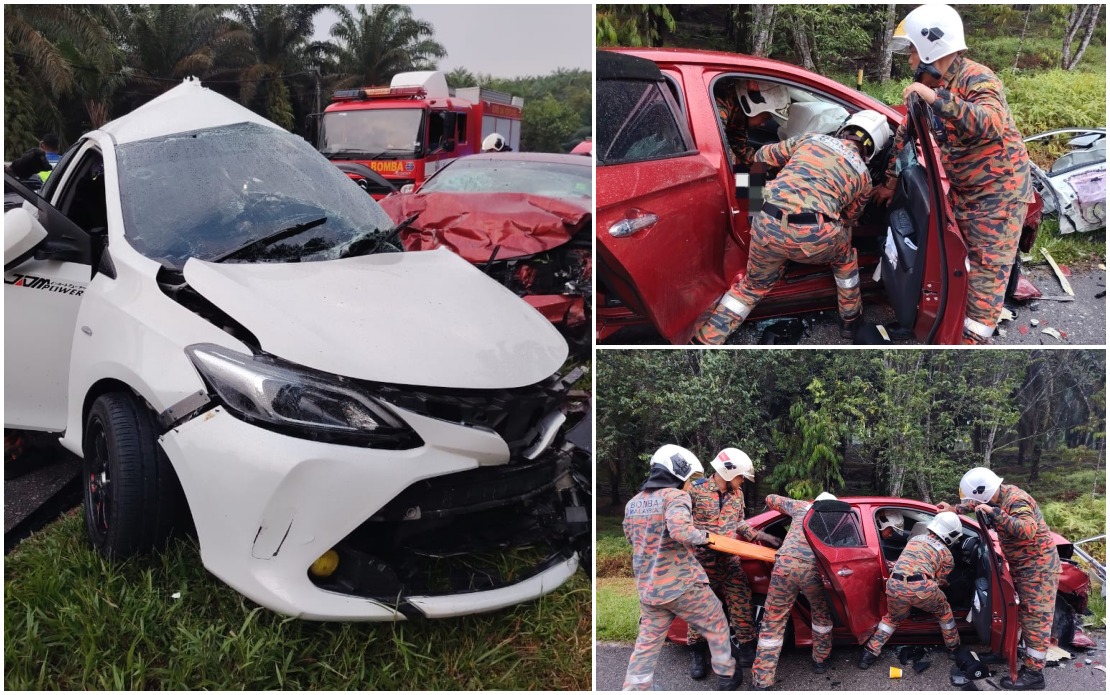
A fatal collision in Kota Tinggi claimed three lives on Sunday afternoon, highlighting continuing road safety concerns in Johor's busy transport corridors. The crash occurred near a petrol station in the Tanjung Leman area along Jalan Jemaluang, bringing together emergency responders from multiple agencies to manage the aftermath of the incident. The victims—two occupants of a Honda City and one driver of a Toyota Vios—were pronounced dead at the scene by Health Ministry officers, underscoring the severity of the impact.
Fire and rescue services received notification of the collision at 5:05 pm and swiftly mobilised a team of eight firefighters to the location, which lay approximately 45 kilometres from their station. Upon arrival, the team encountered a scene involving two passenger vehicles in close contact, requiring specialised extraction techniques to remove the deceased from the wreckage. Senior Fire Officer II Azlan Hamzah, leading operations at the scene, explained that the rescue operation necessitated the use of hydraulic cutters to access the trapped victims, who were subsequently transferred onto stretchers for handover to police authorities.
The victims included a 21-year-old man and a 20-year-old woman travelling together in the Honda City, along with a 31-year-old man operating the Toyota Vios. Their ages suggest that at least two of the victims were young adults, potentially at the start of their productive lives—a tragic pattern that recurs regularly on Malaysian roads. The prompt response from fire services, concluding their operations by 6:59 pm, demonstrated coordinated emergency management, though the brief window between notification and operation completion left little room for intervention that might have altered outcomes.
Kota Tinggi district police chief Supt Othman acknowledged in a subsequent statement that investigators had commenced preliminary inquiries into the circumstances surrounding the collision. The police confirmed that further details would be released once their investigation reached conclusions, indicating that determining factors such as vehicle speed, driver visibility, and potential mechanical failures remained under examination. The location near a petrol station suggests that the area experiences considerable traffic flow, potentially complicating visibility and reaction times for drivers navigating the route.
This incident occurs within a broader context of road fatalities affecting Malaysia's transportation system. The Johor region, encompassing Kota Tinggi, has historically recorded elevated numbers of serious accidents along main highways, particularly during afternoon and evening hours when traffic density peaks. Two-vehicle frontal or side-impact collisions of this nature typically indicate high-speed impacts or sudden evasive manoeuvres by one or both drivers, circumstances that frequently prove fatal despite modern vehicle safety features including airbags and structural reinforcement.
The choice of vehicles involved—compact sedans favoured by Malaysian motorists for urban and highway travel—raises questions about the protective capacity of smaller vehicles in high-impact scenarios. While both the Honda City and Toyota Vios incorporate contemporary safety technologies, the fatality rate in this incident suggests that collision dynamics overwhelmed these protections. Such outcomes reinforce ongoing debates within safety advocacy circles regarding the balance between vehicle affordability and protective capability in the Malaysian automotive market.
Emergency response protocols demonstrated in this incident reflect established procedures within Johor's fire and rescue services. The dispatch of eight personnel indicates recognition of the extrication challenges posed by vehicle entanglement, and the employment of mechanical cutting equipment proved essential for victim recovery. However, the operational duration—approximately two hours from notification to conclusion—highlights the time-intensive nature of serious traffic incident management, during which additional collisions may occur on affected roadways as congestion builds.
For Malaysian road users, this collision serves as a sobering reminder of accident risks during peak travel periods. The afternoon timeframe suggests driver fatigue or reduced concentration after working hours, factors commonly implicated in collision causation. Johor's major routes, while essential for regional commerce and connectivity, demand heightened vigilance from all motorists, particularly near high-traffic zones such as petrol stations where unexpected vehicle movements and variable speeds create additional hazard layers.
The investigation proceeding under Supt Othman's direction will likely examine vehicle mechanical condition, road surface factors, weather conditions at the time, and driver behaviour preceding impact. Such inquiries occasionally yield findings that prompt public safety advisories or infrastructure modifications, though outcomes typically emerge weeks after incidents conclude. Until findings are released, the precise causation remains speculative, though the severity and fatality outcome point toward either substantial speed differentials or unexpected driver actions creating collision conditions beyond recovery capacity.
This tragedy adds to Malaysia's annual road fatality statistics, which consistently exceed targets set by safety authorities. The three deaths represent families affected by sudden loss and communities impacted by preventable trauma. Road safety remains a multifaceted challenge requiring sustained attention to driver behaviour, vehicle standards, road infrastructure, and emergency response capabilities—areas requiring coordinated effort across government, private sector, and individual motorist responsibility. Each incident carries potential lessons that, if properly implemented, might prevent similar outcomes on Malaysian roads.

