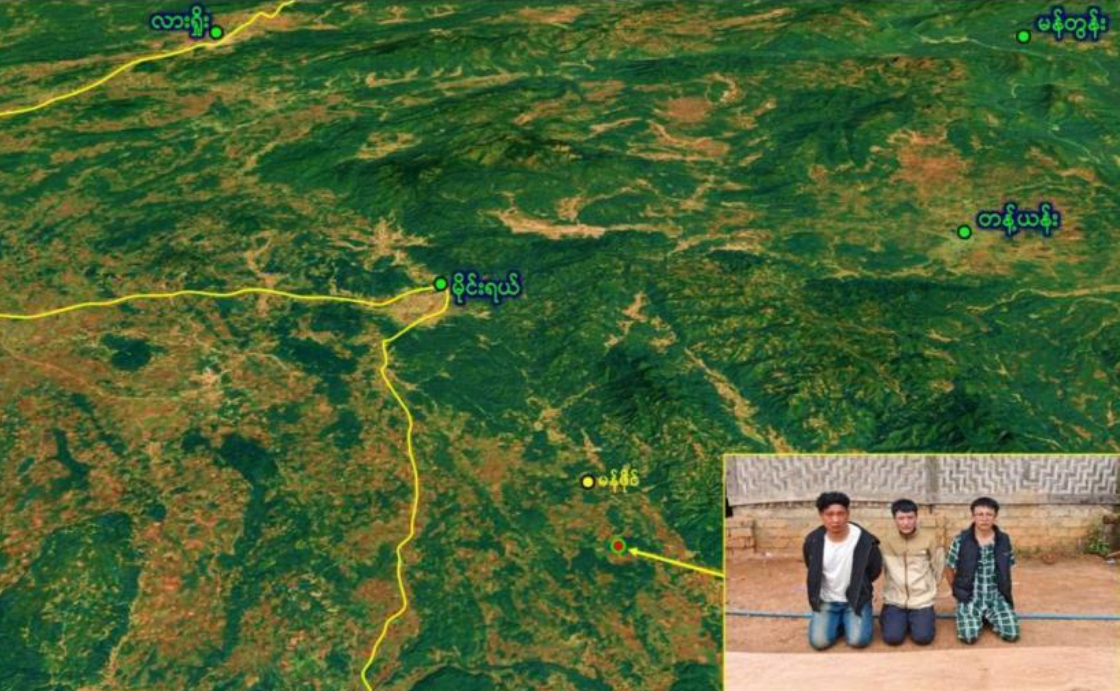
Myanmar's military has apprehended three Chinese nationals suspected of orchestrating an online gambling scam network in Mongyai Township, part of the country's intensifying campaign against cross-border cybercrime. The operation, conducted on August 26 in northern Shan State, represents the latest enforcement action targeting transnational fraudsters exploiting Myanmar's porous borders and remote terrain to launch schemes that prey on victims across Southeast Asia and beyond.
The suspects allegedly entered Myanmar illegally and had established a makeshift compound approximately 26 kilometres southeast of Mongyai town and five kilometres south of Manphai Village. Local residents first alerted authorities to suspicious activity in the area, reporting that individuals involved in online scam gambling had erected temporary structures to shield their operations from detection. This intelligence prompted security personnel to launch investigations that culminated in the arrests and facility seizure.
The sophistication of the confiscated infrastructure reveals the scale at which these operations function. Authorities recovered one corrugated iron-roofed building measuring 50 by 20 feet alongside five temporary tarpaulin shelters of varying dimensions—a setup designed for rapid deployment and relocation if law enforcement closed in. The equipment seizure tells an equally revealing story: 25 mobile phones, five all-in-one computers, two power stations, one Starlink satellite internet device, and ten communication radios. This combination of hardware suggests a well-organised network capable of managing multiple customer interactions simultaneously while maintaining redundant communication channels.
The inclusion of a Starlink device in the seized equipment underscores how international online gambling syndicates leverage cutting-edge satellite technology to maintain consistent connectivity in remote border zones where traditional internet infrastructure remains sparse. This capability allows operators to sustain real-time gambling platforms serving clients across multiple countries without reliance on conventional telecom networks that are easier to monitor and intercept. The technical sophistication stands in sharp contrast to the deliberately low-profile physical footprint the gang attempted to maintain.
Myanmar's border regions have become increasingly attractive to transnational criminal syndicates operating online gambling and scamming enterprises. The country's geographical position, spanning multiple national boundaries with limited institutional capacity in peripheral zones, creates an environment where foreign criminal networks can establish operations with relative impunity. Northern Shan State, already home to various armed groups and economic activities operating outside state control, provides natural cover for such ventures. The porous nature of Myanmar-China border crossings in particular has enabled a steady influx of operators seeking jurisdictions where enforcement remains inconsistent.
Online scam gambling represents a particularly insidious form of cybercrime because it combines elements of financial fraud, illegal gaming, and often human trafficking—as operators frequently coerce workers into managing customer interactions under duress. Victims, frequently recruited through social media and dating apps across Southeast Asia, invest sums they believe will generate returns, only to lose their money to rigged games and manipulated odds. The psychological toll on victims mirrors that of conventional scam operations, but the scale and speed of financial extraction through online platforms can be devastating.
Myanmar's national-level campaign against online scams represents a recognition by the government that such operations pose significant threats to regional stability and public trust. When citizens lose substantial sums to cross-border scams, the resulting economic damage ripples through communities and undermines confidence in digital financial systems. Additionally, online gambling and scamming operations frequently launder proceeds through informal channels and cryptocurrency transactions, creating money-laundering risks that extend far beyond Myanmar's borders. The strategic focus on border areas acknowledges where these operations cluster most densely.
The enforcement approach combines intelligence gathering from communities with systematic military-led security sweeps. By dismantling temporary structures and seizing operational equipment, authorities aim to create friction costs that make Myanmar less attractive as an operational base. However, the mobile nature of these setups—with tents and temporary shelters rather than permanent structures—means operators can relocate to new sites relatively quickly if surveillance pressure increases. Success requires sustained operations rather than isolated raids.
For Malaysian readers and Southeast Asian stakeholders, this development carries direct relevance. Online scam gambling operations typically target victims across the region indiscriminately, and Malaysian citizens represent a significant portion of those defrauded. The syndicates operating from Myanmar often exploit social media platforms and cryptocurrency payment systems accessible throughout Malaysia, making cross-border cooperation on cybercrime enforcement increasingly essential. Myanmar's commitment to combating these networks, though still developing, represents progress in addressing a problem that individual nations cannot solve alone.
The arrested suspects will face charges under Myanmar's existing laws once questioning and investigations conclude. Authorities indicated that seized equipment will be processed according to established procedures, likely meaning destruction of operational devices and documentation of evidence for prosecution. The statement that illegally constructed shelters will be systematically dismantled signals an intention to make border zones less hospitable for such operations, though implementation challenges remain significant given Myanmar's limited resources and territorial control issues.
The sustainability of Myanmar's enforcement efforts depends partly on capacity-building support and intelligence-sharing arrangements with neighbouring countries. Thailand, Laos, and Malaysia have all reported significant problems with cross-border online scam operations, suggesting potential for regional cooperation frameworks. As these criminal networks adapt to enforcement pressure in one location by shifting operations to others, coordinated approaches that increase risks and reduce opportunities across multiple jurisdictions become increasingly important for disrupting the broader ecosystem supporting these syndicates.

