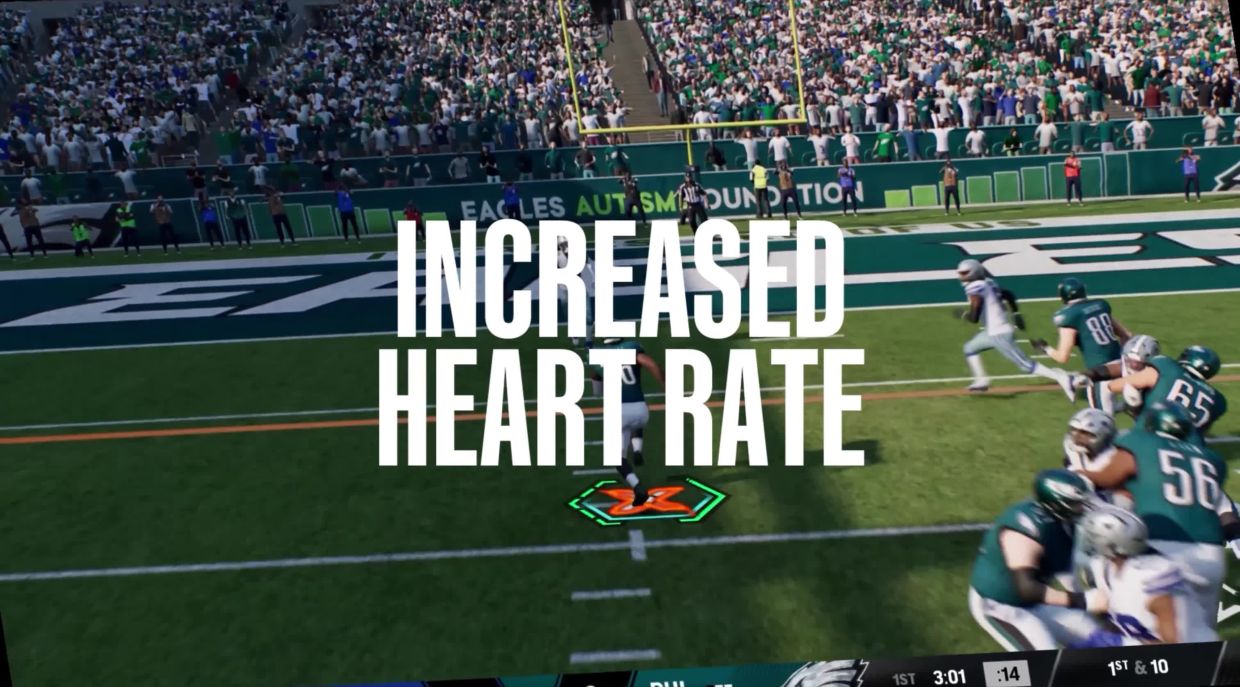
The latest edition of Madden NFL, the world's most popular American football simulation, bills itself as increasingly realistic. Yet something fundamental is missing from the gridiron: concussions. When a linebacker drives New York Giants running back Cam Skattebo headfirst into the turf on a routine play, the game registers nothing. No injury protocol. No sideline evaluation. Nothing. But for the growing number of players downloading a free community modification, that violent collision triggers an entirely different experience—one that mirrors what neuroscientists know concussions actually feel like. The screen blurs, vision becomes painfully sensitive to light, nausea sets in, the heart rate climbs, a persistent ringing sound pierces the audio, and the display shakes with dizziness. This single mod represents a profound contradiction at the heart of American football culture: a game designed for total realism that systematically erases one of sport's most damaging injuries.
The modification, spanning 9,000 lines of code, amounts to an indictment wrapped in game design. Electronic Arts and the NFL have jointly decided that depicting concussions—injuries that affect millions of players from youth leagues through professional ranks—is somehow incompatible with the franchise's mission to deliver authentic football simulation. When players inquired why the mod was necessary at all, the answer became unavoidable: the industry had made a deliberate choice to sanitise the game. This erasure did not happen randomly. It followed years of mounting pressure as evidence accumulated that American football, particularly at the professional level, inflicted catastrophic brain damage that organisations had long minimised or ignored. The NFL's settlement of a US$1.5 billion lawsuit from former players alleging the league concealed the dangers of repeated head trauma, combined with the 2015 film Concussion starring Will Smith, fundamentally changed how the sport was publicly discussed. Yet the Madden franchise—which reaches millions of young people annually—responded not by incorporating realistic injury consequences but by removing them entirely.
Chris Borland, the linebacker who walked away from his NFL career during his rookie season specifically because of concerns over chronic traumatic encephalopathy, acknowledged the mod's awareness-raising potential while identifying its core limitation. Sitting safely on a couch watching a pixelated player experience blurred vision and tinnitus bears almost no resemblance to the lived reality of concussion. "It's really realism up to a point," Borland reflected, noting that authentic simulation would require depicting the longer-term psychological consequences: difficulty with relationships, cognitive decline, emotional volatility—the daily suffering that persists long after the initial impact. A truly realistic Madden would show a player stumbling through post-concussion syndrome, struggling to focus at work or home, wrestling with depression. That version of the game would be uncomfortable to play. It would force young players to confront what actually happens when the brain collides with the skull repeatedly. The industry clearly decided that discomfort was unacceptable.
The historical record reveals how systematically concussions disappeared from Madden. During the 1990s, injured players were wheeled away by ambulances. Through much of the 2010s, those who suffered apparent head injuries underwent on-field evaluations mimicking the NFL's sideline concussion protocol. Then, abruptly, the feature vanished. The timing was no accident. It coincided precisely with the moment American culture began seriously grappling with football's neurological toll. Hall of Fame linebacker Junior Seau's suicide in 2018 followed by posthumous diagnosis of chronic traumatic encephalopathy shattered the mythology that only repeated collisions over decades caused brain disease. The subsequent litigation and settlements forced the NFL to acknowledge what independent researchers had demonstrated: football at the highest level was damaging players' brains in measurable, permanent ways.
Ben Utecht, a tight end who retired in 2010 due to concussion concerns, articulated the league's unspoken logic: promoting awareness of head injuries threatened the sport's expansion. "The league never wanted to bring attention to head injuries because obviously you want to inspire parents and kids to continue playing the game," Utecht explained. The commercial interest superseded the medical reality. By removing concussions from Madden, the NFL and Electronic Arts achieved something subtler than simply denying the problem—they made it literally invisible to millions of young people during their formative years. A teenager spending hundreds of hours with Madden gains no experience processing head injuries as a game mechanic. They never practice making decisions about player safety. They never develop a mental framework for understanding that football fundamentally trades brain health for athletic achievement. This represents a profound form of injury denial, operating through absence rather than assertion.
The NFL's licensing department, which reviews Madden annually for "quality control," engaged in specific discussions about how concussions should be incorporated—or whether they should appear at all. A former league executive recalled negotiations focused on the challenge of realistic implementation: in actual football, two players might experience identical impacts to the head, yet only one develops a clinical concussion. The unpredictability made coding concussions difficult. Rather than solve this design problem, the parties decided erasure was preferable. This reveals the true priority: not realism in service of understanding the sport, but realism exclusively in dimensions that maintain football's appeal. Meanwhile, other injuries remain fully represented. Gamers must weigh whether to keep a player with an ankle bruise on the field, risking greater injury, or substitute him out. The game forces meaningful decisions about player welfare—just not about heads.
The statistics underlying the silence have grown grimmer. Last season, the NFL recorded 168 reported concussions, up from 129 the previous year—an increase the league attributed to rule changes encouraging more kick returns. These are only officially diagnosed cases, meaning the actual number of head impacts and subclinical injuries vastly exceeds the recorded figure. Yet Madden, theoretically the most accessible tool for teaching young people about football's actual mechanics, teaches them nothing about this reality. Young players learn to evaluate ankle injuries, muscle strains, and minor fractures. They learn nothing about the cumulative impact of heading the ball, absorbing tackles, and colliding with opponents repeatedly over a season.
The Derek Sheely Foundation represents the human cost of this silence. Derek Sheely, a fullback at Frostburg State University, suffered a head injury during practice in 2011. When he reported a subsequent headache, according to court documents, a coach berated him for complaining and sent him back into a 7-on-7 drill. During the next play, Sheely collided with a defensive back. He walked to the sideline but within minutes collapsed and never regained consciousness. He died at 22. His family eventually reached a US$1.2 million settlement with the NCAA and Frostburg State, which retired his number 40. The tragedy illuminates what happens when organisations prioritise optics over genuine safety awareness. Had more young athletes and their coaches experienced realistic consequences of head impacts through their entertainment—through games like Madden—a coach might have made different decisions about Sheely's return to play.
Kristen Thomson Sheely, Derek's mother and executive director of the foundation bearing his name, understood the mod's potential precisely because she knew how deeply Madden infiltrated youth culture. Her son played constantly. The concussion modification could theoretically reach "a whole different audience of people who would never order a concussion kit," she reflected. But that audience should not require a fan-created workaround to access basic information about brain safety. The very existence of a grassroots mod proves the official version fails its claimed mission of realism. Electronic Arts declined to comment on the mod or the design philosophy behind omitting concussions, a silence that speaks volumes.
When players complete a game using the concussion mod, a banner unfurls showing Derek Sheely's number 40—a digital memorial to a preventable tragedy. This gesture transforms the modification from mere awareness campaign into something more pointed: an accusation. It asks whether a medium so committed to authenticity in every other dimension can morally justify erasing the injury that most threatens its participants. The question resonates across Southeast Asia, where American football fandom grows among youth seeking connection to global sports culture. Young Malaysian, Indonesian, and Thai players downloading Madden encounter the same sanitised version, learning nothing about the neurological risks that should inform their own participation in contact sports generally. The international implications extend beyond football: any sport celebrating toughness over safety learns from this model. The mod's creators hope their work increases awareness. They implicitly acknowledge that the official product—with all its technological sophistication and designer polish—failed that basic obligation.

