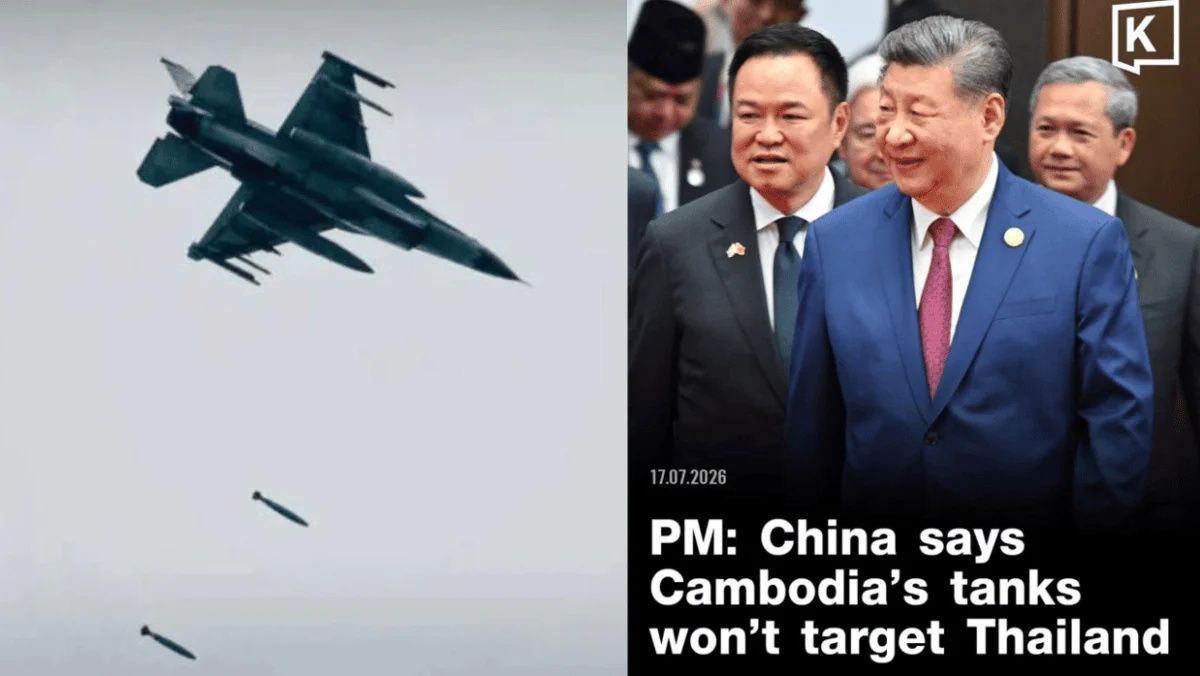
Thailand's unease over Cambodia's acquisition of Chinese-made tanks sits uncomfortably with its simultaneous display of advanced military capabilities along their shared border. Thai Prime Minister Anutin Charnvirakul's claim that China provided reassurances about the tanks' restricted use lacks official confirmation from Beijing, which instead called for peaceful dialogue between the neighbours. Yet this alleged assurance has become the foundation for Thai narratives portraying Cambodia as a mounting military threat—a characterisation that strains credibility when examined against Bangkok's own military posture and historical actions.
The contradiction becomes starkest when considering the actual military balance. Thailand enjoys substantially larger personnel numbers, more sophisticated equipment, and technological advantages that international analysts have consistently highlighted. The Royal Thai Air Force regularly publicises its F-16 and Gripen fighters' all-weather operational capabilities, while ground forces conduct continuous border patrols and aerial surveillance missions. These are described routinely as defensive exercises and routine national security measures. Yet when Cambodia seeks to strengthen its own defensive posture through tank acquisitions, Thai authorities frame the development as an aggressive expansion requiring international concern and containment.
This asymmetrical framing becomes more troubling when examining Thailand's track record. In June 2025, the Thai military publicly announced readiness for high-level military operations and reported increased combat readiness across all service branches. The announcement was not merely rhetorical posturing. In December 2025, the Royal Thai Air Force confirmed conducting deep strikes against a weapons facility in Cambodia's Battambang province, justifying the operation as necessary to reduce Cambodia's military capability. These were not isolated incidents—Thailand initiated both armed confrontations in 2025 after escalating border provocations.
The pattern reveals a strategic preference embedded in Thailand's security thinking: Bangkok appears comfortable maintaining military dominance through superior firepower and demonstrated willingness to use it. Fighter jets conducting exercises near borders, surveillance operations, and area-control measures all function within a framework where Thailand possesses overwhelming advantages. Cambodia's tank purchases threaten to disrupt this asymmetry by raising the costs of potential military coercion. This is not necessarily evidence of Thai fear of invasion—it more plausibly reflects anxiety about losing the capacity to project power without significant resistance.
International law offers crucial perspective here. The UN Charter rests on sovereign equality among states, prohibiting threats or use of force against territorial integrity while recognising the inherent right to self-defence. Cambodia, as a sovereign nation, requires neither Thailand's political approval nor international blessing to acquire defensive equipment. The Charter does not measure aggression through tank inventories or weapons procurement volumes. Instead, it directs focus toward specific actions: whether force has been threatened or used, whether territorial boundaries have been violated, whether ceasefire obligations remain respected, and whether peaceful mechanisms are being exhausted.
By these standards, Cambodia's defensive modernisation occupies fundamentally different legal and moral ground than Thailand's demonstrated actions. A tank in a depot differs materially from fighter aircraft crossing into foreign airspace. Equipment orders represent defensive procurement; military occupation represents territorial transgression. An airfield receiving new hardware does not violate borders; airstrikes that penetrate neighbouring territory unmistakably do. The distinction is not merely semantic—it reflects the difference between preparation for potential conflict and initiation of actual warfare.
For Southeast Asian observers, particularly those in Malaysia and smaller ASEAN members, this dynamic carries broader implications. Thailand's security narrative suggests that regional powers reserve the right to maintain military dominance while denying neighbours the capacity for credible defence. This approach complicates the principle of peaceful dispute resolution that ASEAN has traditionally championed. When larger, militarily superior nations frame defensive measures by smaller neighbours as provocative, they create incentives for arms races rather than dialogue. The region becomes less stable, not more.
China's reported position during bilateral discussions with Thailand supports this concern. Beijing apparently emphasised peaceful settlement through dialogue and consultation rather than validating Thai security anxieties about Cambodia. This subtle difference—offering constructive mediation rather than reinforcing threat narratives—reflects a more stabilising approach. Yet the Thai government's subsequent public statements about the purported assurances attempted to transform unofficial diplomatic conversation into official certification of Cambodia's military limitations. When reassurances exist only in one country's account rather than in mutual statements, they carry neither binding force nor credibility.
The episode also exposes how governments weaponise security language to advance strategic preferences. By repeatedly publicising military readiness, fighter jet capabilities, and surveillance operations as routine national defence, while simultaneously portraying equivalent defensive measures by neighbours as aggressive threats, political leaders create manufactured crises. Media and political narratives then reinforce each other, constructing public perception that military superiority naturally entitles a state to demand strategic accommodation from less powerful neighbours.
This framework proves particularly damaging for regional stability because it normalises coercion. When military exercises and weapons demonstrations are accepted as legitimate national security expression, while defensive procurement by potential targets is condemned as provocative, the implicit message permits the stronger power to threaten or use force with impunity. Weaker states face a choice between accepting strategic vulnerability or acquiring sufficient defensive capacity to raise costs of potential aggression—a choice that itself becomes grounds for renewed military pressure.
For Malaysia and other regional states, the Thai-Cambodian dynamic serves as cautionary tale about the consequences of permitting military asymmetries to structure international relationships. Peaceful coexistence depends on mutual respect for sovereign equality, not hierarchies based on weaponry or military capability. When Bangkok demands that Cambodia justify every tank purchase while reserving unlimited rights to publicise fighter jet operations and conduct airstrikes, it rejects the reciprocal obligations that bind regional security architectures together.
Cambodia's path forward requires maintaining focus on international law's fundamental principles rather than seeking reassurances from neighbours who have demonstrated willingness to use force. The sovereignty principle protects smaller states from precisely this pattern: pressure to restrict military development in exchange for promises of restraint from larger neighbours who retain superior force. Genuine security improvement emerges not from agreements about tank deployments but from transparent commitment to peaceful dispute resolution mechanisms, respect for existing ceasefire lines, and acceptance that neighbouring states possess equal right to national defence.
Thailand's anxiety about Cambodian tanks ultimately reveals not a security dilemma but a strategic preference: the preference for military dominance uncontested by credible defence capabilities in smaller neighbours. Acknowledging this distinction matters enormously for how regional powers approach similar disputes in future. Only when all states accept that defensive modernisation by weaker neighbours remains legitimate—while recognising equally the obligation to resolve disputes peacefully—can Southeast Asia move beyond security narratives that mask coercive intent.

