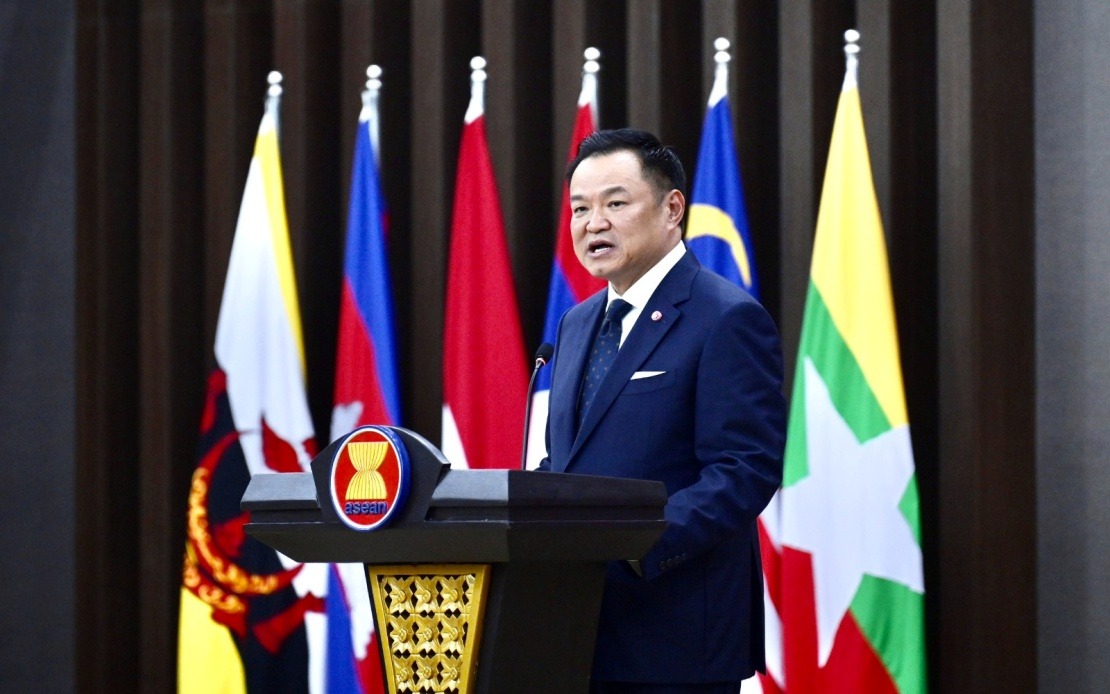
Thai Prime Minister Anutin Charnvirakul has articulated a forward-looking vision for ASEAN during remarks delivered at the ASEAN Secretariat in Jakarta, positioning the 10-member bloc as a more robust and inclusive regional institution. The address, which came during Anutin's maiden official visit to Indonesia since assuming office as Thailand's 32nd prime minister in September 2025, laid out three interconnected pillars for the organisation's future development: strengthening regionalism, building resilience against global uncertainties, and ensuring the bloc delivers measurable benefits to ordinary citizens across member states.
The Thai leader's emphasis on "people-centred" development represents a deliberate pivot away from purely state-to-state diplomacy, signalling recognition that ASEAN's legitimacy ultimately depends on improved living standards, economic opportunities, and security outcomes for its 650 million inhabitants. This rhetorical shift carries particular resonance for Southeast Asian populations facing mounting pressure from technological disruption, climate-related vulnerabilities, and uneven economic growth. By anchoring his vision in tangible outcomes rather than abstract institutional goals, Anutin has positioned Thailand as advocating for results-oriented policymaking within a bloc often criticised for moving slowly on substantive reforms.
Central to Anutin's argument is the proposition that contemporary geopolitical, economic, technological, and security challenges transcend national borders and therefore demand coordinated regional responses. This framing implicitly acknowledges the limitations of individual Southeast Asian states when confronting powers like China, India, and the United States, each of which maintains competing strategic interests throughout the region. The assertion that "no single country" can resolve these challenges unilaterally carries particular weight for smaller ASEAN members that lack independent capacity to influence global outcomes, making collective action not merely desirable but essential for national security and prosperity.
Yet Anutin's proposal to apply ASEAN's founding principles of consensus and non-interference "with greater flexibility" introduces a nuanced and somewhat controversial element. Traditional ASEAN procedures, built on these twin pillars, have historically prioritised sovereignty and solidarity over rapid decision-making, allowing member states to block initiatives they oppose. His suggestion that these principles warrant reinterpretation reflects growing frustration with institutional gridlock—a sentiment likely shared by other regional governments increasingly frustrated with the bloc's inability to effectively address issues ranging from Myanmar's political crisis to environmental degradation and transnational organised crime. However, any attempt to dilute consensus or non-interference risks alienating member states deeply attached to these founding concepts.
The Thai premier outlined several concrete priority areas warranting intensified regional cooperation. Strengthening supply chains, ensuring food and energy security, and accelerating digital connectivity represent pragmatic concerns directly impacting ASEAN citizens' daily lives. These initiatives carry particular salience for Malaysia and other Southeast Asian economies increasingly vulnerable to global supply chain disruptions, resource volatility, and technological competition from China and developed markets. Anutin's emphasis on preparing young people for the digital economy acknowledges demographic realities—ASEAN contains a youthful population with expectations for modern employment opportunities—and recognises that failure to invest in digital literacy and education risks creating intergenerational inequality and social instability.
Anuin also stressed the importance of expanding cooperation with "middle powers and the Global South," a formulation reflecting ASEAN's broader strategic positioning amid great power competition. This language suggests a deliberate diversification strategy, seeking partnerships beyond traditional Western allies whilst avoiding over-dependence on any single major power. For Malaysia, caught between competing Chinese and American interests, such balancing acts remain central to foreign policy calculation. ASEAN's engagement with countries across Africa, Latin America, and South Asia potentially creates new markets, investment sources, and diplomatic allies capable of counterbalancing hegemonic pressure from either Washington or Beijing.
On Myanmar specifically, Anutin reiterated Thailand's support for ASEAN's Five-Point Consensus whilst advocating "calibrated re-engagement" with the military-ruled state. This diplomatic formulation attempts to thread a difficult needle: maintaining ASEAN pressure on Myanmar's junta whilst simultaneously keeping channels open for dialogue and incremental progress. The reference to the International Committee of the Red Cross' visit to detained former State Counsellor Aung San Suu Kyi—reported in good health—signals that limited engagement has yielded modest humanitarian gains. For Thailand, which shares a lengthy land border with Myanmar and faces consequences of regional instability including refugee flows and armed group activity, this balanced approach reflects genuine strategic concerns rather than merely rhetorical positioning.
Anuit's discussion of Thai-Cambodian relations emphasised mutual trust-building and peaceful conflict resolution, reflecting efforts to stabilise bilateral ties that have experienced periodic friction over historical grievances and border delineation. The commitment to resolve disputes "peacefully under international law" carries significance for Malaysia and other Southeast Asian states conscious of their own maritime and terrestrial boundary challenges. By explicitly championing international legal frameworks, Anutin subtly reinforces mechanisms that benefit smaller states over those relying on military strength or geographic proximity to resolve boundary questions—a principle with obvious relevance across Southeast Asia's contested waters and overlapping territorial claims.
Thailand's reassertion of commitment to ASEAN unity and "common agenda" in the context of bilateral relations suggests the Thai government recognises that regional cohesion depends not merely on bloc-level decisions but on bilateral relationships functioning smoothly. Individual dyadic relationships among member states generate friction that inevitably affects collective decision-making and institutional effectiveness. By highlighting efforts to rebuild trust with Cambodia, Anutin implicitly acknowledges ASEAN's structural vulnerability to member state conflicts undermining overall solidarity.
The significance of Anutin's Jakarta visit extends beyond the substance of his remarks. This represents the first official visit by a Thai prime minister to Indonesia in 15 years, underscoring both the importance Bangkok places on the relationship with Southeast Asia's largest economy and the extent to which Thai-Indonesian ties had atrophied during the preceding period. Indonesia's role as ASEAN chair and de facto leader confers considerable influence over the bloc's agenda and priorities. By making this visit his first to a fellow Southeast Asian capital as premier, Anutin has signalled that strengthening the Thailand-Indonesia bilateral relationship constitutes a top foreign policy priority, with implications for ASEAN's broader institutional functioning.
Thailand's positioning itself as an active voice in shaping ASEAN's future ahead of the bloc's 60th anniversary in 2026 reflects broader ambitions to play a prominent role in determining the regional organisation's evolution. For Malaysian observers, Anutin's agenda offers both opportunities and challenges. The emphasis on people-centred development and tangible benefits aligns with Malaysian interests in economic cooperation and security. However, any institutional reforms making ASEAN decision-making more flexible could create unpredictability disadvantageous to smaller economies preferring clearly established rules and procedures. Thailand's advocacy for re-engagement with Myanmar tests Malaysia's own positions on democratic principles versus pragmatic engagement, forcing policymakers to reconsider how firmly to insist on Myanmar junta accountability versus maintaining regional stability.
Looking forward, Anutin's vision will likely shape ASEAN discourse throughout the lead-up to the bloc's anniversary celebrations. Success in implementing his agenda requires sustained commitment from member states facing competing domestic priorities and resource constraints. Whether ASEAN can meaningfully strengthen regionalism, enhance resilience, and deliver tangible citizen benefits whilst maintaining consensus and respecting sovereignty remains the fundamental challenge confronting the regional organisation.

