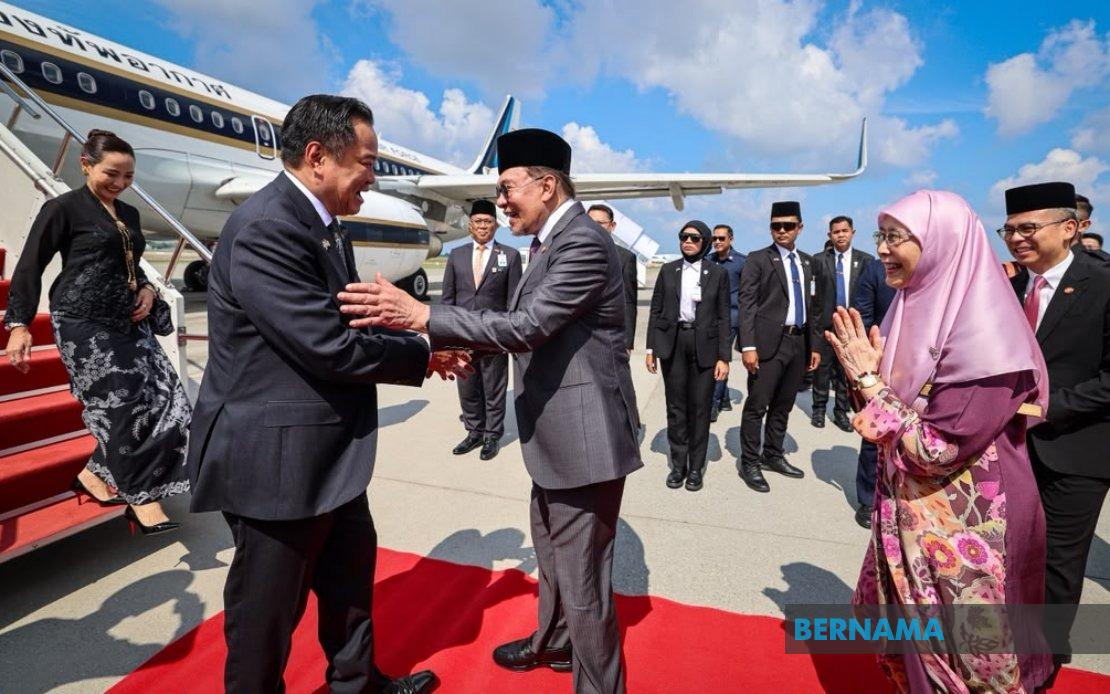
Thai Prime Minister Anutin Charnvirakul touched down at Kuala Lumpur International Airport this morning to commence a two-day official visit that underscores the deepening strategic partnership between Malaysia and Thailand. His arrival, together with his spouse Thananon Charnvirakul, was marked by a ceremonial reception at the Bunga Raya Complex at 11.11 am, where Prime Minister Datuk Seri Anwar Ibrahim welcomed him personally. The presence of Anwar's wife, Datuk Seri Dr Wan Azizah Wan Ismail, and Communications Minister Datuk Fahmi Fadzil, who served as the receiving minister, highlighted the significance Malaysia places on this engagement.
The formal welcome protocol reflected the diplomatic importance of the occasion. A full guard of honour comprising 34 officers and personnel from the First Battalion of the Royal Ranger Regiment, commanded by Major Muhammad Nur Addeen Mustaza, was mounted in Anutin's honour. Both national anthems were played in sequence, followed by introductions to Malaysian Cabinet ministers and senior government officials—a customary element that allows visiting leaders to establish connections with the broader Malaysian political establishment. This was Anutin's inaugural visit to Malaysia following his reappointment as Prime Minister in March 2026, making the occasion particularly significant for resetting the agenda between the two nations.
Central to the visit's agenda is a bilateral meeting scheduled at Perdana Putra, where Anutin and Anwar will review the trajectory of Malaysia-Thailand relations and chart the course for future collaboration. The two leaders are set to witness the signing of a memorandum of understanding on agricultural cooperation, a reflection of both nations' recognition that food security and rural development remain priority areas. This agricultural focus carries particular weight given the regions' shared climatic conditions and the need for shared knowledge in crop management and supply chain resilience. A luncheon hosted by Anwar at the Seri Perdana Complex will provide an informal setting for further dialogue.
Tomorrow's itinerary takes on even greater practical significance. The Prime Ministers will jointly travel to Bukit Kayu Hitam in Kedah to officiate the opening of a critical cross-border road infrastructure project. This road will link the Immigration, Customs, Quarantine and Security Complex in Bukit Kayu Hitam with its counterpart, the Customs, Immigration and Quarantine Complex in Sadao, Thailand. Such infrastructure improvements are vital for streamlining bilateral trade flows and reducing bottlenecks that have historically plagued the Malaysia-Thailand border. For Malaysian businesses reliant on regional supply chains and Thai investors looking to access Malaysian markets, such facilitation measures translate directly into operational efficiency and cost savings.
The economic dimension of this visit cannot be overstated. Thailand has emerged as Malaysia's sixth-largest global trading partner and second-largest within ASEAN, a position underpinned by substantial bilateral trade volumes. In 2025, total trade between the two countries reached RM118.57 billion, equivalent to approximately US$27.73 billion. This commanding presence reflects deep sectoral integration across manufacturing, agriculture, and services. The momentum has continued into 2026: from January through March alone, bilateral trade totalled RM31.33 billion (US$7.90 billion), surpassing the corresponding three-month period in 2025, which recorded RM27.35 billion (US$6.15 billion). This year-on-year increase of roughly 14.5 percent signals robust demand and suggests both nations are successfully navigating post-pandemic trade dynamics.
For Malaysian exporters and businesses, this growth trajectory presents opportunities. Thailand's manufacturing sector remains a key destination for Malaysian intermediate goods, while Thai agricultural products and processed foods command significant shelf space in Malaysian retail and foodservice channels. The agricultural MoU being signed carries potential to formalise and expand these flows, potentially addressing supply uncertainties that both countries have experienced. Enhanced customs procedures and faster clearance through upgraded border infrastructure will lower transaction costs for traders on both sides.
From a broader Southeast Asian perspective, the Malaysia-Thailand relationship anchors regional stability and economic integration. Both nations are founding members of ASEAN and play central roles in ASEAN+3 and other multilateral forums. The strength of their bilateral ties influences the cohesion of the broader organisation, particularly as ASEAN navigates geopolitical pressures and seeks to maintain its strategic autonomy. A visit at the Prime Minister level, with formal protocols and substantive agendas, sends a clear signal that Malaysia and Thailand remain committed to cooperative solutions over disputes.
Anutin's tenure as Prime Minister carries its own political dynamics. His reappointment in March 2026 followed a period of Thai political complexity, and his initial official visit abroad takes him to a neighbouring ASEAN member state rather than a distant global power. This sequencing suggests Thailand is prioritising regional engagement as a stabilising foundation. For Anwar Ibrahim, hosting a fellow Southeast Asian leader reinforces Malaysia's role as a convener and anchor of regional diplomacy, particularly important as Malaysia works to establish its post-election political narrative.
The cross-border infrastructure project symbolises something deeper than mere trade facilitation. It represents the physical embodiment of the borderless ASEAN vision articulated decades ago. While that vision remains aspirational in many respects, projects like the Bukit Kayu Hitam-Sadao road link bring it incrementally closer to reality. For residents along the Malaysia-Thailand border, such improvements translate into reduced travel times, lower costs for cross-border commerce, and tangible improvements in quality of life. Students, workers, and entrepreneurs who traverse the border regularly will benefit from smoother procedures and modern facilities.
Looking ahead, this visit establishes the framework for deeper sectoral collaboration. Beyond agriculture, both governments are likely exploring cooperation in areas such as tourism, logistics, and digital economy initiatives. The region's growing middle class and rising consumer demand create opportunities for integrated value chains that span both nations. Malaysian companies operating in Thailand, and Thai investors in Malaysia, benefit when their home governments maintain strong diplomatic channels and reduce bureaucratic friction.
The timing of Anutin's visit also reflects the normalisation of high-level regional diplomacy following global geopolitical shifts. By positioning ASEAN partnerships at the forefront of their external engagement, Malaysian and Thai leaders are sending a message about regional priorities. This approach has gained traction across Southeast Asia as nations seek to build resilience through regional interdependence rather than reliance on distant powers.
As this two-day visit unfolds, observers will watch closely for any announcements regarding expanded cooperation in emerging areas such as renewable energy, digital infrastructure, or pandemic preparedness—sectors where bilateral action could yield regional benefits. The agricultural MoU provides a foundation, but the scope for collaboration extends far beyond traditional sectors. Whether the visit catalyses such expansion will depend on the substantive discussions conducted behind closed doors at Perdana Putra.

