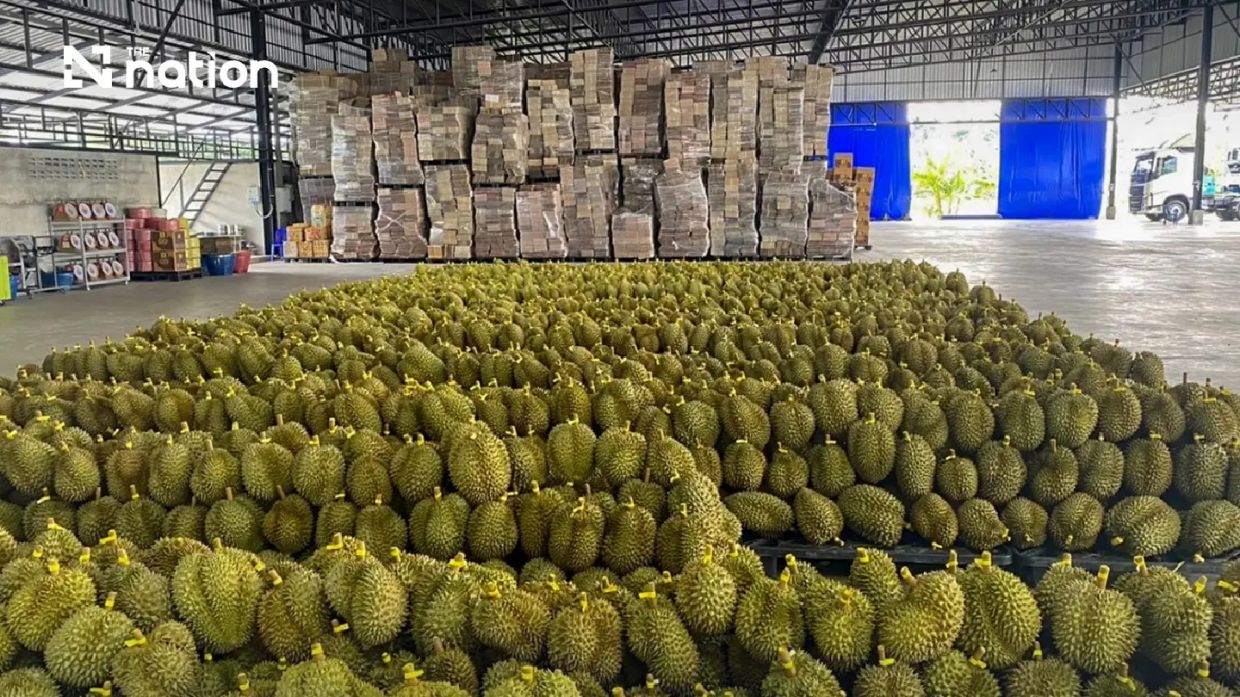
Thailand has achieved a historic milestone in its durian export performance, with fresh shipments to China surpassing THB100 billion during the first six months of 2026. The breakthrough represents a significant validation of the country's strategy to rebuild confidence in its premium fruit exports following years of quality and contamination concerns that had damaged its standing in Beijing. Over 870,000 tonnes of fruit crossed into the Chinese market, delivered through more than 53,000 shipping containers, underscoring the sheer scale of Thailand's horticultural dominance in the region.
The achievement owes much to a fundamental restructuring of how Thailand manages its durian supply chain from farm to port. Rather than addressing problems reactively as they emerge, the Ministry of Agriculture and Cooperatives has introduced a comprehensive framework that emphasizes transparency, traceability, and systematic quality oversight at every stage. This shift represents a departure from traditional compliance approaches toward what officials describe as intelligent regulation, where science-based risk assessment and technology integration replace cumbersome manual inspection protocols. The Department of Agriculture, working alongside specialized agencies including the National Bureau of Agricultural Commodity and Food Standards, has coordinated with producing provinces, testing laboratories, exporters, and Chinese regulatory counterparts to create an integrated ecosystem.
Central to this overhaul is the enforcement of the "Four Nos" doctrine, which prohibits the export of immature durian, fruit containing worms or seed borers, products falsely labeled with incorrect origin claims, and items contaminated with Basic Yellow 2, a synthetic dye detected in some Thai shipments. These restrictions directly address the sanitary and phytosanitary barriers that had previously stalled shipments and eroded buyer confidence. Beyond these core prohibitions, the system incorporates a four-layer screening mechanism to intercept plant pests, coupled with blockchain-style supply chain tracking that enables authorities and importers to verify every product's provenance and handling history. The integration of electronic phytosanitary certificates into this digital ecosystem allows real-time communication between Thai exporters and Chinese customs, dramatically accelerating border clearance times.
Agricultural Minister Suriya Jungrungreangkit, who took office earlier in 2026, has made the overhaul of durian exports a cornerstone of his initial agenda. During his first 90 days, he prioritized eliminating bureaucratic bottlenecks that had slowed shipments even when products met standards. By reducing the number of inspection checkpoints and freeing up government resources for trade facilitation rather than defensive scrutiny, the ministry has created a more efficient conduit for legitimate exports. This recalibration has already shown measurable results, with volumes rising sharply compared to the same period in previous years and the psychological barrier of the THB100 billion threshold finally breached.
The implications for Malaysia and the broader Southeast Asian agricultural sector are substantial. Thailand's success in systematizing quality controls offers a template for regional competitors seeking to penetrate or maintain market share in China, where food safety concerns remain paramount following decades of contamination scandals. Malaysian durian producers, while smaller in scale than Thailand's industry, face similar pressures to demonstrate product integrity and supply chain discipline. The Thai model emphasizes that combining regulatory modernization with genuine quality improvement, rather than attempting regulatory capture or corner-cutting, ultimately yields better market access and higher prices. For regional exporters more generally, Thailand's approach suggests that investing in traceability infrastructure and science-based standards can be a competitive advantage rather than merely a compliance burden.
The immediate commercial target is THB150 billion for the full calendar year, implying that the second half must sustain or exceed the first-half pace. This projection assumes continued momentum in Chinese demand and no major disruptions to supply or shipping logistics. The Chinese market remains by far Thailand's largest durian destination, accounting for the overwhelming majority of the country's fresh durian exports. Maintaining that dominance requires not just meeting quotas but continuously satisfying increasingly sophisticated buyer expectations around sustainability, labor standards, and traceability that extend beyond basic food safety.
The structural reforms also carry implications for Thai farmers and exporters. By making the export pathway more predictable and less dependent on individual inspector discretion, the system allows producers to invest confidently in expanded acreage and processing infrastructure. Smaller operators benefit from reduced compliance costs, since the burden of verification shifts toward systematic data collection rather than repetitive formal inspections. However, the system simultaneously raises minimum standards, meaning that marginal producers who cannot meet the new thresholds will find themselves squeezed out of export markets. This consolidation dynamic could ultimately benefit more sophisticated commercial operations while pressuring traditional smallholder farms.
The digitalization component warrants particular attention, as it aligns Thailand's approach with broader regional and global trends toward supply chain transparency. The e-Phyto system linking production data to certification mirrors emerging requirements in developed markets and may serve as a prototype for other agricultural exports. As major trading partners increasingly demand real-time visibility into production practices and handling procedures, countries that invest early in such infrastructure gain competitive positioning. Thailand's durian sector is essentially pioneering a model that may become mandatory across multiple product categories within the next five to ten years.
The success also reflects Beijing's receptiveness to Thai efforts at reform. Chinese authorities have maintained strong appetite for premium durian and appear willing to accelerate approvals for Thai shipments that meet the new standards. This cooperation between exporter and importer is not inevitable; China has previously used technical barriers and certification delays as subtle protectionist tools. The smooth processing of over 53,000 containers in the first half suggests that Thailand has sufficiently restored trust to warrant expedited handling. Maintaining this cooperation will require sustained commitment to quality and continued senior-level engagement between Thai and Chinese officials.
Looking forward, the ministry's vision extends beyond durian to other agricultural export categories facing similar scrutiny in premium markets. The governance model developed for durian—integrating multiple agencies, leveraging technology, and emphasizing prevention over punishment—can be adapted to mangosteen, longan, and other Thai fruit exports competing for space in Chinese retailers. The narrative around this transition is equally important; Suriya has framed the durian success not as a temporary achievement but as evidence of systemic institutional capacity, positioning Thailand as a reliable long-term supplier rather than a country perpetually recovering from crises. This reputational dimension may ultimately prove as valuable as the immediate export revenues.

