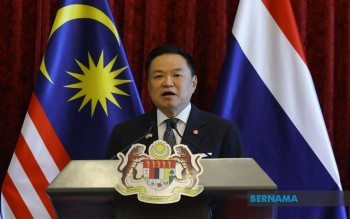
Thailand's Prime Minister Anutin Charnvirakul has signalled strong confidence that his country will reach a US$30 billion bilateral trade target with Malaysia by 2027, representing an incremental expansion from the current trade volume of approximately US$28 billion. Speaking at a joint press conference alongside Malaysian Prime Minister Datuk Seri Anwar Ibrahim following the signing of a memorandum of understanding at the Perdana Putra Complex in Putrajaya, Anutin characterized the achievement of this milestone as imminent, provided both nations maintain their present collaborative momentum.
The bilateral trade relationship occupies strategic importance within Southeast Asia's broader economic architecture. Malaysia currently stands as Thailand's largest trading partner within ASEAN, a distinction that underscores the depth of economic interdependence between the neighbouring states. The trajectory from US$28 billion to US$30 billion, whilst numerically modest, carries symbolic weight as it reflects sustained sectoral growth and the expansion of trade corridors that link the two economies. For Malaysian observers, this optimism signals Thai confidence in the region's post-pandemic recovery and the resilience of supply chains connecting the two nations.
The joint memorandum of understanding represents a formal commitment to deepen trade engagement through institutional mechanisms. Both prime ministers acknowledged that the bilateral trade committee will convene to establish revised, more ambitious targets beyond 2027, suggesting that current discussions may merely represent intermediate objectives within a longer-term strategic framework. This iterative approach to goal-setting reflects how regional economies increasingly structure trade relationships as multi-year, phased initiatives rather than static arrangements.
Thailand's economic priorities moving forward centre on three critical domains: food security, energy security, and digital economy advancement. These sectors directly interface with Malaysian capabilities and resources. Thailand's agricultural sector, notwithstanding its traditional strength, faces mounting pressures from climate variability and shifting global trade patterns—areas where Malaysian expertise and complementary production capacities offer mutual benefit. Energy security concerns have intensified across Southeast Asia following global geopolitical shifts, creating opportunities for Thailand and Malaysia to coordinate on renewable energy development, grid interconnectivity, and strategic petroleum reserves management.
The digital economy emphasis carries particular significance for both nations as they navigate the Fourth Industrial Revolution. Thailand has invested substantially in digital infrastructure and semiconductor manufacturing, whilst Malaysia possesses established technology parks and semiconductor expertise concentrated in regions like Penang and Johor. Collaborative efforts in high-tech industries could position both countries more competitively against established manufacturing hubs, whilst developing talent pipelines and research ecosystems that strengthen regional autonomy in critical technology sectors.
Anwar's corresponding remarks underscored Malaysia's reciprocal commitment to achieving the bilateral trade target, with the Ministry of Foreign Affairs and the Ministry of Investment, Trade and Industry tasked with spearheading the effort. This institutional clarity indicates that Malaysia is approaching the trade target not as aspirational rhetoric but as a concrete policy objective requiring dedicated governmental coordination. The involvement of MITI particularly signals that Malaysia intends to leverage its industrial policy frameworks to facilitate sectoral expansion, whether through tariff coordination, investment facilitation, or regulatory harmonization.
The bilateral meeting itself served broader diplomatic functions beyond trade mechanics. Both leaders reviewed the trajectory of Malaysia-Thailand relations comprehensively and identified avenues for cooperation across multiple domains. Tourism emerged as a particularly significant area for collaboration, reflecting how both nations recognize that economic integration extends beyond merchandise trade into services, travel, and cultural exchange. Tourism revenue represents a substantial component of both economies, and integrated marketing, simplified visa procedures, and coordinated infrastructure development could enhance visitor flows from third countries as well as intra-bilateral tourism.
Anutin's visit marked his first journey to Malaysia since his reappointment as Thai Prime Minister in March 2026, lending symbolic importance to the timing. Official visits of this character typically serve to reset diplomatic tone and reinforce personal relationships between leaders—relationships that often prove decisive in resolving trade disputes or accelerating sensitive negotiations. The fact that Anutin accepted Anwar's invitation and travelled with explicit intent to strengthen bilateral relations suggests both leaders perceive significant opportunity in deepening Malaysia-Thailand cooperation during this political cycle.
For Malaysian stakeholders, this bilateral engagement carries implications extending beyond bilateral trade statistics. Thailand's economic health and growth trajectory directly influences Malaysian export markets, particularly within sectors such as automotive components, plastics, and chemicals where supply chains remain deeply integrated. Enhanced trade flows would likely stimulate employment in Malaysian manufacturing sectors and generate revenue for logistics and transportation services. Additionally, strengthened Thailand-Malaysia economic ties contribute to broader ASEAN stability and cohesion, reducing regional economic fragmentation and supporting the Association's bargaining power in negotiations with major trading partners.
The phased approach to trade expansion also reflects pragmatic recognition that dramatic jumps in bilateral trade require underlying structural changes rather than merely rhetorical commitments. Supply chain integration requires investment in transportation infrastructure, customs modernization, and regulatory alignment—undertakings that typically unfold across multiple fiscal cycles. Both governments appear cognizant that the journey to US$30 billion represents not merely a numerical target but a proxy for deepened institutional integration and sectoral maturation.
Regional observers should note that Malaysia-Thailand cooperation increasingly operates within competitive dynamics involving Vietnam, Indonesia, and other Southeast Asian economies. As these nations vie for foreign direct investment and establish regional hubs for various industries, Malaysia and Thailand face incentives to coordinate rather than compete destructively. The emphasis on complementary strengths and regional value chains reflects this logic—by differentiating their contributions to regional production networks rather than duplicating capabilities, both countries can enhance overall competitiveness and resilience.
Looking ahead, the success of these ambitious targets will depend on several variables beyond governmental intention. Global economic cycles, commodity price fluctuations, and technological disruptions could either accelerate or impede progress toward the 2027 milestone. Nevertheless, the explicit commitment from both prime ministers, coupled with institutional mechanisms for regular coordination, suggests that Malaysia-Thailand bilateral relations will remain a priority within both governments' economic agendas during this period.

